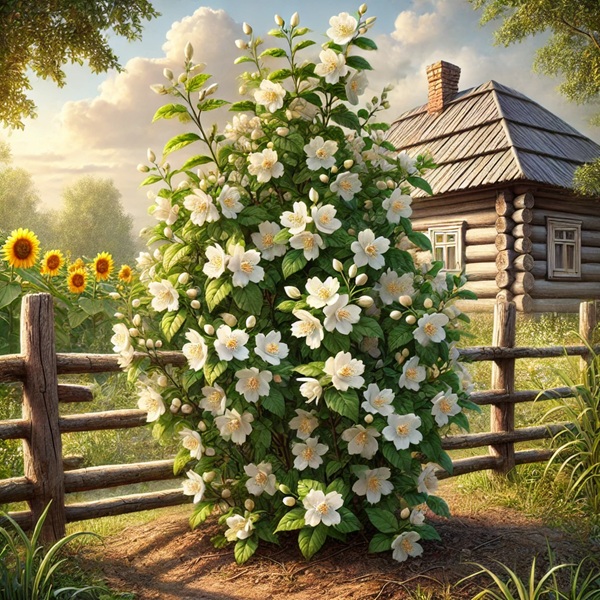
Jasmine is one of the best-known and most beloved ornamental plants, renowned for its refined fragrance and lush flowering. In Ukraine, the name “jasmine” most often refers to mock orange (Philadelphus), which resembles true jasmine (Jasminum officinale) in appearance and scent but belongs to a different genus and family. True jasmine is a heat-loving plant that requires a mild climate and, in open ground, is grown only in the southern regions of Ukraine (Odesa, Kherson, Mykolaiv regions, and Zakarpattia). At the same time, mock orange is well adapted to colder regions such as Kyiv, Cherkasy, Lviv, Khmelnytskyi, and other areas.
Mock orange, or garden jasmine, is a deciduous shrub with upright or slightly spreading shoots that reaches a height of 1 to 3 meters depending on the variety. It begins flowering in May–June and blooms for about 2–3 weeks. The flowers are snow-white or cream-colored, either solitary or clustered in inflorescences, and have a rich, sweet fragrance. Some modern varieties are scentless, but stand out for their double petals or unusual flower shape. The leaves are oval and deep green, turning yellow in autumn and adding to the plant’s ornamental appeal.
True jasmine (oriental or common jasmine) is a climbing or shrubby semi-evergreen subshrub. It is much more demanding in terms of warmth and feels comfortable only at temperatures no lower than –10 to –12 °C, so in most regions of Ukraine it is grown as a container or indoor plant. However, in the southern regions it can be grown in open ground on wind-protected sites with mandatory winter covering.
Jasmine, both mock orange and the true species, is widely used in landscape design as a specimen plant, in hedges, and in group plantings. Thanks to its ornamental beauty and incomparable fragrance, jasmine has become a favorite of Ukrainian gardeners. It is planted near terraces, gazebos, and windows, creating fragrant green screens. It combines well with lilac, spirea, barberry, hydrangea, and other ornamental shrubs.
The cultural importance of jasmine is not limited to decorative use. True jasmine is used in perfumery, medicine, aromatherapy, and cooking. Its essential oils have a calming and antidepressant effect. The flowers are used to scent tea, infusions, and oils. In Ukrainian folk culture, jasmine symbolizes purity, love, and tenderness, and is often used in wedding wreaths, bouquets, and rituals.
The choice of a suitable jasmine or mock orange species depends on the climatic characteristics of the region, the properties of the site, and the purpose of cultivation. If you live in central, northern, or western Ukraine, it is better to choose garden jasmine (mock orange). It is a frost-resistant plant that winters well without covering, is adapted to a temperate climate, and is resistant to pests. In southern Ukraine, with its milder climate, true jasmine may be grown in open ground, but it must be protected from frost.
Among the popular mock orange varieties in Ukraine are ‘Gletcher,’ ‘Virginal,’ ‘Snowbelle,’ ‘Erectus,’ ‘Aureus,’ ‘Ballet of Snowflakes,’ ‘Innocence,’ and ‘Mont Blanc.’ They differ in shrub height, flower shape and color, and fragrance intensity. There are both tall varieties suitable for hedges and compact ones for small gardens, borders, and flower beds.
In the southern regions of Ukraine, it is possible to grow true jasmine species such as common jasmine (Jasminum officinale), Arabian jasmine (Jasminum sambac), and Spanish jasmine (Jasminum grandiflorum). They are planted in open ground in protected areas or in containers that are placed in the garden in summer and moved indoors for winter.
The planting site should be well lit and protected from the wind. Jasmine will also grow in partial shade, but flowering will be less abundant and the fragrance weaker. Southern or southwestern slopes and sites near fences or walls are best. The soil should be loose, fertile, neutral, or slightly acidic (pH 6–7). If the soil is clay-heavy, sand, peat, and humus are added.
Before planting, the site is cleared of weeds, loosened, and, if necessary, the soil structure is improved. The planting hole is prepared 7–10 days in advance, with a depth and width of 40–50 cm. Drainage is placed at the bottom (crushed stone, broken brick), then filled with a mixture of garden soil, compost, and sand. Superphosphate and ash may be added to improve rooting. The seedling is placed in the hole, the roots are spread out, covered with soil, compacted, and watered generously (8–10 liters per bush).
The best planting time is spring (April–May) or autumn (September–October), depending on the region. In autumn, planting is better in the south, where the long warm autumn promotes good rooting. In spring, plants begin growing faster but require regular watering.
Caring for jasmine or mock orange in Ukraine is not difficult, especially if the plant grows in favorable conditions. The main stages of cultivation are watering, mulching, fertilizing, pruning, and loosening the soil. These measures ensure active growth, abundant flowering, and the long life of the shrub.
Watering is carried out regularly, especially during the first two years after planting. Young seedlings are watered 1–2 times per week (8–10 liters of water per bush). Mature plants are more drought-resistant, but for lush flowering in May–June, moisture should be maintained. Jasmine needs the most water during the budding and flowering stages. Watering is best done in the morning or evening, without wetting the flowers and leaves.
Mulching the area around the trunk helps retain moisture, suppress weed growth, and improve soil structure. Peat, compost, pine needles, bark, and humus are used as mulch. The mulch layer should be 5–7 cm thick. It should be renewed or topped up every spring. The soil is loosened after rain or watering to a depth of 5–7 cm to ensure air reaches the roots.
Feeding is done several times a year. In spring (March–April), nitrogen fertilizers such as urea or ammonium nitrate are applied to stimulate vegetative growth. During budding and flowering (May–June), complex fertilizers with phosphorus and potassium are used, such as nitroammophoska, humates, or ash infusion. After flowering, potassium-phosphorus fertilizers are applied to strengthen the shoots and prepare the plant for winter.
Pruning is crucial for ornamental appearance. In spring, before sap flow begins, sanitary pruning is carried out: dry, broken, and weak branches are removed. After flowering, formative pruning is done: faded shoots are shortened by one-third of their length, crowded growth is thinned out, and old branches are removed. Every 3–4 years, rejuvenation is recommended by cutting out 2–3 of the oldest shoots at the base. Excessive pruning reduces flowering the following year, since flower buds are formed on the previous year’s shoots.
Jasmine, especially mock orange, is generally resistant to diseases and pests, but under unfavorable conditions it may be affected by fungal diseases and insects. The main problems are powdery mildew, gray rot, leaf spot, scale insects, aphids, and spider mites.
Powdery mildew appears as a white coating on leaves and shoots and develops under high humidity and overcrowding. Fungicides such as Skor, Topaz, and Horus are used for control, along with removing affected parts and thinning the crown.
Gray rot affects flowers and leaves, especially in rainy weather. Symptoms include rotting buds and wet spots. Treatment includes spraying with Fundazol or Switch, watering correctly without wetting the leaves, and improving bush ventilation.
Leaf spot appears as dark or yellow spots. The cause may be fungal or bacterial infection. It is treated with Bordeaux mixture or copper-containing products, and affected leaves must be removed.
Aphids and mites are the most common pests. Aphids deform leaves and suck sap. Spider mites leave pale dots, and the leaves curl. They are controlled with insecticides such as Aktara and Confidor, acaricides such as Fufanon and Actellic, as well as folk remedies like onion, garlic, or ash infusions.
Scale insects form brown growths on stems and leaves. They are removed by hand or treated with soap solution, oil-based products, or systemic insecticides.
Prevention includes proper planting in sunny, well-ventilated places, sanitary pruning, moderate watering, clearing fallen leaves from around the bush, and using healthy planting material.
Jasmine is easily propagated both by seed and vegetatively. The most popular methods are cuttings, layering, and dividing the bush. Seed propagation is rarely used because varietal traits are lost and the development period is long.
Green cuttings are prepared in June–July from the current year’s shoots. Cuttings 8–12 cm long are planted in a moist substrate of peat and sand under film or in a greenhouse. Rooting takes 3–4 weeks at a temperature of +22 to +25 °C. In autumn, they are transplanted to a nursery bed or into a container.
Layering is done in spring: a lower shoot is bent to the ground, part of the stem is buried in a trench, and watered. Roots form within 1–2 months. In autumn or the following spring, the young plants are separated.
Division of the bush is carried out when transplanting older plants, in autumn or early spring. The bush is divided into several parts, each of which should have roots and living shoots.
Preparation for winter depends on the species. Mock orange winters well without covering. It is enough to carry out autumn pruning and mulch the root zone. In northern or exposed places, the base of the bush can be hilled up and covered with dry leaves.
True jasmine in Ukraine requires protection. The shoots are tied, bent to the ground, and covered with agrofiber or spruce branches. In containers, jasmine is moved to a cool, bright place (+5 to +10 °C), watered sparingly in winter, and taken outside again in spring.