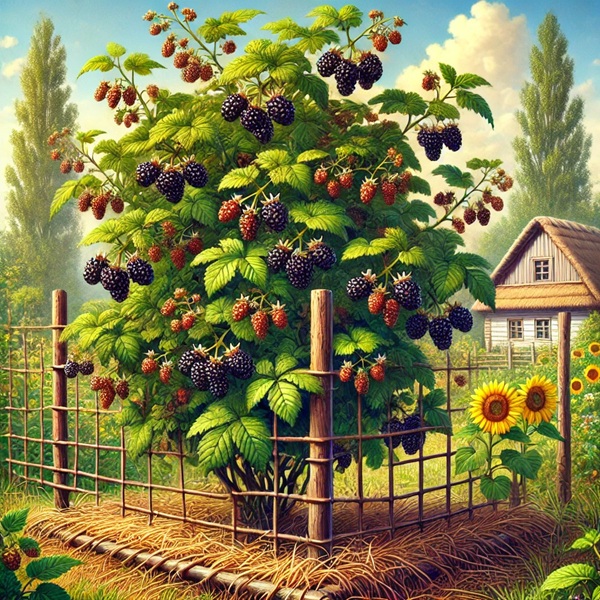
Blackberry (Rubus fruticosus) is a perennial semi-shrub of the rose family. In the wild, it is widespread throughout almost all of Europe, including Ukraine, where it grows along forest edges, in ravines, and near rivers. Over recent decades, however, blackberries have increasingly been cultivated in both private and commercial horticulture. This is due to their high productivity, resistance to unfavorable conditions, the beneficial properties of their berries, and relatively simple cultivation practices.
Blackberry is a close relative of raspberry, but it differs in its more powerful bush structure, longer shoots (sometimes reaching 3–5 m), greater shade tolerance, and better drought resistance. Blackberry bushes may be upright (erect), semi-trailing, or trailing (creeping). Modern cultivars are also divided into thorny and thornless, primocane-fruiting and traditional types, which makes it possible to choose the most suitable option for a specific region of Ukraine.
Blackberries are juicy, aromatic, dark purple or nearly black berries, rich in vitamins, especially C and E, anthocyanins, pectins, and organic acids. They have strengthening, anti-inflammatory, and antioxidant properties and are valued both fresh and processed — in jams, compotes, juices, frozen products, fruit leather, and wine.
For Ukraine, blackberry is especially promising in the southern, central, and western regions. These areas have enough sunny days, moderate humidity, and suitable soils. In recent years, due to climate change, blackberries have also been successfully grown in the north of the country, especially with the use of winter covering technology. Commercial blackberry production is actively developing in Vinnytsia, Lviv, Cherkasy, Kyiv, Chernivtsi, and Odesa regions.
The advantages of blackberry include high yields, up to 15–20 kg per bush with proper care, a long fruiting lifespan of up to 20 years, high marketability of the berries, resistance to pests and diseases, and the possibility of mechanized pruning and harvesting. In addition, modern cultivars produce large fruits, tolerate frosts down to –25 °C, and have good transportability, which makes blackberry profitable for both farmers and home gardeners.
The right choice of blackberry variety is the key to successful cultivation. Modern breeding offers a wide range of cultivars that differ in growth habit, presence of thorns, ripening time, flavor, and frost resistance. For Ukrainian conditions, thornless varieties with good drought resistance, winter hardiness, and high productivity are the best choice.
Among the popular and well-tested varieties in Ukraine are Loch Ness, Thornfree, Triple Crown, Chester Thornless, Natchez, Ouachita, Karaka Black, and Arapaho. They have large berries, up to 10 g, high yields, resistance to disease, and excellent transportability. For the northern regions, it is better to choose varieties with increased frost resistance and to use mulching and winter covering.
Choosing the planting site is one of the most important cultivation factors. Blackberry prefers sunny, wind-protected locations with fertile, well-drained soil. Insufficient light reduces the sugar content of the berries and lowers overall productivity. The best soils are light loams and sandy loams with a neutral or slightly acidic reaction, pH 5.5–6.5. Blackberries should not be planted in lowlands where cold air and moisture accumulate, as this increases the risk of winter damage and fungal diseases.
Before planting, the soil should be prepared by clearing the area of perennial weeds, adding organic matter such as well-rotted manure or compost, and applying phosphorus-potassium fertilizers, for example superphosphate and potassium sulfate. Liming should be carried out if the soil is too acidic. It is advisable to dig the soil 25–30 cm deep about 2–3 weeks before planting.
In Ukraine, blackberries are planted both in spring, from late March to April, and in autumn, from late September to October. Spring planting is preferable in regions with severe winters, because the plant has time to establish before frost. The spacing depends on the variety: for upright types, 0.8–1.2 m between bushes and 2–2.5 m between rows; for trailing types, 2–2.5 m between bushes and 2.5–3 m between rows.
Planting pits are prepared at about 40 × 40 × 40 cm and filled with a mixture of fertile soil, compost, and wood ash. The root collar is buried 2–3 cm. After planting, the bush is watered generously with 10–15 liters per plant and mulched with straw, sawdust, peat, or agrofabric. This helps retain moisture, suppress weeds, and protect the root system from temperature fluctuations.
Blackberry care requires consistency, especially in the first years after planting. The main cultivation measures are watering, soil loosening, mulching, feeding, pruning, and tying the canes. All of these practices are aimed at forming a strong bush, maintaining high yields, and making harvesting easier.
Watering is one of the key factors. Blackberry has a powerful root system, but it is still quite sensitive to drought, especially during flowering and berry filling. Young plants are watered 1–2 times per week with 10–15 liters per bush. Mature bushes are watered as needed depending on the weather. At the same time, overwatering must be avoided, because it causes root rot.
Mulching is an essential part of care. It preserves moisture, suppresses weeds, and protects the roots from overheating. Straw, peat, compost, or cut grass can be used as mulch. The mulch layer is renewed in spring and after harvest. Loosening is carried out after watering or rain to a depth of 5–7 cm.
Training is necessary for trailing and semi-trailing varieties. Without support, the shoots become tangled, break easily, the berries get dirty, and the risk of disease increases. A trellis is installed with two rows of wire at heights of 0.5 m and 1.5 m. The shoots are arranged in a fan shape or trained in arches. Young replacement canes are directed separately to avoid shading.
Pruning is carried out twice a year. In spring, sanitary pruning is done by removing dry, weak, and damaged branches, leaving only healthy strong shoots. In summer, after harvest, the canes that have already fruited are cut out, since they will not bear fruit again. Replacement shoots are pinched at a height of 1.5–2 m to stimulate lateral branching, which will bear fruit the following year.
Fertilizers are applied according to the growth stage. In spring, nitrogen fertilizers such as nitrate or urea are used for active growth. During budding, complex fertilizers with phosphorus and potassium such as nitroammophoska or potassium humate are applied. After harvest, phosphorus-potassium fertilizers are used so the plant can recover and overwinter well. Organic matter, such as humus or compost, is added to the base of the bush every 2–3 years.
With proper care, blackberry is fairly resistant to most diseases and pests. However, under conditions of high humidity, dense planting, or improper cultivation, outbreaks of fungal and viral diseases may occur. The most common diseases are gray mold, anthracnose, rust, purple blotch, and powdery mildew. Among the pests are aphids, spider mites, blossom beetles, the raspberry-blackberry beetle, and stem fly larvae.
Gray mold (Botrytis) affects berries in wet weather, especially when ventilation is poor. The berries rot and become covered with a gray coating. Prevention includes thinning the plants, avoiding overcrowding, and treating with fungicides such as Teldor, Switch, or Horus.
Anthracnose and spotting diseases cause brown spots on leaves and shoots and lead to cane dieback. These diseases progress under excessive moisture. Effective prevention includes copper-containing products such as Bordeaux mixture and Cuproxat, removal of infected plant residues, and proper crop rotation.
Rust appears as orange spots, mainly on the underside of leaves. Fungicides such as Skor and Topaz are used for control, and resistant varieties should also be planted.
Aphids and mites are the most common pests. Aphids settle on young shoots, suck sap, and weaken the plant. Mites cause leaf curling and stunted growth. Insecticides such as Aktara, Confidor, and Fufanon, as well as biological products such as Fitoverm and Bitoxibacillin, are used against them.
The raspberry-blackberry beetle damages flowers and berries. Effective control measures include insecticides, pheromone traps, soil digging, and removal of plant debris. The main prevention is avoiding overcrowding and thinning the bushes in time.
Blackberries ripen from late June to September, depending on the variety. The berries are harvested several times during the season. Harvesting is done by hand in dry weather, in the morning or evening when the berries are cool. It is important not to leave the fruit on the bush too long, because overripe berries become soft and spoil quickly. The berries are placed in shallow containers in a layer no more than 2–3 cm deep.
Fresh blackberries can be stored for up to 3–5 days in a refrigerator at +2 to +4 °C. For longer storage, the berries are frozen, dried, or processed into jam, preserves, fruit leather, or juice. With good care, yields may reach 10–15 kg per bush, and on commercial plantations up to 20 kg.
After fruiting is complete, autumn pruning is carried out: old fruiting canes, as well as weak and damaged shoots, are removed. Replacement canes are shortened to the optimal length. Then the bushes are prepared for winter by removing them from the trellis, bending them to the ground, and fixing them in place. They are then covered with agrofabric, straw, or spruce branches. This is especially important in the northern and eastern regions.
Blackberries are propagated mainly vegetatively: by layering, root suckers, division of the bush, and green cuttings. The simplest method is tip rooting: in August, the shoots are bent to the ground and covered with soil. In spring, the rooted plants are separated and transplanted. Green cuttings are taken in June–July in greenhouses or under film.
Blackberry is one of the most promising berry crops in Ukraine. It provides stable yields, has high profitability, excellent flavor, and valuable health benefits. It is suitable both for home use and for commercial cultivation.