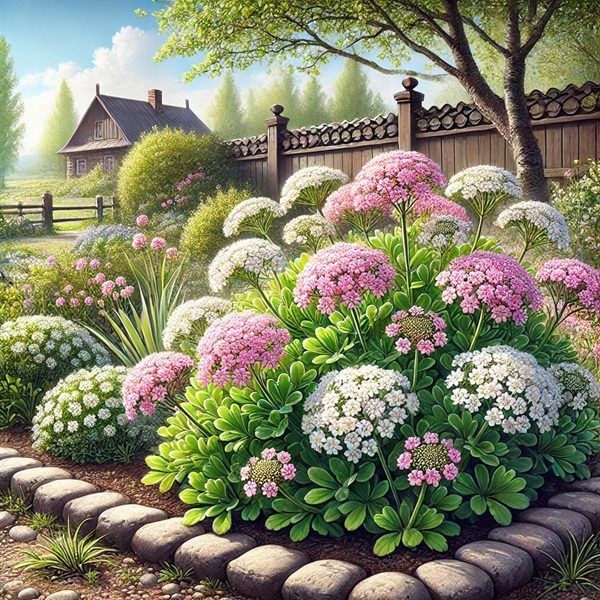
Iberis (Iberis), also known as candytuft, is a striking ornamental plant that belongs to the cabbage family (Brassicaceae). Most species of iberis are annual or perennial herbaceous plants and subshrubs widely used in landscape design because of their compact form, bright flowering, and low maintenance requirements.
The genus Iberis includes more than 30 species, most of which originate from the Mediterranean. Under the conditions of Ukraine, the following species are most commonly grown:
Bitter candytuft (Iberis amara) — an annual plant with white or pink flowers.
Umbrella candytuft (Iberis umbellata) — a bright annual with white, pink, and lilac flowers, often used in rabatkas and borders.
Evergreen candytuft (Iberis sempervirens) — a perennial subshrub that remains decorative even in winter thanks to its glossy dark green foliage.
Rock candytuft (Iberis saxatilis) — an ideal option for rock gardens and alpine slides.
The flowers of iberis are small and gathered into dense umbrella-like clusters that cover the plant almost completely during flowering. The blooming period depends on the species: annuals begin flowering as early as late May, while perennials bloom from April through June. Some cultivars may also bloom again in autumn. Thanks to its compact growth habit (15–40 cm tall), iberis is widely used for edging flower beds, decorating borders, and planting in flowerpots, containers, and alpine gardens.
In Ukraine’s ornamental gardening, iberis is valued for its drought resistance, hardiness, ease of care, and ability to maintain an attractive appearance throughout the season. Perennial species can withstand frosts down to –25 °C, which makes it possible to grow them even in the northern and eastern regions of the country without cover.
In addition to its aesthetic advantages, iberis has phytoncidal properties: it releases substances that suppress the development of pathogenic microorganisms in the soil. This makes it a good companion plant for more demanding species. It also attracts bees and other beneficial insects, which is important for the garden ecosystem.
Iberis is a light-loving plant, so it should be planted in well-lit areas, preferably with direct sun for most of the day. It will also grow in partial shade, but flowering will be less abundant, and the shoots will become more elongated and less decorative. The best choice is southern or southwestern slopes, open flower beds, rocky retaining walls, and borders along paths.
The ideal soil for iberis is light, well-drained, with a neutral or slightly alkaline reaction (pH 6.5–7.5). Sandy or sandy loam soils are best, but the plant also performs well on loam if additional sand or fine gravel is added. Heavy clay soils are unsuitable, since in such conditions iberis often suffers from excess moisture and poor root aeration.
Site preparation includes digging the soil to a depth of 20–25 cm, removing weeds, and adding humus or compost (2–3 kg/m²), as well as wood ash (150 g/m²) to normalize acidity. Fresh manure is not recommended, since it promotes soil compaction and increases nitrogen content, which negatively affects flowering.
Annual species of iberis (umbrella and bitter) are grown mainly from seed, either by sowing directly into open ground or through seedlings. Perennial species (evergreen and rock) can be propagated both by seed and vegetatively — by cuttings or division of the clump.
Among the popular cultivars in Ukraine are:
‘Snowflake’ — a compact form with abundant white bloom, ideal for borders.
‘Appen Etz’ — a hardy perennial that blooms in May–June.
‘Pink Beauty’ — delicate pink flower clusters, suitable for rabatkas and flower beds.
‘Candy Tuft’ — a classic umbrella iberis available in a range of colors.
In container gardening, iberis combines well with low-growing petunias, lobelia, alyssum, and ornamental grasses. It can also be used as a “living carpet” to cover bare patches of soil or serve as a background for tall perennials.
The planting method for iberis depends on the type (annual or perennial), the propagation method (seed, cuttings, or division), and the growing purpose (open ground, container, or alpine garden).
Direct sowing into open ground is the most common method for annual iberis. In the southern and central regions of Ukraine, it is done in the second half of April or early May, as soon as the danger of frost has passed. The seeds are sown shallowly — 0.5–1 cm deep — in rows or nests, with 20–25 cm between plants. Sowing can be done in two stages at intervals of 10–14 days to ensure a longer flowering period.
Iberis is grown through seedlings less often, but this method makes it possible to achieve earlier flowering. Seeds are sown in March in boxes or trays. Seedlings appear in 7–10 days. At the stage of 2–3 true leaves, the seedlings are pricked out and planted into the ground in mid-May.
Perennial species can be planted in spring (March–April) or autumn (September–October). When planting ready-made seedlings or divided clumps, a spacing of 25–30 cm between plants should be observed, since they spread well in width.
Cuttings are taken in June–July. Young shoots 6–8 cm long are cut, treated with a rooting stimulant such as Kornevin, and rooted in sand or a light substrate in partial shade under film. After 3–4 weeks, the plants can be transplanted.
Before planting, it is recommended to moisten the soil. Sand, compost, or crushed limestone may be added to the planting holes. After planting, the soil is firmed and mulched to preserve moisture.
Iberis is considered a plant with minimal care requirements, but several basic growing practices can significantly improve its ornamental quality and prolong flowering.
Watering. In most regions of Ukraine, iberis tolerates drought well. Watering is needed only during long hot periods or during seed germination and seedling establishment. It should be watered at the root, avoiding overwatering. Morning or evening watering is best.
Mulching is recommended on sandy soils or in open places where moisture evaporates quickly. Mown grass, sawdust, pine needles, or декоративна mulch can be used. This also helps suppress weeds.
Pruning. After flowering ends, the flower clusters are cut back — this stimulates the formation of new buds in some cultivars and helps the bush remain attractive. Perennial iberis is trimmed in autumn to preserve its compact shape. In spring, dried parts of the plant are removed.
Feeding. If iberis grows in fertile soil, fertilizers are not necessary. However, on poor soils it is recommended to apply a complex mineral fertilizer with a low nitrogen content once or twice per season, such as Kemira Lux or Agricola for flowers. Excess nitrogen encourages the growth of green mass at the expense of flowering.
Maintaining ornamental appearance. It is important to avoid overcrowding. If the bushes spread too much, they should be thinned or rejuvenated by division. In rock gardens or containers, iberis needs periodic transplanting every 2–3 years.
In open ground in Ukraine, iberis is rarely affected by diseases or pests, especially when properly planted and well ventilated. Still, some problems may occasionally arise:
Clubroot — a fungal disease that appears as swellings on the roots. It is more common on acidic soils. Prevention includes liming and crop rotation.
Powdery mildew — a white coating on the leaves. It develops under conditions of high humidity. Treatment: Topaz, Skor, Horus.
Aphids — gather on young shoots and leaves. They are controlled with insecticides such as Aktara or Confidor, or with a soap solution.
Mole crickets and crucifer flea beetles — pests that may damage young plants. Wood ash, tobacco dust, and pheromone traps may be used.
Wintering. Perennial species of iberis overwinter well in Ukraine without cover. In northern regions, it is advisable to mulch the base of the bush. Annuals are removed after the season ends, and the site is dug over.
Propagation. In addition to seeds and cuttings, perennial forms can also be propagated by division of the bush, best done in spring or autumn. The bush is dug up, divided into 2–3 parts, and replanted with 25–30 cm spacing.