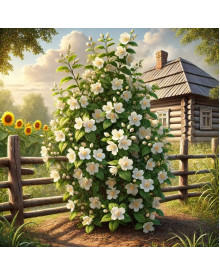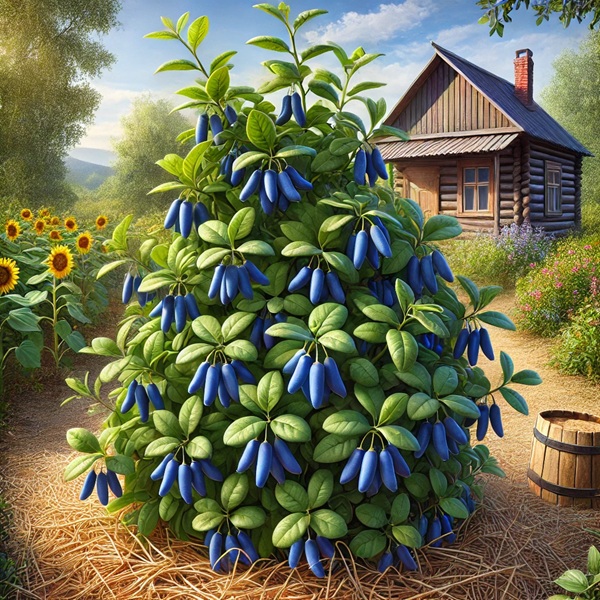
Honeysuckle (Lonicera) is a genus of perennial shrubs and vines that includes more than 200 species, about a dozen of which are actively used in gardening and landscaping in Ukraine. Of greatest importance in agricultural practice and home gardening is edible honeysuckle (Lonicera edulis), valued for its early fruiting, high frost resistance, and the medicinal properties of its berries. Ornamental honeysuckle species are also grown in Ukrainian gardens, including common honeysuckle, Brown’s honeysuckle, and Tatar honeysuckle, but it is the edible form that has become the most widespread as a fruit crop.
Edible honeysuckle is a spreading shrub 1 to 2 meters tall. Its shoots are upright, with gray-brown bark; the leaves are opposite, elongated, and light green. The flowers are pale yellow or cream-colored, self-pollinating, and appear in early spring. The berries ripen very early, in May–June, depending on the region and cultivar. They are elongated, blue-violet with a waxy bloom, sweet-and-sour in taste, and rich in vitamins C, A, and P, organic acids, anthocyanins, and antioxidants.
One of the main features of honeysuckle is its exceptional frost resistance. The bushes can withstand temperatures down to –40 °C, while the flower buds tolerate –7 to –8 °C. This makes honeysuckle especially valuable for the northern and central regions of Ukraine. In Polissia, the Carpathians, and Podillia, it bears fruit reliably, is not afraid of return frosts, and can serve as the first berry crop of the season. Fruiting begins as early as the 2nd or 3rd year after planting, while maximum productivity is reached in the 6th to 8th year. The lifespan of a bush is 20–25 years, and with proper care, up to 30 years.
In addition to its nutritional value, honeysuckle has medicinal properties. Its berries have anti-inflammatory, vascular-strengthening, antipyretic, and antiseptic effects. They are recommended for vitamin deficiency, hypertension, and cardiovascular diseases. The berries are used to make jam, preserves, fruit leather, and juices, and are also eaten fresh or frozen.
In recent years, interest in honeysuckle in Ukraine has grown significantly. This is linked to climate change, the growing popularity of early berries, and the expansion of the varietal range. Leading Ukrainian and foreign breeding centers have developed cultivars with large, aromatic, sweet berries that are resistant to fruit drop and suitable for mechanical harvesting. Promising cultivars include Ukrainian selections (‘Dzherelo’, ‘Zorianka’), Russian ones (‘Bakcharsky Veleten’, ‘Nymph’), Polish ones (‘Duet’, ‘Wojtek’), and Canadian ones (‘Boreal Beauty’, ‘Aurora’).
The choice of honeysuckle cultivar in Ukraine should be approached carefully, since it affects not only the taste and size of the berries, but also the plant’s ability to cross-pollinate. Most honeysuckle cultivars are self-sterile or only partially self-fertile, so for a stable harvest it is necessary to plant at least 2–3 cultivars on the site that bloom at the same time. The ideal option is to plant 3–5 cultivars nearby, which ensures effective pollination and a high yield.
For Ukrainian conditions, cultivars with early and mid-early ripening periods that are resistant to berry drop are well suited. Among the best are ‘Zorianka’, ‘Viola’, ‘Blue Bird’, ‘Bakcharsky Veleten’, ‘Bdzhilka’, ‘Amphora’, ‘Duet’, ‘Hanita’, ‘Aurora’, and ‘Indigo Gem’. They are characterized by yields of up to 2–3 kg per bush, good flavor, transportability, and disease resistance.
The planting site should be sunny and protected from the wind. Honeysuckle can also grow in partial shade, but in that case the berries become less sweet and the overall yield decreases. North-facing slopes and low-lying areas are unsuitable, since cold air and excess moisture accumulate there, which may lead to freezing or damage to the buds.
The soil should be light, loose, water-permeable, with a neutral or slightly acidic reaction (pH 5.5–7). Honeysuckle does not like acidic, heavy, clay soils, so in such cases sand, humus, compost, or drainage should be added. It is advisable to carry out autumn digging with the addition of humus (6–8 kg per 1 m²), superphosphate (30–40 g), and ash (100 g).
The best time to plant honeysuckle in Ukraine is autumn, from late September to early November. With autumn planting, the bushes have time to root before frost and begin active growth immediately in spring. Spring planting is possible, but it is more difficult, since honeysuckle awakens very early and late transplanting slows its development.
The distance between bushes should be 1.2–1.5 m, and between rows 2–2.5 m. The planting hole should measure 40 × 40 × 40 cm. Drainage (crushed stone, sand) is placed at the bottom, followed by a mixture of fertile soil, compost, ash, and mineral fertilizers. The root collar is buried 2–3 cm. After planting, the plant is watered generously (10–12 liters per bush) and mulched with peat, sawdust, or cut grass.
Honeysuckle is an undemanding crop, but to obtain a stable and generous harvest, regular care is necessary. The main cultivation practices include watering, pruning, mulching, feeding, and protection from diseases and pests. Honeysuckle is most demanding during the first 3 years after planting, when the root system and crown are forming.
Watering is especially important during dry periods. Although honeysuckle is fairly drought-tolerant, a lack of moisture causes the berries to become smaller, more acidic, and reduces yield. In May–June, during flowering and berry filling, watering is carried out regularly — 10–15 liters of water per bush, 1–2 times a week. In hot weather, watering is increased. It is best to water in the morning or evening. After watering, the soil should preferably be mulched.
Mulching is an essential practice for conserving moisture, suppressing weeds, and improving soil structure. Peat, humus, cut grass, or sawdust are used for this purpose. The mulch layer is renewed every spring.
Pruning begins in the 3rd or 4th year after planting. Before that, the bushes are hardly touched. In adulthood, honeysuckle requires annual sanitary and formative pruning. In autumn or spring, dry, damaged, and intertwined shoots are removed. Five to seven strong branches are left. Crown formation ensures better light penetration, ventilation, and fruiting. Old bushes are rejuvenated by cutting shoots back at the base.
Feeding begins in the second year after planting. In spring, nitrogen fertilizers such as urea or ammonium nitrate are applied at 20–30 g per 1 m². During budding and flowering, phosphorus-potassium complexes such as nitroammophoska or humates are used. In autumn, wood ash (100–150 g per bush) or ready-made autumn fertilizers are added. Every 2–3 years, it is advisable to add humus or compost.
Honeysuckle is fairly resistant to diseases and pests, but under dense planting, excessive moisture, or lack of proper care, damage is possible. In Ukraine, the most common problems are powdery mildew, leaf spots, gray mold, as well as pests such as aphids, honeysuckle gall midge, scale insects, mites, and sawflies.
Powdery mildew appears as a white coating on the leaves, especially in the lower part of the bush. It develops in wet weather and under dense growth. It can be controlled with fungicides such as Topaz, Skor, and Horus, as well as by thinning the bushes.
Leaf spot appears as brown or black spots on the leaves caused by fungi. Treatments with Bordeaux mixture or copper sulfate 2–3 times per season help stop the disease from developing.
Gray mold affects the berries in wet weather. The fruits become soft and are covered with a gray coating. Treatments with Fundazol or Switch, along with improved crown ventilation, are effective.
Aphids are the most widespread pest. They appear in spring on young shoots, causing leaf curling and weakening the bush. They can be controlled with Aktara, Confidor, or soap solutions.
The honeysuckle gall midge lays larvae in the shoots, causing thickening, deformation, and dieback. Affected branches should be removed and the bushes treated with insecticides such as Inta-Vir or Decis.
Spider mites cause the appearance of speckles and webbing on the leaves. They can be controlled with acaricides such as Neoron, Apollo, and Actellic, as well as infusions of wormwood or garlic.
Prevention includes choosing the right planting site, pruning, ensuring good light exposure, cleaning the area around the base of the bush, selecting resistant cultivars, and moderate watering. With proper care, diseases occur only rarely.
Honeysuckle berries in Ukraine begin to ripen in late May and continue through mid-June. This is one of the very first berries of the season. The berries are harvested by hand 2–3 times at intervals of 3–5 days. It is important not to delay harvesting, since some cultivars are prone to dropping fruit. Cloth or plastic film is spread under the bush and the branches are lightly shaken — ripe berries fall off easily.
Fresh berries can be stored for 2–3 days in a refrigerator at +2 to +4 °C. For this reason, they are recommended to be processed or frozen immediately. Honeysuckle is ideal for jam, compotes, juices, jelly, and fruit leather. Frozen berries retain up to 90% of their vitamins.
Propagation is carried out vegetatively, while seed propagation is rare. The main methods are:
Green cuttings — in June, shoots 10–15 cm long are cut and rooted in a moist substrate under film. Roots form within 2–3 weeks.
Woody cuttings — planted in autumn or spring in a slanting position.
Layering — in spring, branches are bent to the ground, fixed, and covered with soil. Roots form in 1–2 months.
Division of the bush — carried out when transplanting mature plants.
Seasonal care:
Spring — sanitary pruning, feeding, mulching, watering.
Summer — berry harvest, pest protection, loosening, thinning.
Autumn — formative pruning, organic matter application, digging.
Winter — no cover is required, though young bushes can be mulched and lightly hilled up.