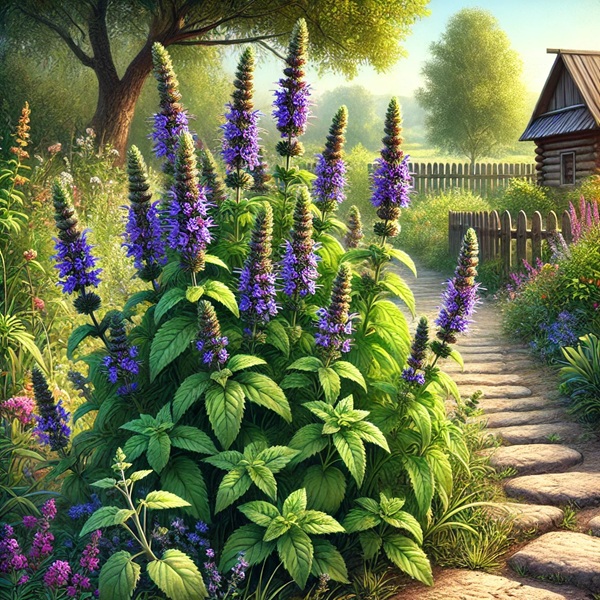
Hyssop (Hyssopus officinalis) is a perennial essential-oil and medicinal plant that in recent years has been gaining increasing popularity in Ukraine among both amateur gardeners and professional agricultural producers. This plant attracts attention with its ornamental qualities, high value as a nectar source, medicinal potential, aromatic character, and versatility of use.
Hyssop is a compact subshrub of the mint family (Lamiaceae) that grows to a height of 40 to 80 cm. Its upright, branched shoots with narrow elongated leaves and bright blue-violet, pink, or white flowers form dense bushes that remain decorative throughout the entire season. Flowering lasts from late June to September. The flowers of hyssop are gathered in spike-like inflorescences at the tops of the shoots, attracting bees, butterflies, and other pollinators.
The plant has an intense spicy aroma resembling a combination of mint, thyme, and sage. The above-ground part of hyssop is used in folk and official medicine, cooking, aromatherapy, and cosmetology. In Ukraine, it is traditionally used as an expectorant, antiseptic, anti-inflammatory, and diuretic remedy. Infusions and decoctions based on hyssop are effective for colds, bronchitis, sore throats, and digestive problems. Hyssop is also included in herbal blends, teas, and balms.
Hyssop is a heat-loving, light-loving, and drought-resistant plant. Under Ukrainian conditions, it grows well almost throughout the entire country — from Zakarpattia to Luhansk region, including Polissia, the Forest-Steppe, and the Steppe. It feels best in the southern and central regions (Odesa, Mykolaiv, Kherson, Kirovohrad, and Dnipropetrovsk regions), where the long warm summer promotes active accumulation of essential oil. However, hyssop also adapts excellently to moderate climates, tolerating winters down to –25 °C with light protection.
Among its main advantages are longevity and low maintenance: hyssop can grow in one place for up to 6–7 years without losing productivity. Already in the second year after sowing, it is possible to obtain a full harvest of green mass, and with regular pruning — 2–3 cuttings per season. Hyssop is easily propagated by seed, cuttings, and division of the bush, quickly builds biomass, and does not require complicated care.
In addition to its medicinal and ornamental properties, hyssop is an excellent honey plant. It blooms from early summer until autumn. From one hectare of plantings, it is possible to obtain up to 100–150 kg of high-quality honey. Hyssop honey is light-colored, aromatic, with a delicate spicy aftertaste, and is valued in apitherapy and cooking.
Successful cultivation of hyssop largely depends on proper site selection and soil preparation. The plant does not tolerate shade, excessive moisture, or acidic clay soils. Ideal conditions are well-lit, wind-protected sites with light, loose, well-drained soil that has a neutral or slightly alkaline reaction (pH 6.0–7.5). Hyssop grows best on loamy and sandy loam soils.
Low-lying areas where moisture or cold air accumulates are unsuitable. If the soil is acidic, it is advisable in autumn to apply dolomite flour, lime, or chalk. It is also useful to add sand, compost, and humus to improve the soil structure.
Before planting, the site is dug to a depth of 25–30 cm, weeds and the roots of perennial plants are removed. During autumn digging, 3–4 kg of humus per 1 m², 30–40 g of superphosphate, and 20–30 g of potassium salt or 100–150 g of ash are added. In spring, before sowing, the soil is loosened, leveled, and beds are formed.
In the central and northern regions of Ukraine, it is more practical to grow hyssop through seedlings. Seeds are sown in March–April. They are planted 0.5–1 cm deep and lightly covered with sand. Seedlings appear in 7–10 days. At the stage of 2–3 true leaves, they are pricked out. Planting into open ground is carried out in April–May, when the threat of frost has passed.
In the southern regions of Ukraine, direct sowing into open ground is possible in the second half of April. It is sown in rows with 40–50 cm between rows and 25–30 cm between plants.
The most common hyssop varieties in Ukraine are:
‘Blue Aroma’ — with rich blue-violet flowers, suitable for essential-oil production.
‘Pink’ — an ornamental variety with delicate pink flowers.
‘Snowy’ — a white-flowered variety with a pronounced aroma, resistant to drought.
‘Nectar’ — a high-yielding honey plant adapted to the climate of Ukraine.
Hyssop is one of the easiest crops to care for. It grows well without intensive intervention, but regular minimal care significantly increases yield, ornamental value, and the lifespan of the plant. It is especially important to pay attention to young plantings in the first two years.
Watering. Hyssop is drought-resistant, but during periods of prolonged heat or after pruning it requires moderate moisture. It is watered 1–2 times per week, depending on the weather, at the root. It is important to avoid water stagnation, since excess moisture promotes the development of fungal diseases and rotting of the root system.
Weeding and loosening. Young plants require regular weed removal, since weeds may shade hyssop and compete with it for moisture and nutrients. After rain or watering, the soil is loosened to a depth of 4–6 cm to improve air exchange and retain moisture.
Mulching is recommended in the southern and central regions: straw, grass, and sawdust reduce moisture evaporation and suppress weeds.
Feeding. On fertile soil, hyssop grows without additional fertilizers, but to encourage growth in spring, nitrogen fertilizers may be applied, such as nitrate at 20–30 g/m². During budding, phosphorus-potassium fertilizers are applied, such as superphosphate and ash. Excess nitrogen is undesirable, since it causes excessive leaf growth and reduces the content of essential oils.
Bush shaping. After the first cutting, the branches may be trimmed slightly — this stimulates branching and the formation of a dense crown. In autumn, sanitary pruning is carried out: dry, weak, and damaged shoots are removed.
Harvesting of green mass is carried out during active flowering, when the content of essential oils reaches its maximum. The shoots are cut at a height of 10–15 cm above the ground. Harvesting is best done in dry, clear weather, in the morning after the dew has dried.
During the season, 2–3 cuttings may be obtained, especially in the southern regions of Ukraine. After each harvest, the plants are fertilized and watered to stimulate renewed growth.
The branches are dried in shaded, well-ventilated rooms, spread in a single layer on paper or racks. Drying takes 5–7 days at a temperature of +30 to +35 °C. Dried hyssop retains its aroma, color, and medicinal properties.
Methods of propagating hyssop:
By seed — the simplest and most common method. It produces stable and vigorous plants.
By cuttings — in June–July, cuttings 10–12 cm long are taken and rooted in a mixture of sand and peat under cover. Rooting takes 2–3 weeks.
By division of the bush — in spring or autumn, overgrown bushes are dug up, divided into 2–3 parts, and transplanted to a new place.
Diseases and pests. Hyssop is usually not affected by disease, but under excessive moisture or overcrowding the following may occur:
powdery mildew
fusarium and root rot
leaf spotting
For prevention, excess moisture should be avoided, plantings should not be overcrowded, and timely pruning should be carried out. If necessary, treatment with biofungicides may be used.
Among pests, the following sometimes appear:
aphids
thrips
whitefly (in greenhouses)
slugs (in wet weather)
Protection includes ash solution, wormwood and garlic infusions, wood ash, and biological insecticides.
Wintering. In most regions of Ukraine, hyssop overwinters without cover. In northern regions, the root zone may be mulched with peat, sawdust, or compost. If the winter has little snow, it is advisable to cover the plants with spruce branches or agrofiber.
In addition to its medicinal and agricultural value, hyssop has wide application in landscape design and everyday life. Thanks to its dense compact bush, bright flowers, and rich aroma, it is perfectly suited for creating borders, flower beds, mixed borders, and aromatic garden beds. Hyssop looks especially impressive when combined with lavender, thyme, sage, rudbeckia, and ornamental grasses. It can be grown in containers, on balconies, in rock gardens, and between paving stones along paths.
On farms in Ukraine, hyssop is used as a promising essential-oil crop for producing herbal teas, tinctures, cosmetic products, and as a natural raw material for pharmaceuticals. Dried leaves and flowers are actively purchased by processing enterprises, manufacturers of natural products, herbal blends, aromatic sachets, and soap makers. Hyssop cultivation is becoming especially relevant in organic farming, since it does not require chemical treatments and grows excellently without pesticides.
In cooking, fresh and dried hyssop leaves are used as a seasoning for meat and fish dishes, salads, vegetable soups, and marinades. It gives a spicy, lightly minty flavor resembling oregano with a menthol note. In folk medicine, hyssop is used to treat bronchitis, colds, and sore throat, and as a soothing and toning remedy.
Its ecological benefit should also be noted separately. The plant’s aromatic compounds repel pests, while its flowers attract bees, bumblebees, and butterflies, contributing to the pollination of neighboring crops. In flower beds, it not only decorates the site but also acts as a natural protector, improving the microclimate for other plants.
Thus, hyssop is not only a beautiful and fragrant plant, but also a practical perennial with great potential for medicinal, culinary, agricultural, and aesthetic use in the conditions of Ukraine. Its versatility, hardiness, and ease of care make hyssop an indispensable element of the modern Ukrainian garden and homestead.