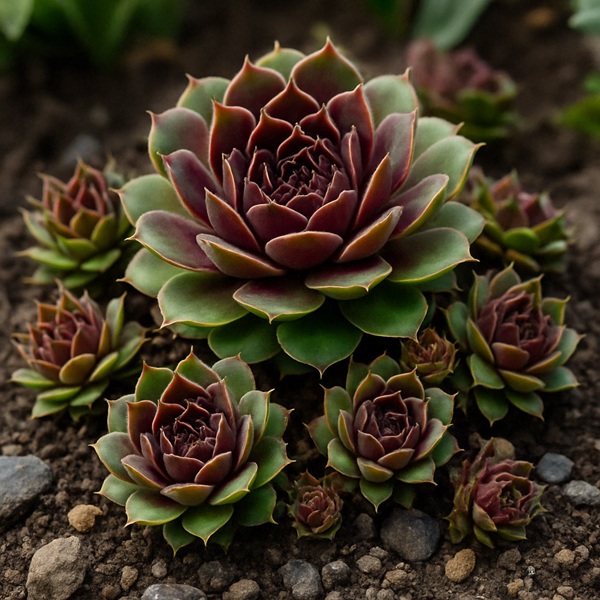
Hens and chicks, also known as houseleek or stone rose (Sempervivum), is a unique evergreen succulent plant that combines decorative appeal with exceptional low-maintenance qualities. The name Sempervivum translates from Latin as “always alive,” which very nearly reflects reality: with minimal care, these plants can decorate a garden, rooftop, rock garden, or even stone walls for decades. Hens and chicks forms dense, symmetrical rosettes of fleshy leaves that resemble stylized flowers. Thanks to its resistance to drought, heat, cold, and wind, it is perfectly suited to Ukraine’s climate — from the south to the north.
In nature, hens and chicks grows on rocky slopes, alpine meadows, and in cracks between stones. This explains its ability to withstand unfavorable conditions: the plant hardly needs fertile soil, tolerates prolonged drought, is not afraid of sun scorch, and even survives frosts down to –30°C. In Ukraine, hens and chicks can be successfully grown both in open ground — in rockeries, borders, and alpine beds — and in containers, planters, or hanging arrangements. Particularly popular are varieties with unusual leaf colors: burgundy, silvery gray, green with a red edge, and so on.
One of the key features of hens and chicks is its ability to reproduce on its own. The central rosette dies after flowering, but many offsets form around it and gradually create dense carpets. This makes hens and chicks an ideal groundcover option or a substitute for a traditional lawn in dry areas. Stone roses pair beautifully with other drought-tolerant plants such as sedums, stonecrops, thyme, and carnations. They do not require frequent watering and are resistant to pests and diseases, which makes them a favorite among gardeners who value both beauty and ease of care.
Choosing a variety of hens and chicks is primarily a decorative decision. Thanks to breeders, there are many varieties that differ in rosette size, leaf color, shape, and flowering time. In Ukraine, the most widespread species are common houseleek (Sempervivum tectorum), cobweb houseleek (Sempervivum arachnoideum), globose houseleek, and their hybrids. Common houseleek forms large rosettes with rich green or reddish leaves. Cobweb houseleek is more compact, with hairy leaves and a characteristic “web” in the center of the rosette.
For planting, choose areas with as much sunlight as possible. Hens and chicks is a light-loving plant: in shade, the rosettes stretch out, lose their compact shape, and become less intensely colored. Ideal places are southern slopes, raised spots, and open sites without stagnant air or water. Alpine beds, the edges of paths, and rocky mounds work especially well. The main requirement is drainage. Hens and chicks absolutely does not tolerate standing water: excess moisture causes rotting. If necessary, the soil should be improved beforehand with sand, expanded clay, or fine gravel, and raised beds or mound-style flower beds should be formed.
The soil should be light, poor, neutral, or slightly alkaline. Peaty, overly rich, or heavy black soils are not recommended — in them, the roots suffocate and rot. The ideal mix is garden soil, coarse sand, and fine gravel in a 2:1:1 ratio. A little ash or lime can be added to reduce acidity. When planting in a container, a drainage layer 2–3 cm thick must be placed at the bottom. In open ground, hens and chicks is planted 10–15 cm apart, taking into account how quickly it spreads. The rosettes are set so that the center remains slightly above ground level — this helps prevent rotting.
Ukraine’s climate makes it possible to plant hens and chicks almost any time except winter and late autumn. The best period is spring (April–May) or late summer to early autumn (August–September), when the plants have time to root well before the onset of heat or frost. With spring planting, hens and chicks adapts quickly, especially if stable moisture is maintained during the first weeks. With autumn planting, all work should be completed at least a month before possible frosts. The plant tolerates transplanting easily and with almost no stress.
After planting, hens and chicks is watered lightly, avoiding overwatering. Later, watering should remain moderate and only be done during prolonged drought. Young plants adapt better with short, regular watering and mandatory drying of the soil between waterings. It is important not to let water get into the center of the rosette — especially in cool or cloudy weather — because this may cause the growing point to rot. During the first months, weeds should be removed regularly, as they may shade the planting and compete for moisture.
Fertilizing is almost unnecessary in the first year. Hens and chicks grows well in poor soils, and excess nutrients are actually harmful — the rosettes become loose, lose their compactness, and their winter hardiness declines. If needed, especially in container growing, a minimal amount of complex fertilizer for succulents can be applied in the first half of summer. It is also important to inspect the plants from time to time for pests or fungal diseases, although with proper care such problems are very rare.
Once established, hens and chicks requires almost no constant care. It grows beautifully even without watering during the longest dry spells, making it an ideal choice for summer cottage owners and gardeners who cannot visit often. Mature plants need watering only during prolonged heat — more than two weeks without rain. In that case, it is best to water in the morning or evening, avoiding water getting into the center of the rosette. In containers, watering may need to be slightly more frequent, especially on a sunny windowsill or open terrace where water evaporates faster.
Feeding is done rarely — once or twice a season, and only if needed. The best time is late spring or early summer. Use fertilizers for cacti and succulents with a low nitrogen content. Too much nitrogen causes the rosettes to stretch, lose their color, and rot. To improve decorative appearance, an ash solution or a weak compost infusion may be used. Still, in most cases hens and chicks develops well without any additional feeding. Much more important is providing well-drained soil and plenty of sun.
Propagating hens and chicks is extremely simple. The most common method is separating the daughter rosettes, or “babies,” from the mother plant. They are carefully snapped off by hand or cut with a knife, leaving 1–2 cm of stem. After that, they are dried in the shade for 1–2 days and planted in a new place. Rooting happens very quickly — usually within a week. Growing from seed is also possible, but this method is less common because it takes more time and does not always preserve varietal characteristics. Seeds are sown in spring into a light substrate, moistened, and covered with film until seedlings appear.
Hens and chicks is a monocarpic plant, meaning that each rosette flowers only once and then dies. Flowering usually begins in the second or third year after planting, sometimes later depending on the species and growing conditions. Before blooming, the rosette stretches upward and forms a flower stalk up to 20–30 cm tall, on which star-shaped flowers open — pink, burgundy, yellow, or white. Flowering lasts 2–4 weeks, after which the rosette dries up. However, during that time it manages to produce many daughter rosettes that continue the plant’s life.
The flowering period is not only beautiful but also a key stage in the life cycle. Some gardeners cut off the flower stalk before the buds open in order to extend the life of the rosette. But if there is a wish to obtain seeds or observe the bloom, the stalk is left in place. After flowering, the dried rosette is removed, freeing space for the young plants to develop. With proper care, hens and chicks forms entire mosaic-like carpets in which the life stages are constantly renewed.
Because of this cycle, hens and chicks is an ideal plant for continuous landscaping. Even if one rosette dies, it is immediately replaced by several new ones. The plant looks wonderful in rocky gardens, on slopes, and between paving stones. It is used for greening roofs, in container arrangements, florariums, and vertical gardens. Hens and chicks suits any garden style and does not lose its decorative appeal even during the hottest periods.
Despite its delicate appearance, hens and chicks is one of the most winter-hardy ornamental plants. In most regions of Ukraine, it overwinters successfully without cover, tolerating temperatures down to –25 to –30°C. The main threat is not frost, but excess moisture in autumn and winter. Waterlogging is the main reason plants die. For that reason, watering is stopped once autumn begins, especially for container plantings, and sites with hens and chicks must be well-drained.
Winter covering is usually unnecessary. Only if the plants are growing in low spots or heavy soils may they be covered with spruce branches or agrofiber to protect them from excess moisture. Container-grown plants are better moved into a bright, dry room with a temperature of 0 to +10°C. If that is not possible, the pots are insulated with foam or placed under a shelter. In spring, light cleaning is carried out, dried parts are removed, and if necessary overly crowded rosettes are divided and replanted.
Pests rarely trouble hens and chicks. Occasionally aphids or ants may appear in the rosettes, especially if growing conditions are disturbed. In that case, the plant is treated with a soap solution or bioinsecticides. Of diseases, rot is the most common, usually because of too much water. For prevention, Fitosporin is used, and affected plants are removed. Overall, hens and chicks is one of the toughest crops and is perfectly suited to Ukrainian gardens. It is attractive all year round and needs very little intervention, embodying natural harmony and unpretentious beauty.