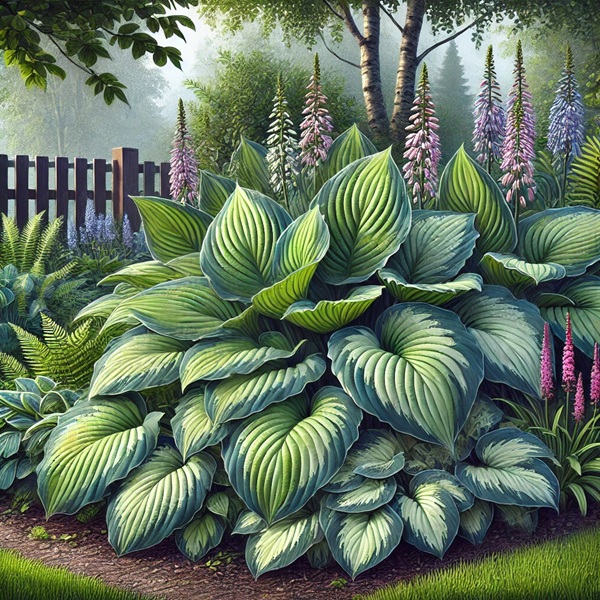
Hosta (Hosta) is a refined and undemanding perennial plant that has become one of the main stars of ornamental gardening thanks to its unique decorative foliage, ability to grow in shade, and capacity to beautify a garden throughout the entire season. It belongs to the asparagus family (Asparagaceae), although it was previously classified as a member of the lily family. Hosta is often called the “queen of shade” because of its ability to transform the least expressive corners of a garden plot.
The genus Hosta includes more than 40 species and several thousand cultivars that differ in leaf color, texture, shape, and bush size. In nature, these plants are found in Japan, China, Korea, and the Russian Far East. In Ukraine, hosta has long been acclimatized and thrives in all regions — from Zakarpattia to Kharkiv — thanks to its frost resistance, endurance, and adaptability.
The main decorative advantage of hosta is its foliage. The leaves may be green, blue, yellow, cream, edged with white, or variegated. Their surface can be matte, glossy, corrugated, or velvety, with pronounced veins. Leaf size ranges from miniature forms with leaves up to 5 cm long to giant bushes over 1 meter in diameter.
Hosta blooms in summer — from late June to August. Flower stalks rise 30–90 cm above the foliage and bear funnel-shaped flowers in white, lilac, or violet shades. Although hosta is mainly grown for its foliage, many cultivars also have attractive and even fragrant flowers.
Hosta is ideal for landscaping shaded and partially shaded areas. It is planted in mixed borders, along paths, near ponds, and in compositions with ferns, astilbes, and rodgersias. Thanks to its dense foliage, it suppresses weed growth and can also be used as a groundcover plant.
In addition to its decorative function, hosta has another major advantage — its low-maintenance nature. It tolerates drought, frost, temporary waterlogging, and does not require complicated care. That is why hosta is especially valuable for Ukrainian gardeners who want a beautiful garden with minimal effort.
One of the main conditions for successfully growing hosta is choosing the right location. Unlike most ornamental crops, hosta thrives in shade and partial shade, though there are certain nuances. Varieties with blue and dark-green leaves grow best in deep shade, while yellow, cream, and variegated forms need diffused sunlight for their coloration to develop fully.
Hosta adapts to different soil types, but it prefers loose, fertile, moderately moist substrates with a neutral or slightly acidic reaction (pH 6.0–7.5). In heavy, clayey, or overly wet soils, water may stagnate, which encourages rhizome rot. For this reason, good drainage must be ensured at planting.
The best time to plant hosta in Ukraine is spring (April–May) or early autumn (September), when the soil is still warm and moisture helps rapid rooting. Planting holes are prepared according to the size of the mature bush: the distance between plants ranges from 30 to 100 cm. Compost, humus, a little sand, and ash are added to the hole. The rhizome is planted so that the growing point remains at soil level.
Special attention should be given to variety selection. In Ukraine, both reliable established cultivars and new Western-bred introductions are available. Among the popular ones are:
‘Frances Williams’ — a large blue hosta with a yellowish-green margin;
‘Patriot’ — contrasting white-and-green leaves, resistant to scorching;
‘Sum and Substance’ — a giant hosta with golden foliage;
‘Blue Angel’ — one of the best blue hostas with large leaves;
‘June’ — an elegant cultivar with shades of blue and gold.
Varieties should be selected according to the microclimate of the site and the landscaping purpose — mass planting, a focal accent in a composition, container growing, and so on.
Hosta is one of the most undemanding ornamental plants. Still, to achieve maximum foliage beauty, stable growth, and a long-lived clump, it needs basic care, especially during the first 2–3 years after planting.
Watering. Hosta likes constant moderate moisture but does not tolerate standing water. It should be watered regularly, especially during hot periods, approximately 2–3 times a week. Watering is done at the root without wetting the leaves. When moisture is lacking, the leaf edges may dry out and curl.
Mulching is an essential practice for hosta, especially in the southern and central regions. A mulch layer of peat, wood chips, or well-rotted grass helps retain moisture, prevents weed growth, and stabilizes soil temperature. The optimal thickness is 3–5 cm.
Feeding is carried out 2–3 times during the season. In spring, nitrogen fertilizers are applied for active leaf growth; in summer, balanced complex fertilizers are used (NPK 10:10:10 or similar); in autumn, phosphorus-potassium fertilizers such as ash or superphosphate are applied to prepare the plant for winter. Excess nitrogen may cause the leaves to stretch and lose ornamental quality.
Removing flower stalks is optional. If flowering is not the goal, it is better to cut the flower stems so the plant does not waste energy on seed production. Some cultivars have fragrant or decorative blooms, which can be left.
Cutting back the leaves for winter is recommended. After the first frosts, the above-ground part of the hosta dies back. It should be cut at ground level to prevent pests and diseases from overwintering. After that, it is advisable to mulch the root zone.
The main method of propagating hosta is dividing the clump. This makes it possible not only to obtain new plants but also to rejuvenate older ones that gradually lose their ornamental value.
The best time for division is spring (April–May) or early autumn (September). In spring, divisions have enough time to root well and produce leaves; in autumn, mild temperatures and moisture promote successful establishment.
A mature clump (3–5 years old) is carefully dug up and divided with a sharp knife into 2–4 parts. Each division should have 2–3 growth buds and part of the rhizome. The cuts are treated with ash or crushed charcoal.
Planting is done in a prepared hole at the same depth as before. The soil should be loose, with added humus, sand, and ash. After planting, the divisions are watered generously, mulched, and protected from direct sun until they root.
Other methods of propagation include:
by seed — rarely used, because it does not preserve varietal traits;
by cuttings — a young bud with part of the rhizome is separated and rooted separately, which is relevant for valuable cultivars.
After transplanting, hostas need regular watering and protection from overheating. Feeding should begin no earlier than one month later.
Hosta is considered a resistant crop, but under unfavorable conditions it may be affected by fungal infections and pests.
Main diseases:
Phytophthora — rhizome rot and leaf wilting. Prevention includes drainage, crop rotation, and fungicide treatment.
Gray rot and powdery mildew — appear in wet weather. Treatment: Topaz, Skor.
Ring spot virus — cannot be treated. Affected plants must be removed and destroyed.
Pests:
Slugs — the main threat to hosta. They are attracted by the succulent leaves. Protection includes traps, ash, and pine-needle mulch.
Nematodes — microscopic worms that damage the leaf veins. Symptoms include brown streaks between the veins.
Aphids, caterpillars, and beetles — less common, but they may still cause damage.
Prevention includes proper spacing between plants, drainage, insecticide treatment when needed, and regular removal of old foliage.
Hosta occupies a special place in garden design. It is used in traditional, naturalistic, and even minimalist compositions. It remains decorative from spring until late autumn, combines beautifully with other plants, and does not require complicated care.
Hosta is planted:
along garden paths;
near ponds;
in mixed borders;
under trees and shrubs;
in containers and on terraces.
It combines well with ferns, astilbes, rodgersias, tiarellas, lungwort, heucheras, and hostas of other colors. In sunny places, it can be paired with daylilies, monarda, and echinacea.
Thanks to its variegated foliage, hosta can serve as either a bright accent or a calm background. It is often used for mass planting in shaded zones.
Hosta is an ideal choice for shady corners of the garden in Ukraine. Frost-hardy, long-lived, shade-tolerant, and ornamental, it brings beauty for many years with minimal care.