Gladiolus (Gladiolus) are striking perennial bulbous plants of the iris family (Iridaceae), which in Ukraine are traditionally grown as annual crops with mandatory yearly lifting of the corms for winter. These flowers are valued for their majestic blooming, great diversity of colors and forms, and relative ease of cultivation.
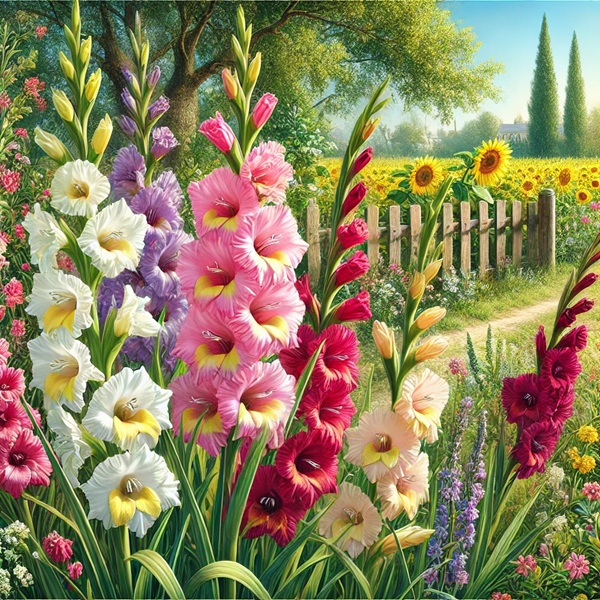
More than 5,000 gladiolus varieties are known in cultivation, classified by height, flowering time, flower size, flower shape, and coloring. In Ukraine, the most widespread are cultivars of the garden group Gladiolus hybridus, developed through interspecific hybridization. Gladiolus inflorescences may reach 60–150 cm in height and bear up to 20–25 flowers, which open gradually from the bottom upward. The flowers may be simple, double, ruffled, with smooth or wavy edges, solid-colored or variegated — from snow-white and pastel shades to deep, насыщені dark tones.
Gladiolus are widely used in ornamental floriculture for decorating flower beds, rabatkas, and mixed borders, as well as for cut flowers and bouquet arrangements. In Ukraine, they are especially popular as festive flowers, particularly for Knowledge Day, weddings, and commemorative occasions.
Ukraine’s climate is favorable for growing gladiolus: warm spring, sunny summer, moderate rainfall, and long daylight hours. They perform best in the southern and central regions (Odesa, Mykolaiv, Dnipropetrovsk, and Kirovohrad regions), but with proper care they also thrive in cooler zones such as Polissia and the Carpathians.
It is worth remembering that, despite their ornamental beauty, gladiolus are a crop with a pronounced seasonal cycle that requires timely planting, careful maintenance, mandatory lifting, and proper storage of the corms. Only by following these rules can one obtain abundant annual flowering and preserve the varietal qualities of the plants.
For full growth and luxurious flowering, gladiolus require a sunny, well-ventilated site. With insufficient light (less than 6 hours of direct sun per day), the flower stalks become thin and bent, and flowering is weak. Areas with stagnant moisture or low relief where cold air accumulates are unsuitable, since in such conditions the bulbs are often affected by rot and fungal diseases.
The ideal soil type is light loam or sandy loam, rich in organic matter, loose, well-drained, with a neutral or slightly acidic reaction (pH 6.5–7). In autumn, the site is dug to a depth of 30–35 cm, and humus or compost (5–7 kg/m²), superphosphate (30–40 g), and ash (100–150 g) are added. In spring, the soil is loosened and leveled again.
The planting material — corms — is prepared in advance. After being lifted in autumn, they are cleaned, dried, sorted by size, stripped of the old basal plate, and stored at +4 to +8 °C in a dry, ventilated room (cellar, enclosed balcony, or refrigerator). Seven to ten days before planting, the corms are taken out, cleaned of dry scales, and treated in a potassium permanganate or fungicide solution.
In Ukraine, gladiolus are usually planted in April to early May, when the soil has warmed to +10 to +12 °C. For southern regions — from April 5 to 15, for northern regions — from April 20 to mid-May. Planting depth depends on bulb size: large bulbs — 10–12 cm, medium — 8–10 cm, cormels — 4–6 cm. The distance between plants is 10–15 cm, and row spacing is 25–30 cm. It is better to orient the rows from north to south for even lighting.
It is advisable to add a little ash and sand to each planting hole. After planting, the area is mulched — this preserves moisture and prevents crust formation and overheating of the soil in summer.
For gladiolus to produce abundant and long-lasting bloom, it is important to provide regular and complete care throughout the growing season. The main measures include timely watering, loosening, weeding, mulching, feeding, and staking tall varieties.
Watering is critically important for the formation of a strong flower spike and the development of the inflorescence. Gladiolus are most moisture-loving during the stages of 3–5 leaves, budding, and flowering. The optimal schedule is 1–2 times per week, depending on the weather, at 10–15 liters of water per 1 m². Watering is done at the root, avoiding wetting the leaves and flower stalks to prevent fungal diseases. After each watering, it is advisable to loosen the soil to avoid crust formation.
Weeding and mulching. In young plants, weeds can suppress growth and block light. Weeding is done carefully by hand. An effective practice is mulching with straw, grass, or compost, which not only suppresses weeds but also retains moisture and softens soil temperature fluctuations.
Feeding is carried out in several stages depending on the phase of development:
First feeding — 2–3 weeks after planting: ammonium nitrate (20–30 g/m²).
Second — at the 5–6 leaf stage: complex mineral fertilizer (NPK 10:10:10).
Third — during budding: potassium-phosphorus fertilizers (potassium sulfate, superphosphate).
Fourth (optional) — after flowering: phosphorus and potassium to nourish the bulbs.
Organic fertilizers are also effective: mullein infusion, fermented grass infusion, and wood ash. Excess nitrogen is undesirable, since it causes excessive leaf growth at the expense of flowering.
Staking is necessary for tall varieties, especially in windy weather. Supports, mesh, or trellises are used. The stems are tied with soft twine without tightening them too much.
Removing faded flowers is an important care step. They are removed so the plant does not waste resources on seed formation. The leaves are left after flowering, since they continue photosynthesis and accumulate nutrients in the bulb.
Gladiolus are sensitive to fungal, bacterial, and viral infections, especially under conditions of high humidity and dense planting. Timely prevention is the key to healthy and decorative flowering.
Main diseases:
Fusarium — a very dangerous fungal disease. Symptoms: yellowing leaves, rotting of the basal plate, and stunted growth. Prevention: dressing planting material with Fundazol or Maxim, and crop rotation.
Gray mold (Botrytis) — brown spots on leaves and flowers. It becomes active with excess moisture and stagnant air.
Sclerotinia, penicilliosis, dry rot — affect the bulbs both in the soil and during storage.
Protection: follow crop rotation (returning to the same site no earlier than after 4 years), thoroughly clean the site of plant debris, and treat with fungicides such as Horus, Oxyhom, or Topaz.
Pests:
Thrips — small insects that cause deformation of buds and leaves. They leave silvery streaks. Treatment: Aktara, Confidor, Fitoverm.
Wireworms (click beetle larvae) — dangerous for bulbs. Ash application, abundant watering before planting, and traps are helpful.
Mole cricket, onion fly, aphids — local pests, especially relevant in southern regions.
After lifting, the bulbs are carefully inspected, and damaged specimens are destroyed.
Under Ukrainian conditions, gladiolus do not overwinter in open ground. Therefore, the bulbs are lifted every autumn. The best period is September to early October, when the lower leaves begin to turn yellow and the plant stops growing.
They are lifted carefully with a fork or spade, without damaging the basal plate. The stem is cut back to a height of 2–3 cm, and the cormels are separated. The planting material is washed, disinfected in potassium permanganate or fungicide, and dried in the shade for 2–3 weeks.
Storage: a cool, dry place with a temperature of +4 to +8 °C. A refrigerator (vegetable drawer), balcony, or basement is suitable. The material is checked periodically, and rotting samples are discarded.
Propagation:
By corms — the main method, which preserves varietal characteristics.
By cormels — small bulbs that produce full flowers in the second year.
By seed — used only for breeding purposes.