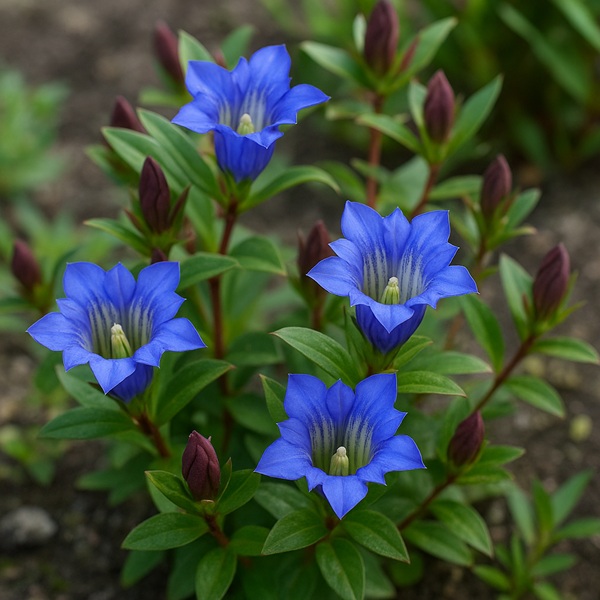
Gentian (Gentiana) is one of the most striking genera among perennial and annual plants, comprising more than 400 species, most of which grow in temperate climates and mountainous regions of the Northern Hemisphere. The plant received its name in honor of the Illyrian king Gentius, who was the first to use gentian in medicine. In Ukrainian gardens, this plant is highly valued for its intense blue, sky-blue, or violet flowering and its refined form. It is ideal for alpine gardens, rockeries, borders, and mixed flower beds.
Among the many species, the ones best adapted to Ukrainian conditions are:
Fringed gentian (Gentiana septemfida) — a low-growing perennial (up to 20 cm) with large blue flowers. It thrives in sunny locations with well-drained soil.
Spring gentian (Gentiana verna) — one of the earliest species, up to 10 cm tall, with bright sky-blue flowers. Ideal for rocky gardens.
Chinese gentian (Gentiana sino-ornata) — blue tubular flowers with white veins, blooming in autumn. Requires an acidic, moist substrate.
Cross gentian (Gentiana cruciata) — a wild species found in the Carpathians, with bell-shaped flowers, well adapted to Ukraine’s climate.
Willow gentian (Gentiana asclepiadea) — a lush bush up to 60 cm tall, flowering in August–September, harmoniously paired with ferns and hostas.
The choice of species depends on the landscaping goal: spring miniatures are best used in the foreground or in alpine compositions, while taller autumn species work better in partial shade, in natural-style mixed borders. It is worth keeping in mind that gentians differ not only in size, but also in flowering period, soil requirements, and care needs. That is why the right combination of several species makes it possible to achieve continuous flowering from spring until late autumn.
Planting gentian requires precision and an understanding of the natural conditions this plant is used to. In nature, most species grow on mountain slopes, in crevices between stones, and in poor but well-drained soils. In Ukrainian gardens, these conditions can be partially recreated, especially if gentian is planted in rockeries or raised flower beds. The main requirement is to avoid water stagnation.
The main preparation stages:
Choosing the location. Most species prefer sunny or partially shaded areas. Spring gentians develop better in full sun, while autumn ones prefer diffused light.
Soil. It should be loose, permeable, with a neutral or slightly acidic reaction (pH 5.5–6.5). A mixture of turf soil, sand, and peat works well. Heavy clay soils are unsuitable.
Drainage. A 5–7 cm layer of expanded clay, gravel, or broken brick is added to a planting hole 20–30 cm deep.
Seedlings are planted in April or September. After planting, they are watered carefully, without overwatering. It is advisable to mulch the area around the plant with pine needles, bark, or fine gravel. The spacing between plants is from 15 to 40 cm, depending on the species. The root collar should remain at soil level — burying it is undesirable.
Tip: for Chinese or autumn gentians, it is useful to add colloidal sulfur or conifer compost to the soil — this acidifies the substrate and improves micronutrient uptake, which is especially important in the alkaline conditions of central Ukraine.
Gentians are not demanding, but they are sensitive to both excess and lack of moisture. They do not tolerate stagnant water in the root zone, yet drying out is also dangerous for them. During dry periods, without proper care, the plant may stop flowering or even die.
Watering routine:
In spring: watering is moderate, depending on the amount of rainfall. The main thing is to avoid overwatering.
In summer: water 2–3 times a week, in the morning or evening, especially during hot weather.
In autumn: for autumn species, it is important to maintain even moisture. Watering is less frequent but deeper.
Lighting depends on the species:
Low-growing spring gentians need sun and open spaces.
Tall autumn gentians do well in partial shade, especially in southern regions.
In hot weather and direct sun, without watering, wilting and yellowing of the leaves are possible. In such cases, it is helpful to mulch the soil and temporarily shade the plant. It is also advisable to remove faded flowers — this prolongs blooming and improves the overall appearance of the clump.
Despite its delicate appearance, gentian is quite a hardy plant if provided with conditions close to its natural habitat. The most active growth and flowering are observed in spring and autumn, while in summer some species enter a dormant period. Comprehensive care includes watering, feeding, pruning, and periodic repotting.
The main aspects of care:
Feeding. Applied at the beginning of the growing season and during budding. Mineral fertilizers with reduced nitrogen and higher phosphorus and potassium content are optimal. Excess nitrogen causes lush leaf growth but suppresses flowering.
Pruning. After flowering, old flowers and yellowed leaves should be removed. This not only improves appearance, but also stimulates possible repeat blooming.
Mulching. Helps retain moisture, maintain acidity, and suppress weeds. Pine needles, bark, and peat are the best options.
Repotting is recommended every 3–4 years. The best time is spring or early autumn. Older clumps gradually lose compactness and ornamental value. During repotting, care should be taken, as gentian roots are shallow and very delicate. Many species tolerate division of the clump well — this is also a convenient way to propagate them.
It is not recommended to repot the plant during active flowering. This causes stunted growth and bud loss. Repotting should be done before the start of vegetation or after it has ended.
Gentian is rarely affected by diseases, but with improper care — excessive moisture, compacted soil, or overcrowded planting — it can suffer from fungal infections and pests. Most problems arise in conditions of high humidity or sharp cooling after warm days.
Typical problems:
Root rot. Develops in conditions of water stagnation. Symptoms: wilting, blackening of the stem base, unpleasant smell. Treatment: cut off the affected roots, repot into fresh substrate, and treat with Fundazol or another fungicide.
Powdery mildew. A white coating on the leaves, especially in damp weather. Spraying with Skor, Topaz, or biological products is recommended.
Gray mold. Appears as spots with a gray coating. More common in dense plantings — thinning and preventive spraying help.
Aphids and thrips. Appear in dry weather. They damage young leaves and leave a sticky coating. Fitoverm, Aktofit, or soap solutions are suitable for control.
Preventive measures:
avoid overwatering;
ensure drainage and ventilation;
remove fallen leaves and faded flowers;
do not exceed the norm of nitrogen fertilizers.
In winter, most perennial gentians need only natural snow cover. But in winters with little snow or during sharp thaws, it is advisable to additionally cover the plant with spruce branches or agrofiber.
Thanks to its compact forms, bright flowers, and structured foliage, gentian is ideal for decorating naturalistic compositions. It combines easily with other plants — both in classic alpine gardens and in modern mixed borders, edging, or container arrangements.
Recommended options:
Alpine gardens. Spring dwarf species such as Gentiana verna create carpet-like patches of sky-blue color among stones.
Rockeries. They pair well with houseleeks, sedums, and carnations.
Borders along pathways. Autumn gentians with tall, curved stems create a natural frame.
Container growing. Suitable for balconies and terraces, especially with varieties that bloom in September–October.
Gentian also combines well with conifers, hostas, and ferns. It can be planted both in groups of a single species and in combinations with plants of a similar habitat. And thanks to different flowering times, it is possible to create decorative groups that will delight from spring until late autumn.
In summary: gentian is not just an ornamental plant, but a symbol of natural beauty and harmony. It does not tolerate haste or rough handling, yet it generously rewards the patient gardener with enchanting blooms and longevity.