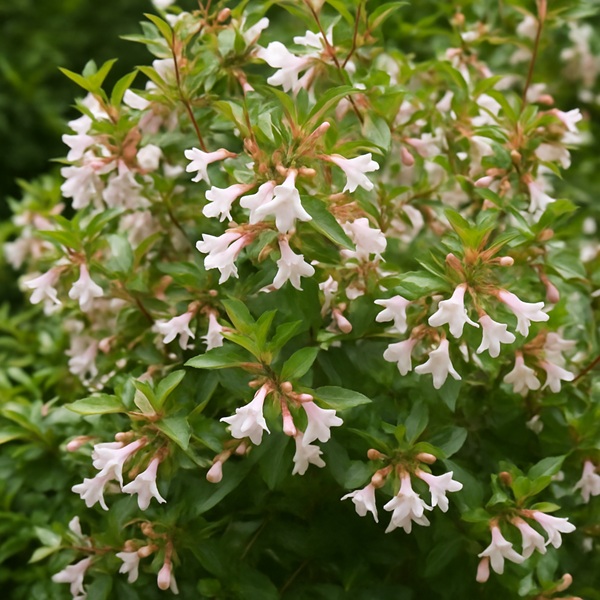
Abelia (Abelia) is an ornamental shrub with elegant foliage, a long flowering period, and good tolerance to pruning. The plant belongs to the honeysuckle family (Caprifoliaceae) and includes about 30 species, most of which originate from East Asia and Mexico. In recent decades, abelia has been increasingly established in European gardens, including in Ukraine—especially in the south and in central regions with mild winters. Thanks to its low-maintenance nature and decorative appeal, it has become popular both in open ground and in container cultivation.
The most common species and cultivars:
Abelia × grandiflora (glossy abelia) — the best-known hybrid with semi-evergreen foliage and tubular pink-white flowers. It blooms from late spring until late autumn. It can overwinter outdoors in southern Ukraine.
Abelia chinensis (Chinese abelia) — a deciduous shrub with slender shoots and fragrant flowers. It tolerates shaping very well and is suitable for border plantings.
Abelia floribunda — less frost-hardy, but a profusely flowering plant with bright pink flowers. Most often grown in winter gardens.
Abelia × grandiflora ‘Kaleidoscope’ — a dwarf cultivar with variegated foliage that changes shades from yellow to red depending on the season.
Most abelias reach 1–2 meters in height, but they are easy to shape. They can be used to create a dense hedge or grown as a specimen plant. Additional ornamental value comes from the glossy foliage, which turns reddish or bronze in autumn. In regions with moderate winters, abelia can remain outdoors without protection, while in northern areas it is better grown in a container and moved to a cool room for the winter.
For successful abelia cultivation, its biological characteristics should be taken into account: it is heat-loving, light-loving, and requires fertile, well-drained soil. At the same time, it tolerates urban conditions and periods of drought, which makes it suitable both for private gardens and for landscaping public spaces. In Ukraine, the best time for planting is mid-April or September.
The main steps:
Choosing a site. Abelia prefers sunny or lightly shaded locations protected from the northern wind. Ideal options include southern slopes, areas near house walls, or hedge plantings.
Soil. Slightly acidic or neutral loams with added humus and sand are suitable. If the soil is heavy, drainage is necessary.
Planting hole. Depth — 40–50 cm, width — up to 60 cm. A 10–15 cm drainage layer (gravel, expanded clay) is placed at the bottom, followed by a nutrient-rich mix.
Watering. After planting, water moderately and mulch the trunk circle with compost, sawdust, or bark.
In colder regions, container planting is recommended so the plant can overwinter in an unheated but bright room at +5 to +10°C. In southern regions, abelia can be left in the ground under a cover of spruce branches or agrofiber if the temperature does not fall below –12°C.
Tip: after planting, carry out light pruning to remove damaged shoots and shape a compact crown — this stimulates rooting and new growth.
Although abelia is fairly drought-tolerant, in the first years after planting it requires regular watering. Insufficient watering may lead to leaf drop and reduced flowering. Over time, the plant becomes less sensitive to short-term drought, but even then it still needs attention during hot months.
Recommendations:
Young plants: during the first year, water twice a week if there is no rain. Water should penetrate deeply.
Mature shrubs: once every 10–14 days, and during drought — every 5–7 days.
In autumn: be sure to carry out deep pre-winter watering before frost so the root system enters winter without drying out.
Lighting is extremely important for abundant flowering: the more sun, the denser the crown, the richer the coloring, and the more actively buds are formed. In shade, abelia grows, but hardly blooms. For most regions of Ukraine, southern or south-western sites are best.
Feeding should be carried out from April to August once every 3–4 weeks. Use complex fertilizers for flowering shrubs with phosphorus and potassium. Avoid excess nitrogen — it stimulates foliage rather than flowers.
Yellowing leaves are a sign of three possible problems: overwatering, lack of light, or alkaline soil reaction. In such a case, adjust watering and lighting, and add an acidifying material such as peat or conifer compost.
Abelia tolerates pruning very well and recovers quickly, which makes it ideal for ornamental shaping. Thanks to its flexible shoots and dense foliage, it can serve either as a hedge or as a single accent in landscape design. Regular care ensures a thick crown, long-lasting flowering, and plant longevity.
Basic pruning rules:
Early spring (March–April): remove frost-damaged, injured, and weak branches. This stimulates the growth of new shoots on which buds will appear.
Summer: light correction of shape, especially in fast-growing cultivars. Shoots can be pinched to increase density.
Autumn: overly long branches may be shortened, and in regions with frost the shrub can be bent down and covered.
It should be remembered that abelia flowers on the current year’s shoots, so overly hard spring pruning may reduce the number of flowers. It is better to combine thinning of old branches with gentle shortening of young ones to create the desired shape.
Some cultivars change leaf color in autumn, taking on bronze or reddish shades. This creates additional decorative appeal. Winter covering should be done after the first frosts in order to avoid overheating and rotting under insulating material.
Abelia is considered resistant to most diseases and pests, but in unfavorable conditions — excessive humidity, stagnant air, lack of light — it may lose its resilience and become a target for typical garden problems. Damage is most often observed in autumn or during periods of sharp cooling and damp weather.
Main threats:
Root rot. Occurs due to stagnant water. The plant wilts, and the base of the shoots darkens. Repotting, pruning of rotten parts, and fungicide treatment are required.
Powdery mildew. A white coating on the leaves, especially in shaded places. It is treated with Topaz, Skor, or biological preparations.
Aphids and spider mites. Appear in hot weather. Signs include curled leaves, stickiness, and webbing. Fitoverm, Aktara, or garlic infusions can help.
For prevention:
do not allow water to stagnate in the root zone;
avoid dense plantings — this improves ventilation;
control feeding — especially do not overuse nitrogen;
inspect leaves on both sides, especially in summer.
In container growing, it is important to control soil moisture even in winter — condensation on the cover or indoors may cause mold or rot.
Thanks to its harmonious appearance, dense foliage, low-maintenance nature, and long flowering period, abelia is perfectly suited to modern landscapes. It decorates not only private gardens, but also city parks, balconies, terraces, and winter gardens. Its visual softness and variety of foliage colors make it versatile for almost any style.
Ways to use it:
Specimen planting. A single abelia shrub looks striking on a lawn or near a house entrance.
Hedge. It responds well to shaping, recovers quickly after trimming, and holds its form for a long time.
Container growing. An ideal option for balconies, terraces, and entrance decoration.
Borders and mixed borders. Variegated or dwarf cultivars beautifully complement compositions with hostas, lavender, and heucheras.
Abelia combines well with perennials, ornamental grasses, and conifers. It remains attractive even without flowers thanks to its glossy leaves, dense form, and even growth.
In summary: abelia is a harmonious combination of beauty, endurance, and ease of care. It does not require complicated procedures, but it responds gratefully to attention. For gardeners in Ukraine — especially in warmer regions — it is a plant that can become an ornament to any season.