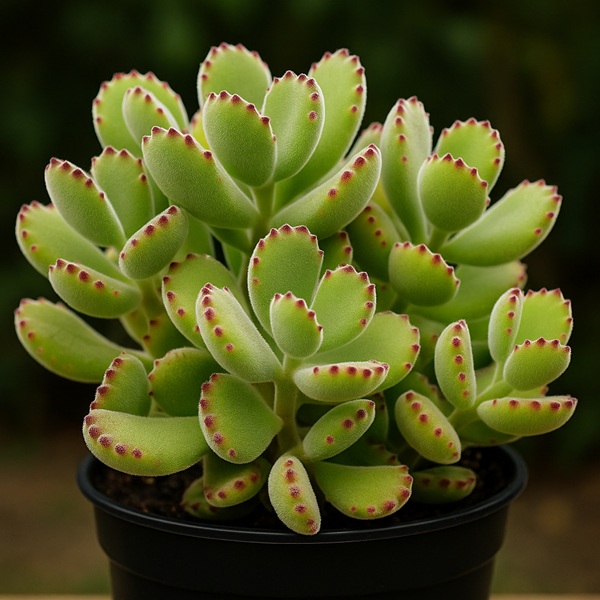
Cotyledon is a genus of ornamental succulents from the Crassulaceae family, native to South Africa. In Ukraine, it is rapidly gaining popularity among plant enthusiasts thanks to its unusual leaf shape, hardiness, and drought tolerance. With its wide range of species, cotyledon is suitable for both beginners and experienced admirers of succulent flora.
The most common species:
Cotyledon orbiculata — the best-known species, with rounded leaves covered in a waxy coating, often edged in red. It forms compact bushes up to 50–60 cm tall. It blooms with tubular orange-red flowers.
Cotyledon tomentosa (woolly cotyledon or “bear’s paws”) — compact, with fleshy fuzzy leaves whose edges resemble little claws. Ideal for growing in pots.
Cotyledon pendens — a trailing variety with drooping shoots covered in gray-green leaves and pink flowers. Perfect for hanging planters.
Cotyledon ladismithiensis — distinguished by wavy leaf edges and a soft surface. Less common, but highly ornamental.
All of these species require bright light, small amounts of soil, and good drainage. Cotyledon is not just another succulent on a windowsill, but a true element of an interior composition. Its architectural form allows the plant to blend harmoniously with modern design, miniature gardens, or balcony plantings.
Planting cotyledon is one of the most important stages, as it determines the plant’s future condition. Despite its drought tolerance, mistakes in substrate preparation or pot selection can lead to root rot or stretched stems. In Ukraine, cotyledon is mainly grown indoors, although in summer it can be moved to a balcony or terrace.
What to consider when planting:
Pot. It is better to choose wide but shallow containers. Ceramic or clay pots are preferable to plastic ones because they “breathe” better. A drainage hole is essential.
Substrate. The ideal option is a ready-made succulent mix with added perlite, sand, or fine expanded clay. You can also make your own: 50% leaf soil, 30% sand, and 20% perlite or zeolite.
Drainage. A layer of expanded clay (1–2 cm) is placed at the bottom, then the substrate. When planting, it is important not to bury the stem — the growing point should remain above the soil level.
After repotting, the plant should not be watered for 3–5 days so that damaged roots have time to heal. If the cotyledon was bought from a store, it should be given time to adapt: 7–10 days without feeding, in diffused light, and without letting it dry out completely. Succulents in stores are often planted in peat, which should definitely be replaced, since it retains moisture for too long and encourages rot.
Tip: when repotting or dividing the plant, cut surfaces can be treated with crushed charcoal or a fungicide. This is especially important after removing damaged parts or old roots.
One of the main reasons cotyledon dies at home is improper watering. Despite its ability to store water in its leaves, this succulent cannot tolerate overwatering, especially in conditions of poor light and high humidity. In Ukraine, this is especially critical during winter, when the air is dry and daylight hours are short.
How to water correctly:
In summer — once every 7–10 days; in hot weather, more often, but only after the soil has dried out completely.
In autumn and spring — reduce watering to once every 2 weeks.
In winter — if the temperature is below +18°C, watering is stopped completely. If kept at room temperature, only slight moistening around the edge of the pot is needed.
The water should be settled and at room temperature. It should never be poured into the center of the rosette, as this can cause rotting. Water only the substrate, avoiding drops on the leaves.
Lighting is critically important. Cotyledon needs bright, diffused light. The best place is a south- or southeast-facing window. In winter, without supplemental lighting, the plant stretches out, loses its shape, and becomes more prone to disease. It is recommended to use grow lights with a neutral white spectrum.
Note: when light is insufficient, cotyledon loses its decorative appeal — the leaves fade, elongate, and the shoots flop over. With too much sun, burns are possible. The ideal option is direct sun in the morning or evening and diffused light during the day.
Cotyledon is not only decorative but also an especially rewarding plant to grow. If it is given basic conditions — enough light, the right soil, and moderate watering — it can live for years, forming an attractive shape and even blooming with age. To keep the bush neat, it is important to shape the crown regularly; otherwise, the shoots become leggy, the leaves shrink, and the lower parts become bare.
Key care techniques for a mature plant:
Shaping. In spring or early summer, elongated shoots are pruned — this stimulates branching. The cut areas are dusted with charcoal. New shoots usually appear from the leaf axils within 2–3 weeks.
Cleaning. Yellowed or dried leaves should be removed regularly — they interfere with air circulation and encourage fungal growth.
Rejuvenation. The top of an older plant can be cut off and rooted in fresh substrate, while the old stump can be left to recover — it often produces new shoots.
Cotyledon propagates well from cuttings. Stem cuttings 5–10 cm long are first left to dry for 1–2 days, then planted in sand or a succulent mix. Watering begins only after roots appear. Rooting usually takes 2–4 weeks. Leaf propagation is also possible, but it is less effective — roots appear more slowly, and the development of young plants is slower.
Tip: for faster rooting, keep the temperature at +22 to +26°C and place the cuttings in a well-lit spot without direct sunlight. Autumn and winter are not the best times for propagation, because cotyledon is dormant during this period.
Despite its hardiness, cotyledon can suffer from diseases or pests. Most often, problems arise because of improper care: excessive watering, heavy soil, sharp temperature fluctuations, or poor light. Keeping the plant in a stuffy, humid room is especially dangerous.
Common diseases:
Root rot. Caused by stagnant water or watering with cold water. Treatment: remove the affected roots, repot into dry soil, and treat with a fungicide.
Powdery mildew. A white coating on the leaves is a sign of overwatering and stagnant air. Treatments with products such as Topaz or Skor can help.
Black leg. Affects the stem near the base and spreads quickly among young plants. Urgent repotting and drying out are required.
Pests:
Spider mite. Appears in dry air. The leaves become covered with pale spots and webbing. Fitoverm, Aktofit, or wiping with alcohol can help.
Mealybug. Noticeable as white clumps in the leaf axils. It is removed mechanically and treated with Aktara or Confidor.
Scale insect. Brown, hard spots on the leaves. Remove them by hand and then treat the plant with a systemic insecticide.
Prevention is the best protection: sterile tools, a good-quality substrate, careful watering control, and regular leaf inspection will keep the plant healthy for many years.
Cotyledon is an ideal plant for creating a cozy atmosphere in a modern interior. It combines the elegance of succulent architecture with complete practicality. Thanks to its clear forms and unusual coloring, cotyledon fits beautifully into Scandinavian, minimalist, and eco-style green interiors.
How to use it:
Specimen planting. One bush in a stylish pot with decorative pebbles makes a ready-made decoration for a table or windowsill.
Dish garden. In a large shallow container, cotyledon can be combined with haworthia, echeveria, and crassula.
Hanging compositions. Trailing varieties look wonderful in hanging planters, with shoots cascading down and showing off their decorative leaves.
In the warm season, cotyledon can be moved to a balcony or terrace, provided it is protected from direct midday sun and heavy rain. In autumn, when the temperature drops below +10°C, the plant should be brought back indoors. Cotyledon tolerates relocation well if the change in conditions happens gradually.
Cotyledon is a succulent that combines ornamental appeal, hardiness, and ease of care. It is perfectly suited to city apartments, summer cottages, and balconies. All it needs is light, a dry substrate, and your patience.