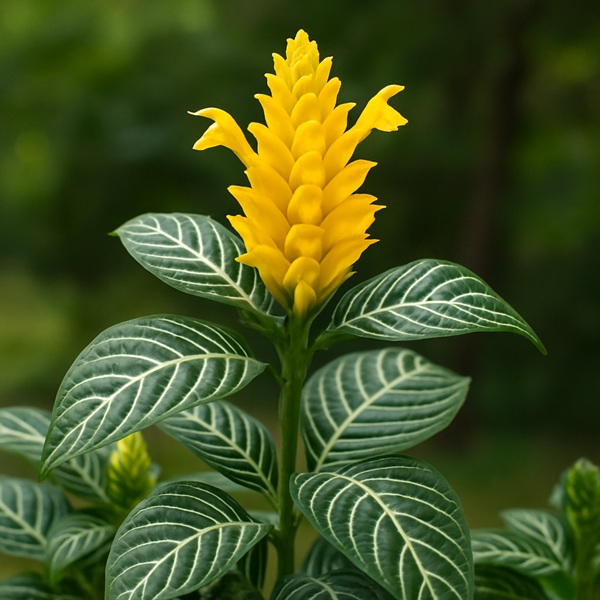
Aphelandra is a bright and memorable plant from the Acanthus family, valued for its decorative foliage and striking blooms. It is native to the tropics of Central and South America, where it grows in humid, shaded conditions. Still, with proper care, aphelandra adapts well to Ukrainian apartments, where it becomes a truly exotic highlight. Its unusual leaves with clearly defined veins and rich inflorescences not only decorate the interior but also create a sense of living tropical energy even on dull winter days.
Among the many varieties, the best suited for indoor cultivation are:
Aphelandra squarrosa — the best-known species. It has large, glossy dark green leaves with silvery veins and bright yellow spike-like inflorescences. It usually blooms in autumn.
Aphelandra aurantiaca — distinguished by its compact size and orange flowers. Its foliage is less contrasting, but still ornamental.
Aphelandra sinclairiana — a species rarely found in cultivation, with pinkish-purple inflorescences. It requires higher humidity and regular misting.
Aphelandra tetragona — a miniature variety often grown in terrariums.
Despite their outward differences, all these species need similar conditions: warmth, stable humidity, plenty of diffused light, and a calm environment. Aphelandra is not just a simple “green plant,” but a true “tropical princess” that needs care. But if given the right conditions, it will generously reward you with vivid blooms lasting up to 4–6 weeks and luxurious foliage.
Planting aphelandra is a responsible process in which every detail matters. The plant’s root system is very delicate, so it is easy to damage with rough handling. In Ukraine, aphelandra is best grown indoors all year round. In summer, it can be moved to a balcony or terrace, but only if protected from direct sunlight.
The main planting points:
Pot. Choose a stable, medium-sized pot with drainage holes. The material can be ceramic or plastic. It is important to avoid stagnant water.
Drainage. A layer of expanded clay, pebbles, or broken brick 2–3 cm thick must be placed at the bottom of the pot.
Soil. The optimal mix is: 2 parts leaf soil, 1 part peat, 1 part sand, and 1 part perlite or vermiculite. Adding charcoal reduces the risk of rot.
After planting. For the first week, the plant should not be watered — only the leaves should be misted. The temperature should remain stable: +22 to +24°C, with no drafts.
Mature plants are repotted once every 2 years in spring. Young ones — every year. During repotting, the roots must be handled as carefully as possible, and the stem should not be buried deeper. If the aphelandra has become leggy, the top can be cut off and rooted as a cutting.
Tip: after planting, it is helpful to cover the plant with a transparent bag with holes for 3–5 days — this creates a mini-greenhouse effect. This method is especially useful if indoor humidity is below 50%.
Aphelandra is a plant with very specific moisture requirements. It tolerates neither drying out nor overwatering. In its natural environment, its roots are always moist, but not wet. At home, it is important to find a balance: too much water causes rot, while dryness leads to leaf drop.
Watering rules:
Spring and summer — 2–3 times a week, when the top 1–2 cm of soil has dried out.
Autumn and winter — once a week, if the temperature does not drop below +18°C. In cooler conditions — even less often.
Water quality. Use soft, settled water at room temperature. Rainwater or filtered water is the best option.
The lighting should be bright but diffused. The ideal places are an east- or west-facing window. On a south-facing one, shading is necessary. In summer, aphelandra is easily burned by direct sun, while in winter it may suffer from a lack of light. In that case, supplemental lighting with a grow light is needed — at least 10–12 hours a day.
Signs of problems:
Yellow spots — sunburn.
Pale, stretched leaves — lack of light.
Dry leaf edges — air that is too dry or watering with cold water.
Wilting despite moist soil — a sign of root rot.
Regularly wiping dust off the leaves and misting with soft water helps maintain the plant’s health and ornamental appearance. Aphelandra loves humid air — ideally, humidity in the room should not fall below 50–60%.
Aphelandra tends to stretch out and lose its compact form, especially when there is not enough light or regular care. To keep the plant attractive, it needs to be shaped from time to time. This ensures not only a pleasing appearance but also stimulates the growth of new shoots and the development of a dense bush.
What is worth doing:
Pinching the tips — an effective way to encourage side branching. This is best done in spring, when active growth begins.
Pruning elongated shoots — helps rejuvenate the plant. The cut parts can be used as cuttings for propagation.
Tying up — necessary for taller varieties, which may lean under the weight of their leaves.
Aphelandra is rejuvenated by deep pruning: the stem is shortened to a height of 10–15 cm. This may seem drastic, but it gives a quick boost to the formation of new buds. If the lower leaves fall off and the plant becomes leggy, the best solution is to cut off the top and root it — this way you preserve your favorite specimen.
Thanks to its active growth in the warm season, aphelandra recovers quickly after pruning. The main thing is to provide it with light, warmth, and humidity. During the recovery phase, the plant should not be fertilized until it has produced new leaves.
Aphelandra is not highly prone to diseases, but with improper care it may lose both its decorative appeal and its vitality. The greatest risks come in winter or with excessive watering. It is worth remembering: it is better to underwater than to overwater.
The most common diseases:
Root rot — the main cause of plant death. It shows up as wilting even when the substrate is moist. Urgent repotting is needed, with removal of the affected roots and treatment with Fundazol or similar fungicides.
Gray rot / powdery mildew — appears as a coating on the leaves. It develops because of stagnant air and excessive humidity. Systemic fungicides and improved ventilation help.
Viral infections — rare, but they show up as leaf mosaic patterns and deformation. Unfortunately, there is no treatment — the plant must be discarded.
Pests:
Spider mite — appears in dry air. The leaves become spotted, and fine webbing appears on the reverse side. Fitoverm and Aktofit can help.
Aphids / whitefly — easy to notice on the underside of the leaves. They can be eliminated with Aktara or a soap solution.
Scale insect / mealybug — look like hard or fluffy spots. They are removed mechanically, followed by treatment with alcohol or insecticides.
Prevention: do not overwater, ventilate the room, keep aphelandra away from dry radiators and sudden temperature changes. Regular inspection is the key to a healthy plant.
Aphelandra is a plant with character and a striking appearance. It is ideal for decorating modern interiors, from minimalism to eco-style. Its large glossy leaves with vivid veins and rich flowering add a tropical note even to a modest room.
Where it looks best:
As a specimen plant — one large aphelandra in a stylish pot on the floor or on a table is already a complete composition.
In a group with other ornamental foliage plants — for example, with calatheas, aglaonemas, and zamioculcas.
On a balcony or terrace in summer — if protected from direct sun and wind, it feels great outdoors.
In the warm season, aphelandra responds to fresh air with active growth. But it is important to remember: nighttime temperatures should not drop below +15°C. In autumn, the plant should be gradually brought back indoors, avoiding shock from a sudden change in conditions.
Aphelandra is a plant for those who appreciate bright tropical exoticism and are willing to care a little for its comfort. In return, it will give you a striking appearance, positive energy, and real green-and-yellow joy in your home.