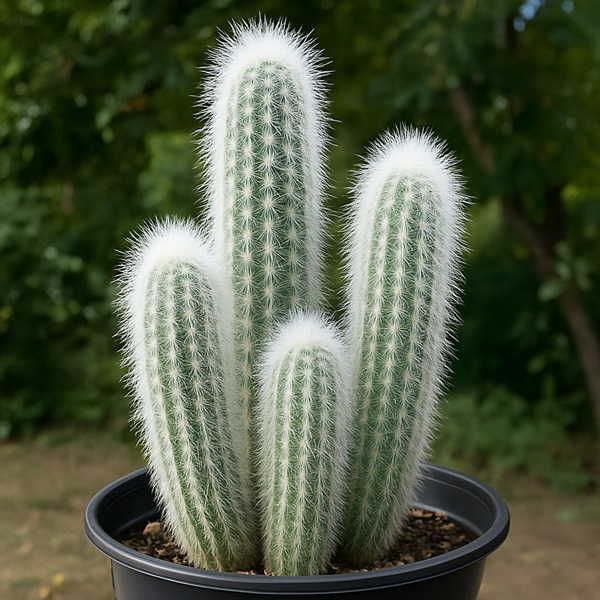
Cleistocactus (Cleistocactus) is a striking columnar cactus native to South America (Bolivia, Argentina, Peru). The name of the genus comes from the Greek word kleistos, meaning “closed,” due to the characteristic structure of its flowers, which almost never open fully. However, this does not prevent them from remaining decorative and attractive. In apartments across Ukraine, cleistocacti are grown as houseplants and sometimes in greenhouses.
Cleistocacti have thin, upright or trailing stems that reach 50–120 cm indoors and more than 3 m in nature. The stems are covered with numerous ribs and fine spines that create a fluffy visual effect. Flower colors vary: red, pink, yellow, and sometimes even greenish.
Popular species for growing in Ukraine:
Cleistocactus strausii — known as the “silver torch.” It has dense white bristles and red tubular flowers.
Cleistocactus winteri — the “golden cleistocactus,” with reclining or trailing stems and bright orange flowers.
Cleistocactus brookeae — upright-growing, with red flowers that bend slightly.
Cleistocactus samaipatanus — compact, flowering abundantly even on a windowsill.
Regardless of the species, all cleistocacti require similar care: plenty of light, moderate watering, and good drainage. Under the right conditions, even in Ukrainian apartments, these cacti not only grow actively but may also bloom every year.
Planting cleistocactus requires a careful approach. Because of its well-developed root system, these plants need a deeper pot and a loose substrate that is permeable to both water and air. In Ukrainian conditions, where humidity levels can change sharply between seasons, it is very important to create proper drainage.
Planting stages:
Choosing the pot. Tall, narrow ceramic or plastic pots with large holes in the bottom are best.
Substrate. A recommended mix is 40% leaf soil, 30% coarse sand, 20% perlite, and 10% charcoal. A ready-made cactus mix with mineral additives is also suitable.
Drainage. Place 2–4 cm of expanded clay or gravel at the bottom. The cactus is planted vertically and covered with dry substrate.
After planting, do not water for 5–7 days — this gives the roots time to adapt. Feeding begins 3–4 weeks after rooting, only in spring or summer.
Tip: when planting thin young plants, it is helpful to install support to prevent leaning. This should be done immediately so the roots are not disturbed later.
Watering is one of the most critical aspects of cleistocactus care. Although it is drought-tolerant, excess moisture or a prolonged lack of it can be harmful. In Ukrainian apartments, especially in winter, it is important to take heating, dry air, and reduced daylight into account.
Watering schedule:
Spring–summer: once every 10–14 days, depending on how quickly the soil dries out.
Autumn: once every 3 weeks.
Winter: at temperatures of +10 to +15°C, watering is stopped completely. In warmer conditions — once a month.
Use soft, settled, chlorine-free water. Pour it along the edge of the pot, avoiding contact with the stem. After watering, drain any excess from the tray.
Lighting is no less important. Cleistocactus loves bright sun; a south- or southeast-facing window is best. With insufficient light, the stem stretches, the spines become sparser, and flowering stops. In winter, it is advisable to use white-spectrum grow lights.
Useful tip: move the plant to a balcony or garden from mid-May to September. But first let it adapt — keep it in partial shade for a few days.
Under indoor conditions, cleistocactus is mainly grown as a single ornamental plant. Its vertical growth allows it to be placed even in narrow spaces — on slim windowsills, shelves, or tiered stands. But behind its outward low-maintenance nature lies a need for a stable microclimate.
What is important to keep in mind:
Temperature. In summer — +20 to +28°C. In winter, it is desirable to lower it to +10 to +15°C to provide a dormant period.
Humidity. Not critical, but the plant does not like fluctuations — avoid drafts and sudden chilling.
Feeding. Once a month during the active growth period (April–August). Mineral fertilizers with a low nitrogen content are suitable.
Cleistocactus is propagated mainly by seed, since most species do not produce offsets. Seeds are sown in a sterile substrate and covered with film or glass. At a temperature of +25 to +28°C, seedlings appear within 1–2 weeks. Pricking out is done when the first true spines appear.
An alternative method is grafting. It is relevant in cases of slow growth or plant damage. Pereskiopsis or Echinopsis is used as rootstock. Grafting speeds up development, but it affects the plant’s appearance — the form changes.
Tip: when repotting, do not completely clean the roots of soil if the plant is healthy. This reduces stress and helps it establish more quickly.
Cleistocacti are fairly resilient, but in apartment conditions, especially in winter, they may suffer from fungal diseases or pests. The main causes are improper watering, poor ventilation, or excessive humidity.
Typical problems:
Root rot. The most dangerous one. It shows up as wilting despite moist soil and blackening of the stem near the base. Repotting, cutting off affected parts, and fungicide treatment are required.
Gray rot / mold. Appears on the surface of the substrate or stem. Treated with systemic fungicides.
Dry rot. Often goes unnoticed at first. The plant seems to dry out from the inside. The cause is sudden overcooling or stress.
Pests:
Mealybug. Forms white clumps in the leaf axils. Removed by hand, followed by treatment with Aktara or alcohol.
Spider mite. Visible webbing and tiny pale spots. Use Fitoverm or spray with a soap solution.
Scale insect. Hard brown “plates” on the stem. Remove mechanically, then apply an insecticide.
Prevention: ventilate the room, do not water unnecessarily, and keep the plant and the substrate surface clean. During winter, keep the plant dormant.
Cleistocactus fits beautifully into modern interiors. Its vertical shape, “soft” appearance thanks to the spines, and ability to bloom even in a pot all make it a popular choice among those who value style and minimalism.
Recommended placement:
Windowsills facing south or east. The plant does not take up much space and grows upward.
Group plantings. It looks good with haworthias, echeverias, and astrophytums.
Trailing species (for example, Cleistocactus winteri) can be placed in a hanging planter.
Decorative techniques — mulching with white pebbles, using ceramic pots, and pairing it with wood or stone — highlight its natural aesthetics.
In winter, cleistocactus slows its growth but keeps its attractive appearance. In summer, after the dormant period, it becomes active again. This is a plant for those who are ready to give it minimal attention but want maximum style.