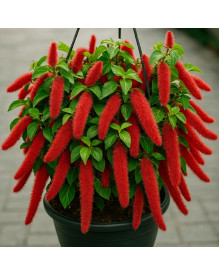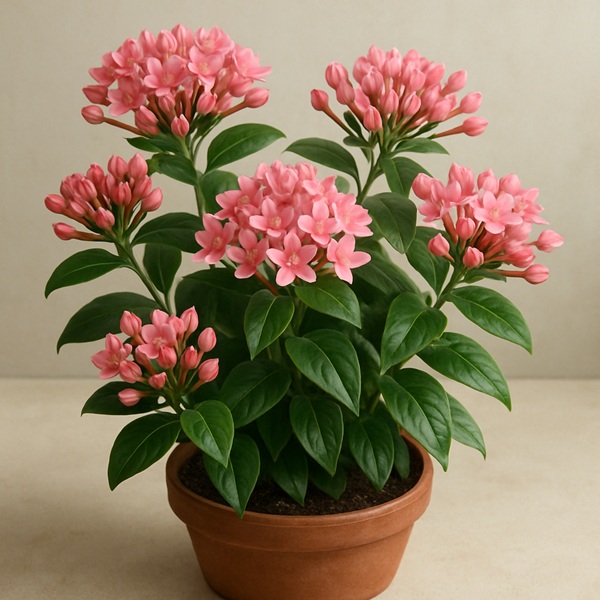
Bouvardia is an ornamental plant from the coffee family, native to Central America. In indoor floriculture, it is valued for its bright tubular flowers gathered in dense clusters and for its ability to bloom abundantly over a long period. In Ukraine, bouvardia can be grown successfully both indoors and outdoors in summer. In nature, more than 30 species of bouvardia are known, but in ornamental growing, hybrid forms with increased resistance to external conditions are most commonly used.
Among the most popular types suitable for cultivation in Ukraine are Bouvardia ternifolia (scarlet bouvardia), Bouvardia longiflora (long-flowered bouvardia), as well as numerous hybrids from the Royal, Classic, and Diamond series. Scarlet bouvardia stands out for its bright red flowers and grows well on sunny terraces and balconies. Long-flowered bouvardia has large fragrant white flowers but is more sensitive to cool temperatures, so it is mainly grown in greenhouses or winter gardens. Hybrids are usually less demanding: they tolerate repotting, fluctuations in humidity and temperature, and produce fuller flowering more easily.
Besides classification by species, bouvardia is also divided by flower shape and color. There are varieties with double corollas, pure white, pink, red, and even purple shades. Large-flowered varieties need higher air humidity, while small-flowered ones are better adapted to dry climates and lower light levels. That is why, when choosing a variety, it is important to consider the region of Ukraine: in the western regions, more moisture-loving types can be grown, while in the south, more drought-tolerant ones are a better choice. A well-chosen variety is the foundation of future success in cultivation.
Planting bouvardia is an important step that largely determines the success of later care. Bouvardia is light-loving, but it does not tolerate direct sun. The ideal placement is an east- or west-facing window. In regions with strong summer sun, the plant should be shaded with a light fabric. Choose a medium-sized pot: one that is too large will retain water, while one that is too small will dry out quickly. A drainage layer of expanded clay or small pebbles must be placed in the pot.
The soil should be loose, nutritious, and slightly acidic. The optimal mix is leaf soil, peat, and coarse sand in a ratio of 2:1:1. Before planting, the substrate should be moistened, but not soaked. Bouvardia roots are extremely sensitive to overwatering, especially in cool weather. After planting a young plant, it is recommended to install a support to stabilize the stems.
Planting bouvardia in open ground is possible only in warm regions and not earlier than late May, when the risk of frost is minimal. The location should be sheltered from the wind, with good drainage and partial shade. In the southern regions of Ukraine, full cultivation in a flower bed is possible; elsewhere, it is better to limit it to container growing with the plant moved outdoors in summer. When planting in the ground, leave at least 25 cm between plants, since the bush quickly develops a large root system.
Bouvardia should be watered moderately but regularly. It reacts equally badly to both drying out and excess water. The best approach is to check whether the top 2–3 cm of soil has dried out. In summer, water 2–3 times a week; in winter, once every 7–10 days. The water should be soft and at room temperature. Misting is not essential, but it is beneficial, especially during the heating season.
Bouvardia needs bright but diffused light. During cloudy seasons, artificial supplemental lighting is useful: cool-spectrum lamps or grow lights work well. Insufficient light causes the stems to stretch and buds to drop, while too much sun leads to leaf burns. A good strategy is to rotate the pot regularly to prevent one-sided growth. Turning it 90° once a week ensures symmetrical crown development.
The microclimate should also be mentioned separately. Sharp drafts, especially in winter, can cause leaf drop. The ideal temperature range is +20 to +25°C in summer and no lower than +15°C in winter. Air humidity is best kept at 50–60%. Bouvardia responds poorly to stress: even simply moving the pot to another place may temporarily stop flowering. Stability is the key to successful care.
Bouvardia may look delicate, but when care conditions are disturbed, it quickly loses its ornamental appeal and becomes vulnerable to infections. To avoid critical problems, it is important to recognize symptoms in time.
Gray mold appears as a gray fluffy coating on leaves or stems. It usually develops because of excessive humidity and lack of ventilation. Treatment: prune the affected parts, treat with a fungicide such as Fundazol, ventilate the space, and reduce watering.
Root rot is the result of stagnant water in the substrate. Signs include wilting, leaf drop, and blackening at the base of the stems. What to do: completely repot the plant into fresh substrate, trim away rotten roots, treat with a fungicide, and strictly control moisture afterward.
Powdery mildew is a white coating on the leaf surface that appears when temperature and humidity fluctuate. Treatment includes sulfur-containing products or biofungicides.
Pests: aphids, spider mites, and scale insects. Aphids gather on young shoots and distort the leaves. Spider mites cause yellowing and webbing. Scale insects look like small plaques on the stems. They can be controlled with a soap solution or insecticides such as Aktara or Fitoverm.
When dealing with diseases, the main thing is not only to remove the symptoms but also to analyze the cause. Chilling, sharp temperature swings, improper watering, and excessive or incorrect fertilization all weaken the plant. Bouvardia’s immunity depends directly on the stability of the microclimate, so even if there are no visible signs of disease, it is important to maintain hygienic conditions, ventilate the room, and avoid overloading the plant with unnecessary treatments.
There are several ways to propagate bouvardia, and not all of them are equally effective. Under home conditions in Ukraine, the most successful are:
Cuttings. In spring or summer, a semi-woody shoot 10–12 cm long is cut, the lower leaves are removed, and it is placed either in water or in a light peat-based substrate. For better rooting, stimulants such as Kornevin are used. The cuttings are covered with film, and the temperature is kept at +22 to +24°C. Roots appear in 2–3 weeks.
Division of the bush. Suitable for mature plants during repotting. The root system is carefully divided into sections with growth points. Each section is planted separately. This method is traumatic, but it makes it possible to obtain several strong plants quickly.
Seeds. Theoretically possible, but in practice rarely used because hybrids lose their varietal characteristics and germination is low. In addition, bouvardia seeds rarely form indoors.
Mistakes to avoid: using thin or still-flowering shoots for cuttings, since they have low energy reserves and rot quickly. The soil in propagation trays should also not be overwatered, as this causes rotting. After rooting, young plants should be gradually adapted to open air by increasing the time without cover.
Propagating bouvardia is not only a way to obtain new plants, but also a method of rejuvenating the mother bush. This is especially important for plants older than two years, which begin to lose their growth vigor. Rejuvenation by cuttings helps preserve varietal traits and produce compact, well-shaped bushes.
Successful cultivation of bouvardia requires adjusting care according to the season. It is most convenient to divide the year into three phases:
Spring–summer (March–August):
– active growth and flowering;
– regular watering and feeding once every 10–14 days;
– pinching the tips to shape the crown;
– the pot may be moved to a balcony or terrace when the temperature is above +18°C;
– preventive pest treatment every 30 days.
Autumn (September–October):
– gradual reduction in watering;
– stop feeding in October;
– move the plant indoors;
– increase lighting with lamps if necessary;
– prune weak shoots after flowering ends.
Winter (November–February):
– dormant period;
– temperature not lower than +15°C;
– watering once every 10–14 days;
– no fertilizers or repotting;
– control air humidity, ideally around 50%.
Thanks to this care schedule, bouvardia preserves its energy and sets buds regularly. It is important to remember that even the hardiest varieties do not tolerate stress well. The key to success is stability, attention to detail, and adapting care to seasonal climate changes, which are especially noticeable in Ukraine.