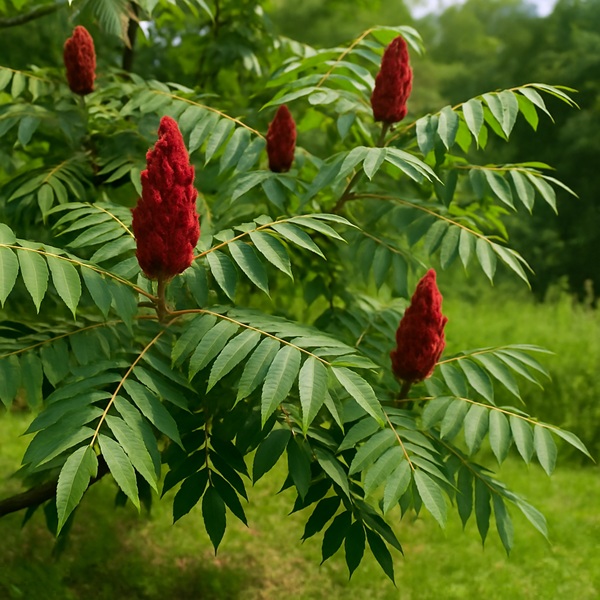
Sumac (Rhus) is an ornamental shrub or small tree that is appearing more and more often in the gardens of Ukrainian growers thanks to its exotic look, low maintenance needs, and drought resistance. The genus includes more than 200 species, but the most popular in Ukraine are staghorn sumac (Rhus typhina), smooth sumac (Rhus glabra), and decorative hybrid forms. The main appeal lies in its expressive foliage, striking flower panicles, and vivid autumn color.
Sumac shrubs can reach 3–5 meters in height and have a spreading, umbrella-shaped crown that gives the plant a tropical appearance. Sumac is especially attractive in autumn, when its pinnate leaves turn crimson, red, orange, and golden tones. The inflorescences appear in summer, after which dense pyramidal panicles of small burgundy or dark red fruits form and remain on the plant into winter.
Besides its decorative role, sumac is valued for its ability to survive in extreme conditions: it easily tolerates drought, poor soils, polluted air, and temperature fluctuations. This makes it an excellent choice for landscaping slopes, reinforcing ravines, creating hedges, and zoning a site. Some sumac species, especially staghorn sumac, are also used in cooking: the ground fruits are included in popular Middle Eastern spice blends, including za’atar.
A properly chosen planting site is the key to sumac’s long-term growth and ornamental value. It is a light-loving plant that needs good sun exposure, especially in the first half of the day. In shade or even partial shade, sumac develops more poorly, becomes leggy, produces fewer shoots, and colors weakly in autumn.
Ideal conditions for growing sumac:
– a well-lit site (south- or east-facing);
– light, loose soils with good drainage (sumac does not tolerate stagnant water);
– neutral or slightly alkaline soil reaction (pH 6.5–7.5);
– protection from strong wind, especially for young saplings.
Site preparation involves deep digging (30–40 cm), removing perennial weeds, and adding loosening and nutrient-rich components. For heavy soils, sand, compost, or gravel is added; for poor soils, organic fertilizers such as humus, compost, or well-rotted manure are used. It is recommended to add wood ash or lime, since sumac prefers slightly alkaline soils.
Planting is done in spring or autumn. In colder regions, spring planting is more advisable. The planting hole should measure 50×50×50 cm. A drainage layer is placed at the bottom, using broken brick or expanded clay, followed by a fertile mix of garden soil, compost, and sand (2:1:1). The sapling is placed in the center, with the root collar kept at soil level. After planting, it is watered generously and the trunk circle is mulched.
Sumac can be propagated in several ways: by seed, root suckers, cuttings, and division of the rhizome. The easiest method is vegetative propagation, using root suckers that appear near the mother plant by the second or third year. These shoots are easily dug up with part of the root and transplanted to a new location.
Main propagation methods:
– Root suckers — dug up in spring or autumn and planted as separate plants.
– Seed — requires stratification for 2–3 months at +1 to +5 °C and germinates slowly.
– Green cuttings — taken in summer and rooted in greenhouses under film.
– Division of the clump — suitable for overgrown specimens, done in spring or autumn.
After planting, the sapling needs minimal care: moderate watering, especially during the first week, loosening of the soil, and weed removal. Young plants respond well to mulching, which preserves moisture and suppresses weed growth. It should be taken into account that sumac forms a wide root system and actively produces suckers. That is why near paving, borders, or in confined spaces, it is recommended to install a root barrier by sinking slate or plastic 40–50 cm into the ground.
Under favorable conditions, sumac may grow by 50–70 cm already in the first year. In autumn, the shrub begins to change color, and by the second or third year it enters the flowering stage. During this period, care is reduced to a minimum: feeding is optional, and watering is needed only during prolonged drought.
Sumac is an example of a hardy plant that adapts perfectly to Ukrainian conditions, especially to dry and sunny regions. Once established, it requires almost no care, but a few basic horticultural practices help preserve its декоративність and health.
Watering. Mature sumac is drought-resistant and almost never needs watering. The exceptions are long rainless periods in spring and early summer, especially on sandy soils. In such cases, deep watering is done with 1–2 buckets per shrub once every 2–3 weeks. Excess moisture is undesirable, since the roots may rot.
Feeding. If enough organic matter was incorporated at planting, no additional feeding is needed for the first 3–5 years. Still, in early spring, from April to May, a complex mineral fertilizer with a higher proportion of potassium and phosphorus may be applied. Too much nitrogen is not recommended, since it causes excessive green growth and weak autumn coloration.
Pruning. Formative pruning is optional. The shrub naturally keeps an attractive shape. In spring, it is advisable to remove dry, damaged, or overcrowded branches for better crown ventilation. In autumn, the fruit panicles may also be removed if they have lost their ornamental appeal. Care should be taken: sumac has brittle branches, so only sharp tools should be used.
One of sumac’s main advantages is its natural resistance to most diseases and pests. However, if growing conditions are poor — stagnant moisture, overcrowded planting, poor drainage — localized problems may appear, especially on young plants.
Diseases:
– Root rot — occurs when the soil is waterlogged; prevention includes good drainage and controlled watering.
– Leaf spot — a fungal disease appearing during long periods of damp weather; treated with fungicides such as Horus or Ridomil Gold.
– Powdery mildew — appears rarely, mainly in damp, shaded places.
Pests:
– Aphids — settle on young shoots; controlled by spraying with soapy water or Fitoverm.
– Butterfly caterpillars — feed on the leaves; controlled with biological products such as Bitoxibacillin or by hand-picking.
– Spider mites — become active in drought; controlled by spraying with garlic or tansy infusions.
With proper care, sumac rarely becomes diseased. A spring inspection of the shrubs and the trunk area helps identify any possible problems early.
Sumac in a Ukrainian garden is not only an ornamental plant, but also a functional landscape element. Its striking appearance, hardiness, and ability to grow on poor soils make it an ideal choice for low-maintenance plots.
Decorative uses:
– single plantings on a lawn or near stone walls;
– combinations with conifers such as juniper, thuja, and pine;
– landscaping slopes and ravines, since the root system stabilizes the soil;
– hedges and dividing zones within a site.
Practical uses:
The fruits of staghorn sumac are used in cooking as a sour seasoning. In dried and ground form, they are a component of spice blends in Turkish, Iranian, and Lebanese cuisine, especially za’atar. However, it is important to remember that not all sumac species are edible. Some North American species are poisonous. The types commonly grown in Ukraine are safe.
Sumac is also used:
– in folk medicine, as bark infusions have astringent and antiseptic properties;
– for making natural dyes from the leaves and fruits;
– in beekeeping, since sumac is a good pollen and nectar plant.
So, sumac is not only a bright accent in the garden, but also a multifunctional plant that combines ornamental value, usefulness, and hardiness. In Ukrainian conditions, it is becoming increasingly popular among gardeners, landscape designers, and even cooks.