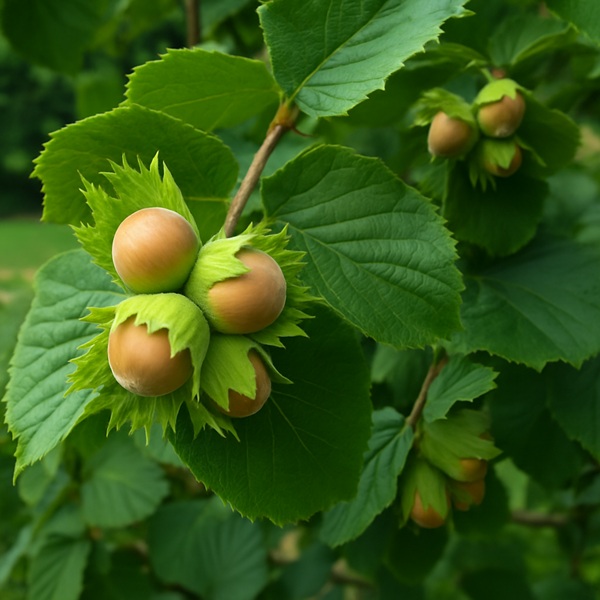
Hazelnut (Corylus avellana) is a valuable nut-bearing shrub that has adapted extremely well to the various climatic zones of Ukraine. High productivity, low growing requirements, and strong economic value make it attractive both to home gardeners and to commercial farms. In addition, hazelnuts are highly prized for their flavor, nutritional value, and health benefits.
The shrub reaches a height of 3–6 meters, forming a dense, branched crown. The leaves are large, rounded or heart-shaped, with fine serrations along the edges. Flowering begins in early spring, before the leaves unfold: the male catkins bloom earlier than the female flowers. Pollination occurs by wind, and the nut set forms in late spring. Full fruit ripening takes place in August–September, depending on the variety and the region.
Hazelnut is valued not only for its tasty nuts. Its ornamental qualities make it an excellent element of landscape design: dense thickets create beautiful hedges and shelter belts for gardens. Hazelnuts are used in the food industry, in confectionery production, and for oil extraction, while the wood of the shrub is used for furniture and decorative items. All of this makes the crop highly promising for cultivation in Ukraine.
Thanks to the wide range of varieties — from early to late — plants can be selected for almost any climatic conditions, from the southern and central regions to Zakarpattia and part of Polissia. With proper cultivation practices, hazelnut bears fruit reliably for 50–60 years and requires very little complicated care.
Successful hazelnut cultivation begins with choosing the right site and preparing for planting properly. These factors directly affect how well the plants establish, how they develop, and how productive they will become.
Light. Hazelnut prefers sunny or slightly shaded areas. With insufficient light, productivity declines and the nuts become smaller.
Wind protection. Young plantings are especially sensitive to strong cold winds, which may damage the flower buds. It is recommended to plant hazelnuts near the southern walls of buildings, along fences, or to establish hedges.
Relief. Sites with a slight slope facing south or southwest are ideal. Low-lying places where cold air stagnates should be avoided.
Light or medium loams, well drained.
High organic matter content.
Slightly acidic or neutral soil reaction (pH 6.0–6.5).
Groundwater no closer than 1.5 m to the surface.
Prepare the planting holes 2–3 weeks before planting. Their size should be 60×60×60 cm.
Place a drainage layer of crushed stone or broken brick, 10–15 cm thick, at the bottom.
Fill with a fertile mixture: garden soil, humus, sand, and ash (2:1:1 plus 1 glass of ash).
Set the seedling so that the root collar is level with the soil surface.
After planting, water the plant generously (15–20 liters of water) and mulch with straw or humus.
The best time for planting hazelnut in Ukraine is autumn (September–October) or early spring (March–April), before active sap flow begins. Autumn planting usually gives better results because the plants have time to root before winter.
Hazelnut is considered a relatively low-maintenance plant, but regular care is necessary to achieve high yields. Careful attention to the plant’s needs at different stages of growth is the key to the shrub’s longevity and productivity.
Watering. Young plants need regular watering, especially during hot periods. In the first year after planting, they are watered 1–2 times a week, using 10–15 liters of water per bush. Mature plants need only 3–4 waterings per season: at the beginning of growth, during nut formation, and in autumn before winter.
Feeding. Systematic fertilization ensures abundant flowering and fruit set:
In spring, nitrogen fertilizers (nitrate, urea) are used to stimulate shoot growth.
In summer, potassium-phosphorus mixtures are applied for fruit development.
In autumn, organic fertilizers (humus, compost) are used to restore the plant.
Fertilizers are applied to the root zone, the soil is loosened, and the area is watered generously afterward.
Bush formation. In Ukraine, hazelnut is usually trained as a multi-stemmed bush:
In the second year after planting, 5–7 strong shoots are left, and the rest are removed at the base.
Every spring, sanitary pruning is carried out, removing broken, frost-damaged, and diseased branches.
After 8–10 years, the bush is rejuvenated by removing old shoots and stimulating the growth of young ones.
Mulching the soil to retain moisture and suppress weeds.
Weed control through loosening or hand removal.
Protecting the trunks from rodents in winter by wrapping them.
With proper care, hazelnut begins bearing fruit in the 3rd–4th year after planting and reaches peak productivity in the 7th–8th year.
Hazelnut propagation is an important stage in expanding the orchard and preserving varietal traits. In Ukraine, vegetative methods are used most often: layering, root suckers, grafting, and cuttings. The seed method is used rarely, mainly for breeding new hybrids, because varietal characteristics may be lost.
Propagation by horizontal layering.
One of the most reliable and simplest methods. In spring or early summer, lower shoots are bent to the ground, shallow cuts are made, they are laid into furrows 10–15 cm deep and fixed in place. They are covered with soil, leaving the tip of the shoot above the surface. In autumn or the following spring, the rooted layers are separated from the mother bush and transplanted.
Propagation by root suckers.
Hazelnut actively produces suckers around the main bush. In the second or third year after planting, strong suckers with their own roots can be dug up and transplanted to a new place. This is the fastest and most convenient method of propagation for Ukrainian gardeners.
Grafting and cuttings.
Grafting is carried out onto wild hazel or special rootstocks by budding or copulation methods. Cuttings are taken as green cuttings in summer, using rooting stimulants and rooting them under film or in a greenhouse.
For amateur gardens in Ukraine, layering and suckers are the best methods because of their simplicity and high establishment rate.
Although hazelnut is considered a fairly resilient crop, under Ukrainian conditions it may be affected by a number of diseases and pests. To ensure stable harvests, preventive treatments should be carried out in time and the plants should be cared for properly.
Powdery mildew. A white coating on leaves and shoots. Prevention: thinning the bushes to improve ventilation and treatment with fungicides such as Topaz and Horus.
Bacterial blight. It appears as drying shoots and blackening bark. Affected branches are cut out and burned, and the cuts are treated with copper-based preparations.
Phyllosticta leaf spot. Often occurs in wet summers. Systemic fungicides are used for control.
Hazelnut weevil. The larvae eat the nut kernels. Prevention: insecticide treatment in early summer.
Aphids. They colonize young shoots and suck out sap. Soap solutions and systemic insecticides are used against them.
Scale insects. They weaken the bushes by sucking out plant sap. Oil-based preparations help control them.
Timely thinning of the bushes.
Removal of plant debris in autumn.
Spring preventive treatments with fungicides and insecticides.
Consistent prevention helps keep the plants healthy and ensures stable fruiting.
Hazelnut occupies an important place in Ukrainian horticulture and agriculture. It is successfully grown both for personal consumption and for commercial purposes, since demand for nuts remains steadily high both on the domestic market and abroad.
Private gardening. Hazelnut is often planted in summer cottages and household plots as a source of tasty nuts. It is also used as an ornamental hedge.
Commercial cultivation. The area of hazelnut plantations in Ukraine is increasing every year, especially in the southern, central, and western regions. The harvest remains in steady demand on both domestic and foreign markets.
Landscape design. Hazelnut bushes with their decorative crown and spring catkins decorate parks, squares, and private gardens.
High profitability: nuts have a strong market value.
A long fruiting period: up to 40–50 years.
Low demands in terms of soil and care.
The possibility of growing it even on less fertile land.
A particularly promising direction is the cultivation of large-fruited hazelnut varieties, as well as the use of modern irrigation and plant protection technologies. Hazelnut has an excellent future in Ukraine both for amateur gardeners and for farmers.