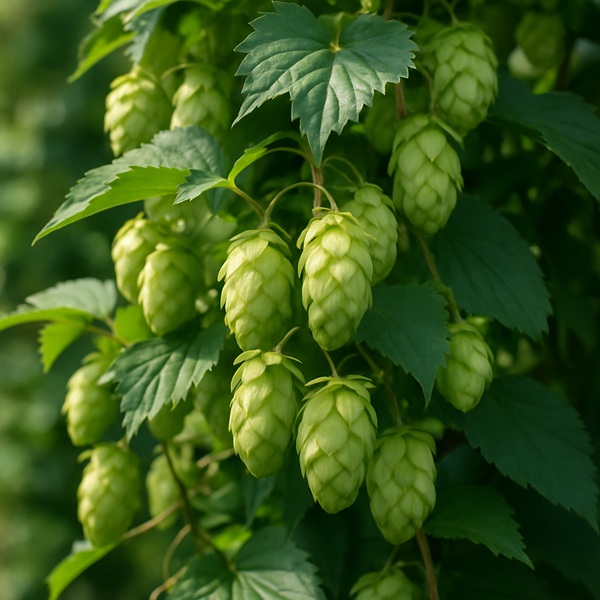
Hops (Humulus lupulus) is a perennial climbing plant known for its unique properties and wide range of uses. In Ukraine, hops are grown both on an industrial scale for the brewing industry and in private gardens for ornamental purposes or for use in folk medicine. The plant is highly valued for the aromatic qualities of its cones, which are rich in essential oils, resins, and bitter compounds.
By nature, hops are a vigorous vine capable of growing 6–8 meters in height in a single season. It actively clings to supports with the help of hooked hairs, making it possible to create green walls, gazebos, and shaded walkways. The main value lies in the female plants, which produce cones rich in useful substances. Male plants are used mostly for pollination, but in gardens they are often removed to increase cone yield.
Hops adapt well to different climatic conditions. In Ukraine, they are successfully grown in many regions, from the western oblasts to the Left Bank. The best results are obtained in the northern and western areas, where humidity and moderate temperatures promote active growth. For successful cultivation, it is necessary to choose the site correctly, arrange a support system, and care for the plant regularly, since its vigorous growth is accompanied by high demands for moisture and nutrients.
To obtain a strong healthy plant and a high yield of cones, it is necessary to choose the planting location properly and create optimal conditions for hop growth.
Site requirements:
Light. Hops prefer well-lit areas. Light shade at midday is acceptable, but prolonged shade causes the shoots to stretch and reduces productivity.
Wind protection. The vines are sensitive to strong winds, especially in the early stages of growth. It is advisable to plant hops in sheltered places or install windbreaks.
Soil. Light and medium loams rich in organic matter with good drainage are best. Water stagnation is harmful to the root system.
Site preparation:
In autumn before planting, the soil is deeply dug with the addition of organic fertilizers (humus, compost).
In spring, the soil is loosened, weeds are removed, and planting rows are formed.
Planting hops:
Planting holes measuring 40×40×40 cm are prepared at a distance of 1.5–2 meters from one another.
A drainage layer (crushed stone or coarse sand) is placed at the bottom.
A nutrient mix is added: garden soil, humus, and wood ash.
The rhizome is placed in the hole so that the buds are level with the soil surface.
After planting, the plant is watered generously (10–15 liters of water per planting hole).
Hops can be planted both in spring (April–May) and autumn (September), but spring planting is preferable in the northern and central regions because of the risk of winter frost.
Hops develop actively throughout the growing season, so their care requires regular attention. It is especially important to control watering, apply fertilizers, and shape the shoots in time.
Watering. Hops are very moisture-loving, especially during active growth (May–June) and cone formation (July). In dry periods, the plant is watered every 5–7 days, using up to 20–30 liters of water per bush. It is important to maintain even soil moisture while avoiding stagnant water.
Feeding. The high demand for nutrients requires regular fertilization:
In spring, nitrogen fertilizers (ammonium nitrate, urea) are applied to stimulate shoot growth.
During cone formation, phosphorus-potassium fertilizers are used to improve crop quality.
Organic fertilizers (diluted manure, compost infusions) are applied 2–3 times per season to maintain soil fertility.
Shoot formation. At the beginning of summer, the vines need regular shaping:
On each plant, 3–5 of the strongest shoots are left, while the rest are removed at the base.
The shoots are trained along trellises or supports, distributing them evenly.
During the period of intensive growth, pinching is carried out to stimulate the formation of lateral shoots.
In addition, it is important to remove old and dried shoots in time and to control weeds, which may suppress hop development.
Hops are distinguished by a high capacity for vegetative propagation, which makes it easy to spread them on a site or establish new plantations. Under Ukrainian conditions, the most effective methods are propagation by root suckers, cuttings, and division of the bush.
Propagation by root suckers.
This is the most common method. In spring or autumn, strong young shoots emerging from the main root are selected, carefully separated together with part of the root system, and transplanted to a new place. With regular watering and light shading during the first weeks after transplanting, the suckers root quickly.
Propagation by green cuttings.
This is done in early summer, when the shoots reach 40–60 cm in length:
Cuttings 10–15 cm long with 2–3 internodes are cut.
They are treated with rooting stimulators, for example heteroauxin.
They are rooted in a light moist substrate (sand, peat) under film or in a greenhouse.
After 2–3 weeks, the rooted plants are transplanted into open ground.
Division of the bush.
This method is used for mature perennial plants. In spring, the bush is carefully dug up and divided into several parts so that each has a developed root system and shoots. The divisions are planted in prepared places and cared for as young plants.
These methods make it possible to increase the amount of planting material quickly and establish new hop plantations without major expense.
Despite its general resilience, hops may be affected by a number of diseases and pests. For successful cultivation, it is important to inspect the plants regularly and carry out preventive measures in time.
The main hop diseases are:
Powdery mildew. A white powdery coating appears on the leaves. Control: treatment with fungicides such as Topaz or Quadris, along with thinning the planting.
Downy mildew (peronospora). It develops in conditions of increased humidity. Prevention includes treatment with copper-based preparations.
Fusarium wilt. A fungal disease affecting the root system. The main control measure is removing diseased plants and following crop rotation.
The main hop pests are:
Aphids. They damage young shoots and weaken the plants. Effective control: insecticides such as Aktara or Fitoverm.
Spider mites. They attack the leaves in hot, dry weather. Treatment: acaricides and increased humidity.
Hop flea beetles. The larvae damage the leaves and inhibit plant growth. Insecticidal treatments and weed removal are used.
Preventive measures:
timely sanitary pruning of shoots;
removal of plant residues in autumn;
spring preventive treatments with fungicides and insecticides.
Regular prevention greatly reduces the risk of serious damage and supports stable plantation development.
Hops are not only an industrial crop for brewing, but also a valuable ornamental plant. In Ukraine, they are actively grown both for industrial and for private use.
The main areas of use are:
Brewing. The principal use of hops is the addition of cones in the brewing process to give beer its characteristic aroma, bitterness, and stability.
Folk medicine. Hop cones are used to prepare tinctures, teas, and ointments with calming, antiseptic, and pain-relieving properties.
Ornamental greening. Thanks to their vigorous climbing form, hops are excellent for greening gazebos, fences, pergolas, and creating living green walls.
Landscape design. They are used to create shaded alleys, hedges, and vertical greenery in private gardens.
Advantages of growing hops in Ukraine:
high adaptability to different climatic conditions;
a wide range of uses for the harvest;
moderate care costs when properly grown;
good prospects for the development of small-scale farming.
Thanks to the combination of ornamental beauty and practical usefulness, hops remain a popular crop among gardeners and farmers in Ukraine.