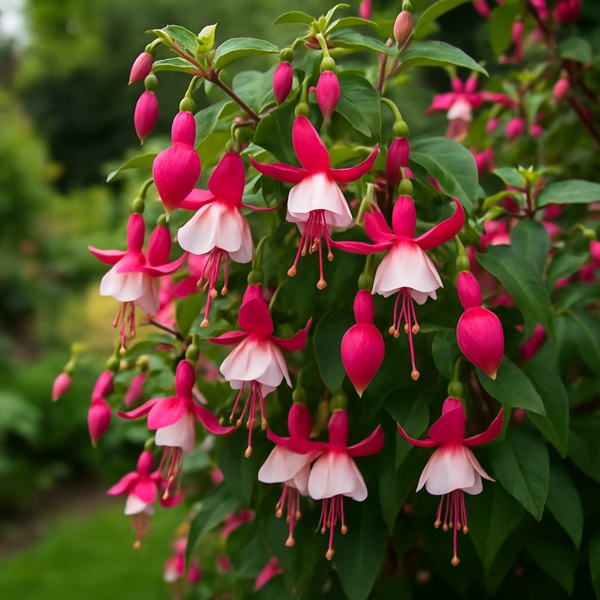
Fuchsia (Fuchsia) is an exceptionally beautiful plant with graceful hanging flowers that is becoming more and more popular among Ukrainian flower growers every year. Thanks to the diversity of forms and colors, fuchsias decorate balconies, terraces, winter gardens, as well as outdoor flower beds in the southern and central regions of the country. Native to South America and New Zealand, modern fuchsia varieties are nevertheless well adapted to Ukraine’s temperate climate with proper care.
The plant is a bush or subshrub with flexible shoots covered in elongated green leaves. Fuchsia flowers have a unique shape: the sepals and petals are usually different colors, creating the effect of two-tiered blooming. Their colors range from delicate pastel shades to rich purple, red, lilac, and white tones. Some varieties also have a subtle fragrance.
Fuchsia can bloom almost continuously from May until late autumn, especially when grown in containers. In Ukraine’s open-ground conditions, it is mostly used as a seasonal plant, since it cannot survive winter frosts without protection. Thanks to the variety of forms — trailing, bush, and standard — fuchsias are widely used in garden design, from greening loggias and verandas to creating vivid floral cascades in home gardens.
The right choice of variety and proper growing techniques make it possible to grow fuchsia not only in heated spaces, but also in open ground, achieving abundant and long-lasting flowering. At the same time, it is important to take into account the specific climate of the region, as well as the plant’s needs for light, moisture, and nutrients.
Planting fuchsia is an important stage that largely determines how successful cultivation will be. The plant is quite demanding in terms of lighting conditions and soil quality, so preparation should begin well in advance.
Lighting. Fuchsia prefers diffused light or light partial shade. Direct sunlight, especially during midday heat, causes leaf scorch and slows growth. The best option is the east or northeast side of the plot.
Protection from wind. The delicate shoots of fuchsia are sensitive to strong wind, so the site should be protected from drafts.
Temperature regime. The ideal temperature for growth is +18...+24°C during the day and +12...+16°C at night.
Light, loose, breathable substrate.
High organic matter content such as humus or compost.
Slightly acidic soil reaction (pH 5.5–6.5).
Good drainage to prevent water stagnation.
Before planting, the soil is thoroughly dug over, weeds are removed, and a balanced mineral fertilizer high in phosphorus and potassium is applied. If the soil is heavy, sand or vermiculite is added to improve its structure.
Dig planting holes 20–25 cm deep and about 30 cm in diameter.
Place a drainage layer at the bottom, using pebbles or expanded clay.
Set the plant into the hole, carefully spreading the roots.
Fill with soil, lightly firm it, and water generously.
Mulch the root zone with peat or humus.
Container planting makes it easier to control the growing conditions and to move the plants when the weather worsens, which is especially important for regions with cool summers or frequent rain.
Fuchsia needs regular and proper care to stay healthy and achieve its maximum decorative effect. Care includes controlling watering, timely fertilization, crown shaping, and protection from unfavorable conditions.
Watering. Fuchsia likes regular moisture, especially during the hot months. It is watered 2–3 times a week depending on the weather. It is important to avoid both drying out and overwatering the soil. Watering through the tray works especially well for container-grown plants.
Feeding. For active growth and abundant flowering, fuchsia needs regular fertilization:
In spring, nitrogen fertilizers are applied to stimulate leaf growth.
At the beginning of bud formation, complex mineral fertilizers with phosphorus and potassium are used.
In August, the amount of nitrogen is reduced to prepare the plant for dormancy.
Feeding is carried out every 10–14 days, alternating organic and mineral products.
Pruning. Crown shaping is very important:
In spring, sanitary pruning is done, removing weak and damaged shoots.
In summer, the tips of young shoots are pinched to stimulate branching.
In autumn, before wintering, formative pruning is carried out.
Regular pruning not only improves the appearance of the bush, but also promotes more abundant flowering.
Propagating fuchsia is an enjoyable process that is accessible even to beginners. In Ukraine, three methods are used most often: cuttings, division of the bush, and seed propagation. The choice depends on the growing goal, the season, and the variety.
Cuttings are the most common and effective method. The best time for taking cuttings is spring or early summer:
Healthy shoots 8–10 cm long are cut.
The lower leaves are removed, leaving 2–3 leaves at the top.
The cuttings are rooted in a loose, moist substrate of peat and sand under film or in a mini-greenhouse.
At +20...+24°C, roots form in 2–3 weeks.
The rooted cuttings are transplanted into separate pots for further growing. With proper care, young plants may bloom already in the first year.
Division of the bush is used for mature plants. In spring or autumn, the bush is carefully dug up and divided with sharp secateurs into sections so that each has roots and several shoots. The divisions are planted into the prepared site and watered generously.
Seed propagation is used less often, mainly for breeding new varieties. Seeds are sown in a light substrate in February–March, keeping the temperature at +22...+24°C. Seedlings appear in 2–3 weeks. With this method, the new plants may differ from the parent form.
Whichever method is used, it is important to maintain optimal soil moisture and protect young plants from direct sunlight.
Like most ornamental plants, fuchsia is susceptible to diseases and pests. Under Ukrainian conditions, the main threats are fungal diseases and sap-sucking insects.
Gray mold (Botrytis). Appears under excessive humidity. The leaves develop a gray coating and begin to rot. Treatment includes removing the affected parts and applying fungicides such as HOM or Fundazol.
Root rot. Caused by water stagnation in the soil. The solution is to transplant the plant into fresh soil with good drainage and use fungicidal treatments.
Rust. Appears as orange spots on the leaves. Copper-based products are used against it.
Aphids. They gather on young shoots and leaves. A soap solution or insecticides such as Aktara and Fitoverm are used.
Spider mites. Fine webbing on the underside of the leaves is a sign of infestation. Treatment involves acaricides and increased air humidity.
Whitefly. A tiny white insect that sucks plant sap. Control requires insecticides and improvement of the microclimate.
Regular control of soil and air humidity.
Inspection of plants to detect the first signs of problems.
Sanitary pruning of damaged parts.
Disinfection of tools before work.
Timely prevention helps avoid serious issues and keeps fuchsia healthy throughout the season.
Fuchsia is a versatile plant widely used in decorating gardens, terraces, balconies, and winter gardens. Thanks to the diversity of forms and colors, it becomes a vivid accent in any composition.
Container arrangements. Fuchsias in planters or hanging baskets beautifully decorate entrance areas, gazebos, and balconies. Trailing varieties with long shoots are especially effective.
Flower borders. Bush forms of fuchsia are used to create living borders along paths and around seating areas.
Central accents in flower beds. Bright fuchsia bushes look excellent in the center of seasonal flower beds, especially when combined with begonias, petunias, and lobelias.
Standard forms. Standard-trained fuchsias look refined and elegant and are ideal for decorating formal areas.
Fuchsias pair beautifully with shade-loving plants such as hostas, ferns, and astilbes.
When planted together with ivy, bacopa, or diascia in hanging arrangements, they create picturesque cascading displays.
Ukraine’s climate allows fuchsia to be grown from late April until early October, and with proper wintering, the plants can be preserved for the following season. Skillful use of fuchsia in garden design gives a site elegance, vivid color, and a sense of movement.