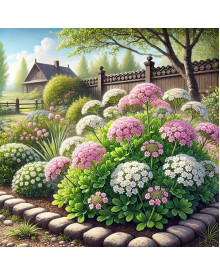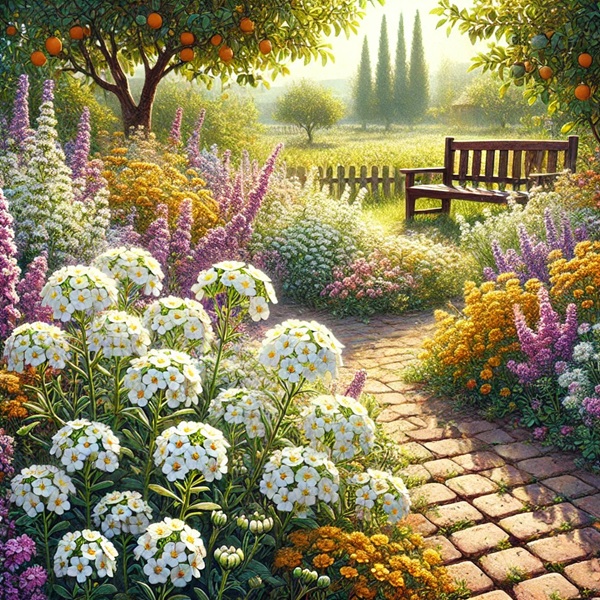
Alyssum (Alyssum), also known as sweet alyssum or lobularia, is one of the most popular groundcover plants, valued for its abundant and long-lasting flowering, resistance to drought and cold, and its pleasant honey-like fragrance. It belongs to the cabbage family (Brassicaceae) and includes about 100 species, most of which are successfully grown in Ukraine as annual or perennial crops.
In appearance, alyssum is a low-growing plant with strongly branched stems that form a dense carpet or semi-rounded cushion-shaped bushes. Most varieties reach a height of 10 to 30 cm. The leaves are small, narrow, light green or grayish, and covered with a slight fuzz. The flowers are tiny, but gathered into large clusters that cover the plant in a solid mass of color. The color palette ranges from white, cream, and yellow to pink, lilac, and purple.
Alyssum blooms for a very long time. When sown early, it begins flowering as early as May and can continue until late autumn, especially with regular pruning and feeding. Some varieties are capable of producing several waves of bloom in one season. Its fragrance is sweet, rich, and honey-like, which attracts bees, butterflies, and other pollinators.
In ornamental gardening, alyssum is used to create borders, flower strips, alpine slides, slope plantings, rock gardens, and container arrangements. Thanks to its compact shape and ability to quickly cover the ground, it is ideal for filling empty spaces in flower beds, especially between taller plants. It is often combined with petunias, violas, lobelias, salvias, and ornamental grasses.
Alyssum is especially valuable for Ukrainian gardeners because of its adaptability to the climate. It tolerates spring and autumn temperature fluctuations very well, is not afraid of drought, grows successfully on poor soils and in full sun, and is one of the few plants that can bloom even with minimal care.
To grow alyssum successfully, it is important to choose the right location and prepare the soil properly. In Ukraine, it grows best in sunny, well-ventilated sites with light, loose, well-drained soil. Alyssum is a light-loving plant: in shade it stretches, blooms less abundantly, and loses its ornamental appeal. In places with stagnant moisture, root rot may develop, especially during long rainy periods.
The optimal soil reaction is neutral or slightly alkaline (pH 6.0–7.5). On acidic or waterlogged soils, alyssum develops poorly. Sandy or light loamy soils are best. If the soil is clay-heavy, it is advisable to add sand, humus, and lime to improve the structure. On rocky slopes and in alpine gardens, alyssum often performs especially well, since this environment is close to its natural habitat.
Alyssum can be sown either by the seedling method or directly into open ground. In the southern and central regions of Ukraine, such as Odesa, Mykolaiv, and Dnipropetrovsk regions, direct sowing into open ground from early April is common, once the soil warms to +10 to +12 °C. In northern regions, such as Kyiv, Chernihiv, and Lviv regions, it is better to use seedlings: the seeds are sown in March and transplanted into open ground in late April or early May.
Alyssum seeds are very small and do not need to be covered deeply — they are sown on the surface and lightly pressed into the soil. Seedlings appear in 5 to 7 days. With the seedling method, pricking out is done at the stage of 2 true leaves. Plants are set in their permanent place with a spacing of 15 to 25 cm, depending on the variety.
The most popular alyssum varieties in Ukraine include:
‘Carpet of Snow’ — white, classic, forms a dense cushion;
‘Royal Carpet’ — purple-violet flowers, low-growing;
‘Snow Princess’ — a sterile hybrid with long-lasting flowering and strong fragrance;
‘Easter Bonnet’ — delicate pastel colors, ideal for spring flower beds;
‘Wonderland’ — a series with various shades, suitable for pots and containers.
The choice of variety depends on its purpose: low-growing varieties are best for groundcover planting, spreading ones for alpine gardens, and compact long-flowering hybrids for hanging pots.
Alyssum is a plant that does not require complicated care, but with proper attention it can provide abundant and long-lasting flowering. The main care measures include regular but moderate watering, pruning faded parts, feeding, and controlling planting density.
Watering. Alyssum tolerates drought well, but in hot weather it needs regular moisture. The plant requires the most water during active growth and flowering. It is watered 1 to 2 times per week, depending on the weather and the condition of the soil. Waterlogging should be avoided, as it leads to rot of the root collar. It is best to water at the base without wetting the leaves.
Mulching helps retain moisture, especially in southern regions. Dry grass, wood chips, or compost are used as mulch. This also reduces weeds and makes maintenance easier.
Pruning is an important part of cultivation. After the first wave of bloom, the plants are cut back — the flower clusters are removed and the shoots are shortened by one-third. This stimulates the formation of new branches and repeat flowering, which continues into autumn. Modern varieties, when properly pruned, can bloom in waves almost continuously.
Feeding. Alyssum responds well to fertilizers. In spring, it is fed with nitrogen fertilizers such as ammonium nitrate or urea to stimulate green growth. During budding and flowering, complex mineral fertilizers with a higher content of phosphorus and potassium are applied. Feeding is done 1 to 2 times per month. Organic options include diluted mullein infusion, biohumus, and ash.
Weeding and loosening are needed in dense plantings. Alyssum grows poorly among weeds, so it is important to keep the area clean. Loosening improves air exchange and soil permeability.
Alyssum is a fairly resistant crop, but in dense plantings, with excessive watering, or in shade, it may be affected by diseases or pests.
Common diseases:
Powdery mildew — a white coating on the leaves. Prevention includes ventilation and treatment with fungicides such as Topaz or Skor.
Gray rot — rotting of shoots and flowers under excessive moisture.
Blackleg (in seedlings) — a fungal disease that develops under high humidity.
Fusarium and downy mildew — cause spotting, root rot, and wilting.
For prevention, it is important to maintain spacing between plants, prune them, provide ventilation, and avoid excess moisture. At the first signs of disease, the plants are treated with fungicides.
Pests:
Crucifer flea beetles — most often damage young plants. Protection includes ash, garlic infusion, or insecticides such as Fitoverm and Actellic.
Caterpillars, aphids, and cabbage moths — damage leaves and buds. Treatment includes biological preparations such as Lepidocide, soap solutions, and manual removal.
Slugs — especially active in wet weather. Protection includes ash, traps, and covering with sawdust.
Regular inspection of plantings and preventive measures help prevent most problems. Excessive nitrogen feeding should also be avoided, since it makes the plant more vulnerable.
Alyssum is grown as either an annual or a perennial crop, depending on the species and the climate. In the southern regions of Ukraine, such as Odesa and Kherson regions, and in Crimea, perennial species such as rock alyssum can successfully overwinter in open ground. In central and northern regions, annual varieties are more often grown, or the plants are resown each year.
Methods of propagation:
By seed — the most common method. Seeds are sown in spring or before winter. Autumn sowing gives early seedlings but requires light cover.
By division of the bush — for perennial varieties. This is done in spring or in September.
By cuttings — young shoots are rooted in a moist substrate during summer.
Wintering. In southern regions, perennial varieties overwinter without cover. In central regions, it is advisable to mulch the roots with peat or straw. The above-ground part is cut back, and agrofiber may be used if necessary.
Self-seeding. Alyssum often reproduces on its own — many seedlings appear in spring. If the variety is not hybrid, this is a convenient way for natural renewal.
Alyssum is an exceptionally versatile plant for landscaping. It is used in both classic and modern compositions, in flower beds, borders, alpine slides, and pots.
It is most often planted:
along garden paths;
in rockeries and on slopes;
in hanging pots and containers;
in mixed borders;
on alpine slides.
It combines beautifully with petunias, lobelias, ageratums, cinerarias, violas, and grasses. White varieties create contrast with purple or blue plants; yellow ones pair beautifully with cornflowers, while purple ones look striking with silvery cineraria.
Thanks to its hardiness, alyssum is also widely used in urban landscaping — in flower beds, roundabouts, and along sidewalks.
Alyssum is a plant that harmoniously combines ornamental beauty, hardiness, and ease of cultivation. It is perfectly suited to any garden in Ukraine, from beginner gardeners to experienced flower growers.