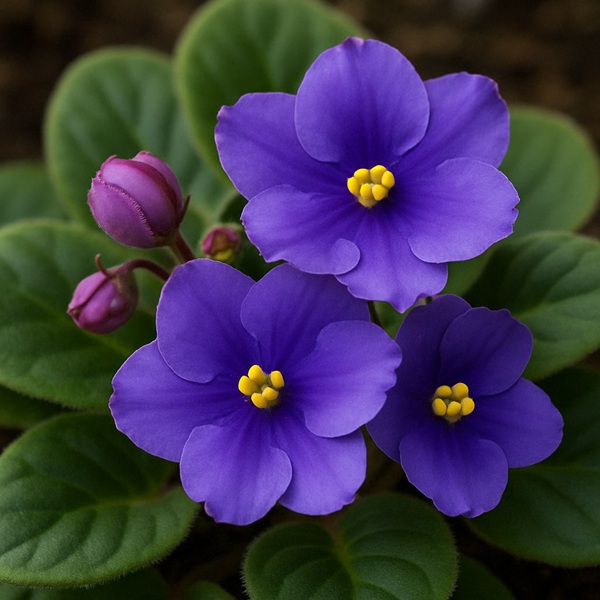
Violets are among the most beloved ornamental plants, known to humankind since ancient times. In botany, the name violet refers to the large genus Viola, which includes more than 500 species of both wild and cultivated plants. In Ukraine, the species most commonly found in the wild are heartsease (Viola tricolor), sweet violet (Viola odorata), and marsh violet. At the same time, the greatest interest for gardeners and collectors lies in ornamental varieties and hybrids, among which garden violet (pansy — Viola × wittrockiana) and the indoor violet, which belongs to another genus (Saintpaulia) but is traditionally also called a violet, are especially well known.
Almost all types of violets are suitable for Ukrainian conditions, except for heat-loving varieties that require greenhouse maintenance in winter. Pansies thrive in open ground — these are biennial plants with abundant spring flowering. They are grown in flower beds, borders, and rock gardens. Sweet violet overwinters well in a temperate climate and delights with its fragrance as early as April. Indoor varieties — saintpaulias — are grown on windowsills, require a stable microclimate, but with proper care are capable of flowering all year round.
Violets attract attention with their delicate beauty, compactness, and variety of forms and shades. The flowers may be solid-colored, edged, spotted, double, or ruffled. Their color palette includes every shade — from white and yellow to deep violet and blue, often with gradients and contrasting blotches. The flowering period ranges from several weeks to several months, depending on the species, the age of the plant, and the growing conditions. Thanks to these qualities, violets have become a staple of landscape design in both urban flower beds and private gardens, balconies, winter gardens, and collections of indoor plants.
Growing violets outdoors is not difficult if the basic rules are followed. It is best to plant them in lightly shaded places — this is especially important in the southern regions of Ukraine, where scorching sun may cause leaf burn. In the central and northern regions, growing them in full sun is acceptable, provided the soil is adequately moist. Violets need sites protected from wind, with light air circulation. They are very sensitive to stagnant water — this is one of the main causes of root rot and fungal diseases.
The optimal soil is loose, fertile, and neutral to slightly acidic, with a pH of 6.0–6.5. If the soil is heavy, its structure is improved by adding sand, humus, and peat. Two to three weeks before planting, complex mineral fertilizers with a predominance of phosphorus and potassium are applied. Organic matter is used moderately: an excess of nitrogen causes vigorous leafy growth at the expense of flowering. The soil is dug to a depth of 15–20 cm, carefully cleared of weeds, and loosened to break up large clods.
Violets are planted either in spring, from April to May, or in autumn, in September, depending on the species. Pansies and other biennials are propagated by seedlings. First, the seeds are sown in frames or containers in July, and in autumn, in September, they are transplanted to a permanent place. By winter the plants have time to establish roots, and by spring they are already flowering. The distance between bushes should be 15–25 cm. After planting, the soil is watered, lightly firmed, and mulched to preserve moisture. In dry weather, young plants are shaded with agrofibre or a fine mesh.
Violets are not overly demanding, but with proper care they bloom more abundantly and for longer. Watering should be regular, especially during budding and flowering. At the same time, it is important not to allow water to stagnate, as this leads to rot of the root collar. It is best to water violets in the morning or evening, at the root, avoiding moisture on the leaves and flowers. In hot weather, the soil is mulched with peat, straw, or dry grass to preserve moisture and lower the temperature around the roots.
Feeding is carried out every 10–14 days during the period of active growth. Water-soluble mineral fertilizers with a low nitrogen content are used. For example, superphosphate or potassium nitrate stimulate abundant flowering. Fresh manure or concentrated organic fertilizers should not be used, as they cause burns. In poor soils, it is advisable to use biohumus, compost infusions, or wood ash infusion in moderate amounts. After rain, the soil must be loosened to prevent crust formation.
Violets are sometimes attacked by pests: aphids, thrips, spider mites, and slugs are their main enemies. For prevention, the plants are sprayed with infusions of garlic, onion, wormwood, or tobacco. In cases of severe infestation, insecticides are used according to the instructions. Beer traps or special pellets are effective against slugs. It is essential to inspect the plants regularly, remove damaged leaves, and cut off faded buds — this encourages new flowering and reduces the risk of disease.
Indoor violets, or saintpaulias, require a special microclimate, but at the same time are considered among the most popular and rewarding flowering houseplants. They do not tolerate sharp temperature fluctuations, drafts, or direct sunlight. The optimal growing temperature is +20 to +24°C during the day and not below +16°C at night. Cold windowsills in winter are especially dangerous for saintpaulias, so it is worth using thermally insulating stands. Air humidity should be moderate: if it is too high, the risk of fungal diseases increases; if it is too low, the flowers become smaller and growth slows down.
Lighting is critically important for flowering. Saintpaulias need 12–14 hours of diffused light every day. East-facing or north-east-facing windows are best. If the plant stands on a south-facing windowsill, shading is essential, for example with tulle or blinds. With insufficient light, the flower stalks become elongated, the leaves grow pale, and flowering becomes sparse. In such cases, grow lights are used. With proper lighting, dense compact rosettes form, and the plant blooms within just a few months after rooting. In summer, violets can be taken out onto a balcony or terrace, but only to a shaded place.
For planting, special soil mixes for saintpaulias are used, or one can be prepared independently from humus, leaf soil, vermiculite, and a little sand. The substrate should be loose and permeable to both water and air. Pots should be small, since violets have a shallow root system. In a large container, the plant develops roots rather than flowers. Drainage such as expanded clay or pebbles must always be placed at the bottom. After planting, the plant is not watered for 1–2 days to avoid overwatering. After that, watering is done moderately, only after the top layer of soil has dried out.
Watering saintpaulias is one of the most important aspects of their care. The water used should be at room temperature and allowed to settle. The safest method is bottom watering: water is poured into the tray, and any excess is drained off after 30–40 minutes. In summer they are watered every 2–3 days, and in winter once every 5–7 days. Overwatering is dangerous, as it causes root and stem rot. Letting the soil dry out is also harmful: the plant loses turgor and growth stops. Spraying violets is strictly not recommended — droplets on the leaves leave spots and encourage disease.
Feeding is applied once or twice a month during the period of active growth. Liquid fertilizers for saintpaulias are used, with an optimal ratio of macro- and micronutrients. During budding, it is recommended to increase the potassium and phosphorus content. Fertilizer is applied only after watering in order to avoid burning the roots. If the plant does not bloom, the reason may be an excess of nitrogen or a lack of light. It is also useful once every few weeks to add a weak ash solution or nettle infusion in a highly diluted form to the watering water, which strengthens the plant.
Repotting is done every year in spring. The old soil is carefully shaken off, and dried or damaged roots are removed. If the rosette has become elongated, it is rejuvenated by cutting the stem and rooting the upper part. Side shoots that have formed at the base can be separated and planted individually. After repotting, the plant is shaded for a few days and not watered — this helps it adapt. Proper repotting renews the rosette, improves its decorative appearance, and stimulates abundant flowering.
Propagating saintpaulias is simple and accessible even for beginners. The most common method is by leaf cuttings. A healthy leaf from the lower row is selected, cut with a sharp knife, and rooted in water or in a light substrate such as peat, perlite, or vermiculite. Within 2–4 weeks, roots appear, and later young plants, or “babies,” develop. They are planted into small cups and provided with a warm, humid environment. To speed up the rooting process, mini-greenhouses or plastic containers with lids are convenient to use.
Rejuvenation is necessary every 2–3 years. Over time, the stem becomes elongated, leaves fall off, and the rosette loses its shape. Such a plant should be cut above the bare stem and rooted again. Rejuvenated violets recover their attractive appearance and bloom sooner. It is also important to remove old yellowed leaves, spent flower stalks, and to control the development of side shoots in order to preserve a symmetrical shape.
Violets may suffer from root rot, fusarium, gray mold, and powdery mildew. The causes are excessive moisture, sudden temperature changes, poor drainage, or contaminated substrate. For prevention, clean containers, high-quality soil, and sterile tools are used. When symptoms appear, such as wilting, spots, or coating, treatment with fungicides is carried out. It is important to isolate the diseased plant so the others are not infected. With proper care, violets will bloom continuously, delighting their owners with beauty and elegance.