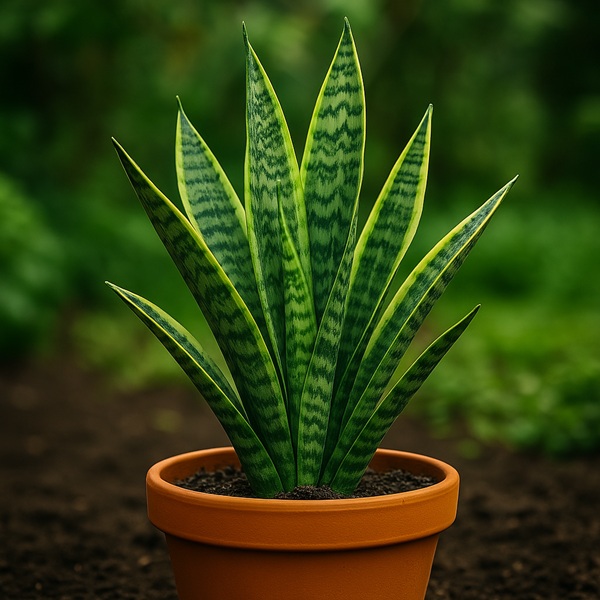
Sansevieria is one of the most undemanding and long-lasting houseplants, and in recent years it has become extremely popular in Ukraine. It is often called “snake plant,” “mother-in-law’s tongue,” or “African bowstring hemp” because of the distinctive shape of its long, fleshy leaves. Sansevieria is native to Africa and South Asia, where it grows in dry conditions, so it is perfectly adapted to temperature fluctuations, limited watering, and different levels of light. These qualities make it an ideal choice for both experienced plant growers and beginners.
In Ukraine, sansevieria is traditionally grown as an indoor plant, although in the southern regions, such as Odesa and Kherson, it can be moved outdoors in summer onto balconies, terraces, or patios. Thanks to its high ornamental value, drought resistance, and ability to purify the air, sansevieria is increasingly found not only in homes, but also in offices, schools, and hospitals. Its attractive appearance is combined with beneficial qualities: it has been scientifically proven that sansevieria effectively removes toxins from the air, including formaldehyde, benzene, and xylene. In addition, it propagates easily and retains its decorative appeal for many years without requiring special care.
Among the most common varieties are Sansevieria trifasciata, cylindrical sansevieria, Hahnii, Futura, and Laurentii. They differ in leaf shape, color, and size, ranging from classic green forms to variegated ones with yellow, silvery, white, or even reddish edges. Because of this, sansevieria fits harmoniously into any interior, from minimalism to ethnic styles. The conditions in Ukrainian apartments, including central heating and fluctuations in humidity, do not pose a problem for this plant — most varieties do very well even in less-than-ideal conditions.
Proper placement is one of the main conditions for successfully growing sansevieria. In Ukraine, where daylight hours are short for much of the year and sunlight is limited, lighting is especially important. Although sansevieria tolerates partial shade well, it grows much better in bright, diffused light. With insufficient light, the leaves stretch, lose their contrast, and become less variegated.
Placement recommendations:
Optimal: eastern or southern windowsills with light shading during hot weather;
Acceptable: western windows, well-lit studies, or offices;
Undesirable: northern windows without supplemental lighting, because the plant loses its decorative look;
Winter lighting: in western and northern regions, grow lights are effective.
Temperature:
Optimal in summer: +20 to +28 °C;
In winter: not below +14 °C, otherwise rotting may occur;
With central heating, it is important to avoid overly dry air, as the leaf tips may begin to dry out.
It is also worth paying attention to drainage: do not place the pot on a cold windowsill in winter, and avoid water stagnation in the soil. It is recommended to rotate the plant once every 1–2 weeks so the leaves grow evenly.
Despite being low-maintenance, sansevieria still needs the right substrate, pot, and repotting conditions to maintain a healthy appearance and active growth. In Ukraine, especially given seasonal changes in humidity and temperature, it is important to create a stable, well-drained environment for the root system. The main requirement is light soil that does not retain excess moisture.
Soil for sansevieria:
Optimal composition: leaf soil + turf soil + sand in a 2:1:1 ratio, or a ready-made substrate for cacti and succulents;
You can also add perlite, vermiculite, or crushed charcoal to improve aeration and prevent rot;
Strongly not recommended: clay-heavy soils or universal mixes with too much peat and no loosening materials.
Pot:
Sansevieria roots spread outward, so it needs a wide but not deep pot;
Drainage holes are essential;
A drainage layer of expanded clay, pebbles, or broken brick, 2–3 cm, should be placed at the bottom.
Repotting:
Young plants are repotted every year, mature ones once every 2–3 years, in spring, March to April;
Repotting is done by transshipment, without disturbing the root ball;
If the root system has become too crowded, it can be carefully divided;
After repotting, do not water for 2–3 days to avoid rotting damaged roots.
In conditions of higher humidity, such as western Ukraine, enclosed balconies, or bathrooms, it is important to ensure good ventilation and avoid excessive moisture — this is the main condition for healthy sansevieria development.
Sansevieria is a succulent plant that stores moisture in its leaves and easily tolerates drying out. Most often, it is harmed not by a lack of water, but by overwatering, especially in winter. In Ukraine’s climate, where homes usually have dry air in winter and high temperatures in summer, watering should be adjusted to the season.
Watering:
Spring–summer: once every 10–14 days, when the soil has dried out completely;
Autumn–winter: once every 3–4 weeks, especially when the temperature is below +18 °C;
Water: room temperature, soft, and settled;
Avoid pouring water into the center of the rosette, as this causes rot.
Typical mistakes:
Watering with cold water, which stresses the roots;
Frequent watering in a cool room, which increases the risk of root rot;
Keeping the soil constantly damp, which creates favorable conditions for fungi.
Feeding:
During the active growing period, April to August, feed once a month with a low-nitrogen fertilizer for succulents;
In autumn and winter, no feeding is needed;
Universal fertilizers with a high nitrogen content are unsuitable, because they can cause tissue softening and loss of decorative appeal.
With the right watering and feeding routine, sansevieria hardly needs any extra care. It is ideal for busy people, offices, and spaces with unstable conditions, such as typical Ukrainian apartments with central heating or fluctuating humidity.
One of the most pleasant advantages of sansevieria is how easily it can be propagated. In Ukraine, where many people grow plants at home, on windowsills, or in offices, the ability to propagate a plant yourself at no extra cost is a real bonus. Sansevieria can be propagated in several ways, all of which require no special equipment and are suitable even for beginners.
Main propagation methods:
Rhizome division:
✦ The easiest method, usually done during repotting.
✦ The root is divided with a sharp knife into 2–3 parts, each of which should have at least one leaf rosette and part of the root system.
✦ The cut sections are dried for 1–2 days, then planted into new pots.
Leaf cuttings:
✦ Suitable for standard, non-variegated varieties.
✦ A leaf is cut into sections 5–10 cm long, marking which side is the bottom.
✦ The cuts are dried for 2–3 days, then rooted in sand, perlite, or water.
✦ Roots appear after 4–6 weeks.
✦ Note: variegated forms often lose their coloration when propagated by leaf cuttings and turn green.
Separating side rosettes, offsets:
✦ Offsets are carefully separated from the mother plant during repotting.
✦ They are planted in a light substrate and establish quickly.
These methods make it possible to propagate the plant without losing its quality and also to create entire arrangements of identical specimens, which is convenient for offices, foyers, hospitals, or educational institutions.
Sansevieria is one of the most disease- and pest-resistant houseplants, but even it requires basic prevention. Problems most often arise because of improper watering, excessive shade, or prolonged lack of ventilation. In Ukrainian apartments and offices, the main risks remain root rot and dry air during the heating season.
Common pests:
Scale insect:
✦ Signs: dark plaques on the leaves and a sticky coating.
✦ Treatment: manual removal, alcohol, Fitoverm, or Aktara.
Spider mite:
✦ Symptoms: tiny spots and webbing.
✦ Treatment: increased humidity and products such as Actellic or Verticillium-based treatments.
Mealybug:
✦ Looks like cotton in the leaf axils.
✦ Treatment: wiping with alcohol and spraying with insecticides.
Diseases:
Root rot:
✦ Caused by overwatering.
✦ The leaves turn yellow and the base becomes soft.
✦ Treatment: repotting, removing damaged parts, and applying a fungicide.
Leaf spot diseases:
✦ Bacterial or fungal in origin.
✦ Caused by prolonged moisture and poor ventilation.
✦ Treatment: copper-based fungicides and removal of affected leaves.
Decorative use of sansevieria:
In interiors: modern concrete or ceramic planters suit minimalist spaces well;
In offices: it purifies the air and does not require frequent care;
On balconies or terraces in warm weather: it tolerates wind and heat well;
In arrangements: it combines harmoniously with zamioculcas, chlorophytum, and spathiphyllum.
Sansevieria is an ideal choice for Ukrainian conditions. It is resistant to dry winter air, handles temperature changes well, and does not lose its appeal. It is a living decoration for the home that not only adds comfort, but also supports a healthier indoor environment.