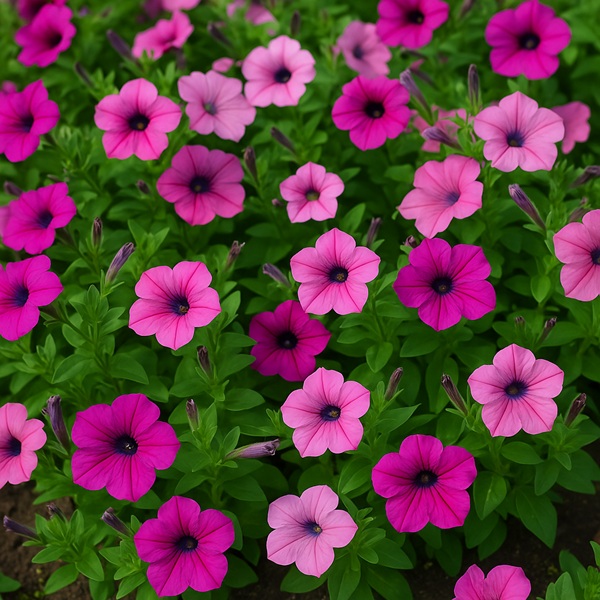
Petunia is one of the most beloved garden plants in Ukraine, widely used for decorating balconies, flower beds, hanging baskets, as well as in urban and private landscape design. Thanks to its vivid colors, long flowering period, and variety of forms, it has rightfully won the affection of both experienced flower growers and beginners. Petunia originates from South America, but over years of cultivation it has adapted perfectly to a temperate climate, including Ukrainian weather conditions. Today, petunia in Ukraine is not just a flower, but a true symbol of summer.
Modern petunia varieties are impressive in their diversity: they differ in height, bush shape, growth type (trailing, bushy, cascading), and color, ranging from white and pink to crimson, purple, bicolored, and double-flowered forms. Trailing and cascading types are especially popular for hanging arrangements and vertical greening. Petunias are valued for their long flowering period, from May until the first frosts. With proper cultivation practices, they form dense, abundantly flowering bushes that are resistant to wind and moderate rainfall. Depending on the region of Ukraine, petunias are successfully grown both in open ground and in containers on balconies, terraces, or outdoor flowerpots.
Petunia prefers sunny locations protected from strong wind. It is a very light-loving plant, and when light is lacking, it becomes stretched, loses its ornamental appeal, and flowers poorly. In Ukraine, where summer may be either hot and dry or rainy, especially in the western regions, choosing the right location is a critical factor for success. Petunia grows best on the southern or southwestern side of a plot, balcony, or windowsill.
Soil requirements:
Type: light, loose, fertile, and well-drained;
Acidity: neutral or slightly acidic, pH 6.0–6.5;
Optimal substrate: a mix of garden soil, peat, humus, and sand in a 2:1:1:1 ratio.
For heavy clay soils, sand is added, while for overly light sandy soils, humus and peat are added.
Before planting, the soil should be properly prepared: dug over, cleared of weeds, and enriched with organic fertilizers. This is especially important when growing petunias in containers or balcony boxes, where a specially prepared mixture enriched with micronutrients is needed. If petunias are planted in open ground in flower beds or borders, the site should preferably be prepared in autumn by adding humus or compost, and mineral fertilizers should be added in spring. The plant grows best on raised ground or beds where water does not stagnate. In regions with a humid climate, such as Western and Northern Ukraine, it is important to ensure that the roots do not rot in wet spring weather.
Despite its decorative appearance, petunia is fairly low-maintenance, but for long and abundant flowering it needs regular care. Under Ukrainian summer conditions, which may be hot or rainy, it is especially important to organize watering, fertilization, and plant shaping correctly.
Watering petunias:
Young plants need daily watering for 1–2 weeks after planting out.
Mature bushes are watered as the top layer of soil dries out, approximately 2–3 times a week.
On especially hot days, trailing forms grown in hanging baskets require daily watering.
It is best not to wet the leaves, especially in the evening, as this may cause fungal diseases.
Feeding:
The first feeding is given 7–10 days after transplanting into open ground: nitrogen fertilizers are used to stimulate active green growth.
Once flowering begins, feed every 7–10 days with potassium-phosphorus fertilizers.
Suitable complex fertilizers with micronutrients include Kemira Lux, Agricola, and Florovit.
Organic feeding is also useful, such as potassium humate or mullein infusion.
Bush formation:
For bush and trailing petunias, pinching the shoot tips is important, as it helps form a dense bush.
Regular removal of faded flowers extends the flowering period.
If the shoots become stretched by mid-summer, they are cut back by one-third of their length to rejuvenate the plant.
Petunias grown in containers or flowerpots require especially careful care: because of the limited soil volume, nutrients are depleted quickly, so feeding is needed more often than for plants grown in open ground.
The most common way to propagate petunias is by growing them from seed. Most modern hybrids are well suited to this method and, when proper cultivation practices are followed, produce strong and abundantly flowering seedlings. However, to preserve varietal traits, especially in double and trailing forms, cuttings are an effective method.
Propagation by seed:
Sowing is carried out from late January to mid-March, depending on the region and lighting conditions.
Seeds are sown on the surface without covering them, because petunias germinate in light.
The soil is moistened with a spray bottle and covered with film or glass.
The optimal temperature for germination is +22 to +25 °C.
Seedlings appear within 5–10 days, and once 2–3 leaves appear, they are pricked out.
Such petunias begin flowering about 2 months after germination.
Propagation by cuttings:
This method is suitable for preserving the variety, especially double and trailing hybrids.
Cuttings are taken in spring or autumn from a mother plant, using tip shoots 5–7 cm long.
The lower leaves are removed, and the cutting is placed in water or planted into a loose substrate such as peat mixed with sand.
To improve results, rooting stimulants such as Kornevin or Radifarm are used.
Rooting takes 7–10 days if the temperature is kept at +20 to +22 °C.
Cuttings are a reliable way to preserve a varietal petunia for the following year. In the southern regions of Ukraine, cuttings can be rooted directly in open ground under film, while in the northern and western regions it is better to do this indoors or in greenhouses.
Petunia, like most ornamental annuals, is susceptible to certain diseases and may suffer from pest attacks. Problems usually arise when care rules are broken, such as overwatering, overcrowded planting, insufficient light, or excess nitrogen. In Ukraine, it is very important to take into account the climate of each region: humidity in the west, drought in the south, and temperature fluctuations in the north.
Common diseases:
Black leg, in seedlings: rotting at the base of the stem, after which the plant collapses and dies.
✦ Causes: overwatering, overcrowding, poor ventilation.
✦ Prevention: disinfecting the soil, watering with a potassium permanganate solution, dusting with ash.
Late blight, root rot: often occurs in cool, rainy weather.
✦ Symptoms: wilting, brown spots on the leaves, root decay.
✦ Treatment: removing affected plants and using Previkur or Fundazol.
Powdery mildew: a white coating on the leaves, most often in hot weather or with excessive nitrogen feeding.
✦ Prevention: ventilation and timely removal of affected parts.
✦ Treatments: Skor, Topaz.
Petunia pests:
Aphids: settle on young shoots in spring and suck plant sap.
✦ Consequences: curled leaves and deformed buds.
✦ Control: Aktara, Biotlin, Fitoverm.
Spider mite: active in hot weather.
✦ Signs: pale spots on the leaves and webbing.
✦ Treatment: Akarin, Bitoxibacillin.
Whitefly: a small flying insect that settles on the underside of leaves.
✦ Control: yellow sticky traps, Confidor, Iskra.
Prevention:
Regular inspection of plants, especially during the budding period;
Thinning out and pruning wilted or affected growth;
Using high-quality seedlings and disinfecting the soil;
Controlled watering and proper fertilization.
In the western regions, such as Lviv, Ivano-Frankivsk, and Uzhhorod, more attention should be paid to drainage and soil aeration. In the southern regions, such as Odesa, Kherson, and Zaporizhzhia, plants should be protected from overheating and drying out, including with mulch.
Petunia is a versatile plant for creating bright, lush, and long-lasting decorative compositions. Thanks to its wide range of varieties, forms, and colors, it is used both in private gardening and public landscaping, from home yards to central city flower beds.
Decorative uses:
Flower beds, borders: bushy and multiflowered varieties create lush masses of color. They combine well with marigolds, ageratum, and salvia.
Edging: low-growing compact varieties are ideal for decorating paths and lawns.
Hanging baskets and arrangements: trailing and cascading petunias create waterfalls of color on balconies and terraces.
Mixed borders: they pair well with perennials such as lavender, hostas, and coleus.
Popular combinations:
Pink petunia + white alyssum + silver cineraria;
Purple petunia + yellow calibrachoa + white geranium;
Red petunia + blue ageratum + green kochia.
Regional features:
In the southern regions, it is better to place them in partial shade and water in the morning or evening.
In the western and northern regions, it is important to provide drainage and choose rain-resistant varieties.
In central Ukraine, petunia is a universal plant that tolerates temperature fluctuations well and suits any design style.
Petunia is not only beauty, but also freedom of expression: it can be used to create almost any color and spatial composition. It adapts wonderfully to different styles, from rustic to modern. For Ukrainian flower growers, petunia is a true ornament of summer.