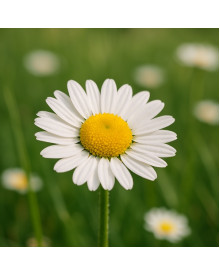
Osteospermum is a bright, ornamental plant that is becoming more and more popular among Ukrainian flower growers every year. It is also called the “African daisy,” and for good reason: its flowers resemble the classic daisy in shape, but stand out for their richer colors and larger, more contrasting petals. The plant originates from South Africa, which explains its love of sun and warmth. However, after adapting to a temperate climate, as in most regions of Ukraine, osteospermum shows high resilience, especially when proper cultivation practices and suitable planting preparation are followed.
Thanks to the diversity of varieties, osteospermum can be either a compact plant 25–30 cm tall or a lush bush up to 80 cm high. Its color range is impressive: from pure white and lilac to deep purple, salmon, yellow, and even bicolored forms. Many modern hybrids have unusual petal shapes — spoon-shaped, twisted, or wavy. All these features make osteospermum ideal both for single plantings and for bright flower beds, borders, and container arrangements. In Ukraine, the plant is mostly grown as an annual, although with enough care and a bright, warm room, it can be kept for several years. Osteospermum is distinguished by its long flowering period — from late May until the first frosts — which makes it an indispensable element of the summer and autumn garden. It is also worth noting that with minimal care, the plant is capable of growing and blooming abundantly under favorable conditions.
Successful outdoor cultivation of osteospermum in Ukraine depends on choosing the right location and preparing the soil properly. Since the plant comes from warm, dry regions, it requires maximum sunlight. It is best planted on the southern or southeastern side of the plot, where it will receive at least 6–8 hours of sun per day. Even in the southern regions of Ukraine, such as Odesa, Kherson, and Mykolaiv, osteospermum grows well provided the watering regime is maintained and the root system is protected from overheating.
Requirements for the site and soil:
Lighting: as much sun as possible, without prolonged shade;
Soil: light, loose, with good water permeability. Sandy loam and light loam are best;
Acidity: neutral or slightly alkaline, pH 6.5–7.5;
Drainage: essential, especially in humid regions such as western Ukraine and Polissia.
Before planting, the site is dug over to a depth of 25–30 cm, organic matter is added, humus or compost, and if necessary a little wood ash to reduce acidity. If the soil is heavy, sand or vermiculite must be added. Seeds for seedlings are sown indoors or in a greenhouse from late February to mid-March. Direct sowing into open ground is possible only in the warmest regions and no earlier than the second half of May. Seedlings are planted into the ground once the danger of return frosts has passed — usually this is late April to the first ten days of May in the southern regions, and the second half of May in central and northern areas. The spacing between plants should be 25–30 cm. After planting, it is advisable to mulch the soil to retain moisture and protect the roots. Under proper conditions, osteospermum adapts quickly and within 2–3 weeks begins to actively build up leaf mass.
Despite its refined appearance, osteospermum is quite an undemanding plant. With proper care, it is capable of producing abundant and long-lasting blooms throughout the whole summer and even into autumn. The main condition for successful cultivation is maintaining a balance between light, watering, and nutrition. In Ukraine, where summer can be either very hot or rainy, cultivation practices should be adjusted according to the weather.
Watering osteospermum:
Regular but moderate. The plant tolerates neither drought nor stagnant water;
In hot weather, water 2–3 times a week, preferably in the morning or evening;
In regions with frequent rain, such as Lviv and Chernivtsi regions, good drainage and loosening are essential;
When grown in containers, the soil moisture should be checked daily.
Feeding:
The first feeding is given 10–14 days after planting in open ground, using a balanced fertilizer with nitrogen, phosphorus, and potassium;
During budding and active flowering, feed once every 10–14 days, preferably with phosphorus-potassium fertilizers;
Excess nitrogen is undesirable, as it stimulates leafy growth at the expense of flowering;
Liquid organo-mineral mixtures, for example those based on humates or vermicompost extracts, are suitable.
To extend flowering:
Regularly remove faded flower heads — this stimulates the formation of new buds;
After the first wave of flowering, in July, the shoots can be lightly cut back by 5–10 cm — this activates the development of side shoots and repeat flowering;
When cold nights begin, cover with agrotextile to preserve the decorative effect until October.
Under suitable conditions, osteospermum in Ukraine can bloom for more than 100 days in a row, while keeping its petals vivid and its bush compact. It looks especially impressive in group plantings, where it adds brightness and color depth to a flower bed.
Propagation of osteospermum in Ukraine is possible in several ways: by seed, by cuttings, and by dividing an adult bush. Each method has its own characteristics, advantages, and drawbacks, and the choice depends on the goal — preserving varietal traits, getting faster results, or keeping the process simple.
1. Propagation by seed — the most common option when grown as an annual:
Seeds are sown from late February to mid-March for seedlings;
The substrate should be light and breathable, with added sand or vermiculite;
The seeds are pressed lightly into the soil and not covered — osteospermum germinates in light;
Optimal germination temperature: +18 to +22 °C;
Seedlings appear in 7–14 days;
Pricking out is done at the stage of 2 true leaves;
Flowering begins 90–100 days after emergence.
2. Cuttings — allow preservation of varietal traits, especially in hybrid forms:
Cuttings are prepared in August–September or in spring, March–April;
Use tip cuttings 8–10 cm long, with the cut made below a node;
The lower leaves are removed, and the base is treated with a rooting stimulant;
They are rooted in a light substrate, peat plus sand, at +20 to +22 °C and high humidity;
After 3–4 weeks, the cuttings form roots and are transplanted into pots.
3. Division of the bush — possible in spring, but used rarely, because osteospermum does not always form a bush suitable for division. It is more effective in greenhouses or if the plant was kept over winter in a pot.
Cuttings make it possible to preserve varietal characteristics, such as color, petal shape, and compact growth, which seed propagation does not guarantee. In the southern regions of Ukraine, cuttings can be rooted directly in the ground under film, while in the central and northern regions it is better to do this in a greenhouse or on a windowsill.
Osteospermum generally has good resistance to diseases and pests, especially when grown in a sunny, well-ventilated place. However, with excessive humidity, overcrowded plantings, or improper cultivation practices, some fungal diseases and insect attacks may occur. This is especially relevant in regions with a humid climate, such as western Ukraine and Polissia.
Most common diseases:
Fusarium wilt — caused by Fusarium fungi. The leaves wilt and the stem darkens near the base.
✦ Prevention: seed treatment, soil disinfection, crop rotation.
✦ Treatment: Fundazol, Previcur.
Root rot — a consequence of overwatering. Symptoms include wilting, stem darkening, and leaf drop.
✦ Good drainage, watering only as needed, and soil loosening are necessary.
✦ Remove the affected plant and treat the soil with copper-containing preparations.
Gray mold, Botrytis — often appears in rainy weather. It is characterized by gray mold on leaves and buds.
✦ Prevention: pruning wilted parts, ventilation, and thinning plantings.
Main pests:
Aphids — attack in spring, causing leaves to curl and producing sticky secretions.
✦ They can be controlled with soapy water or preparations such as Aktara and Biotlin.
Spider mite — active in hot weather. Signs include tiny white specks on the leaves and webbing.
✦ Treatment: Fitoverm, Verticillin; increased humidity reduces activity.
Whitefly — a small flying insect that settles on the underside of leaves.
✦ Yellow sticky traps and preparations such as Confidor and Iskra-M are used against it.
General preventive measures:
Keep at least 25 cm between plants;
Regularly remove fallen leaves and dried flowers;
Treat plants every 2–3 weeks with biological products, or preventive fungicides and insecticides.
Special care is needed when growing in containers: in a confined volume of soil, it overheats faster, loses moisture more quickly, or on the contrary retains it — which creates favorable conditions for rot.
Osteospermum is a universal ornamental plant that looks excellent both in urban landscaping and in private gardens. Its showy flowers, wide variety of colors, long flowering period, and resilience make it a valuable part of decorative compositions. Thanks to its varietal diversity, osteospermum can be easily integrated into any style, from rustic to modern minimalism.
Most popular uses:
Borders and flower bed edges — low-growing varieties, up to 30 cm, are ideal for outlining flower beds and paths;
Mixed borders and rabatkas — osteospermum combines well with petunia, salvia, and marigolds;
Container planting — pots, planters, and hanging containers on balconies, terraces, and in courtyards;
Alpine gardens and rockeries — low-growing creeping forms look especially good on raised spots.
Successful combinations:
White osteospermum + purple petunia + silver cineraria;
Pink osteospermum + blue ageratum + yellow marigolds;
Purple osteospermum + white alyssum + red carnation.
In Ukraine, osteospermum is increasingly used in urban settings: in flower beds near administrative buildings, schools, hospitals, and in street planters. It tolerates heat, air pollution, and temperature swings well, and keeps its appearance attractively. In a private garden, it is an ideal option for those who want maximum effect with minimal care.
In addition, osteospermum is suitable for cutting: its flowers last 5–7 days in a vase. It is actively used in wedding and interior floristry thanks to its vivid colors, petal structure, and airy appearance.