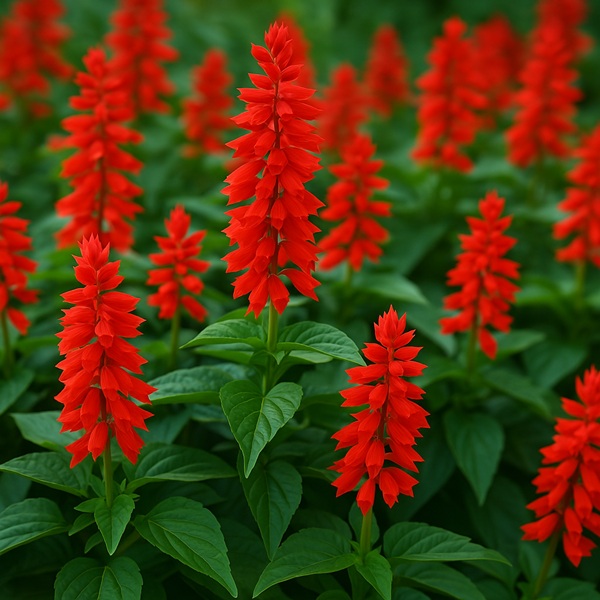
Salvia is a bright, striking, and at the same time low-maintenance plant that confidently holds a leading place among annuals in Ukrainian gardens, parks, and flower beds. It is a decorative form of sage that includes dozens of species, the most popular of which are scarlet sage (Salvia splendens), mealycup sage (Salvia farinacea), painted sage (Salvia viridis), and some perennial species. Thanks to its long and abundant flowering, hardiness, and ability to remain decorative until late autumn, salvia is ideal for urban landscaping, as well as for decorating rabatkas, borders, flower beds, and mixed borders.
Salvia is valued for its upright growth and bright, spike-like inflorescences, most often in red, purple, violet, or white. Some varieties have rich blue or lavender tones. In Ukraine, scarlet sage is especially widespread, with its vivid red flower spikes creating a striking contrast against green lawns or gray paving. An important advantage of salvia is its ability to flower continuously from early summer until the first frost. At the same time, it requires almost no complex care, tolerates drought, and is rarely affected by pests. Because of this, salvia is an indispensable element both in private flower gardens and in public green spaces, from flower beds near schools and hospitals to central city avenues.
For salvia to fully display its ornamental beauty, from vivid coloring to long-lasting flowering, it is important to choose the right planting site. In Ukraine, where summers may be moderately warm in the west or hot and dry in the south and east, salvia adapts well. However, the best decorative effect is achieved by meeting the basic requirements for light, soil composition, and protection from extreme weather conditions.
Main site requirements:
Lighting: as much sun as possible is ideal for lush and prolonged flowering;
Microclimate: protection from cold northern winds, especially in regions with late spring frosts, such as Sumy and Chernihiv regions;
Soil: loose, fertile, with good water and air permeability;
Acidity: neutral or slightly acidic, pH 6.0–7.0;
Drainage: essential, especially on heavy soils or in places with stagnant moisture.
Before planting, the soil is dug to a depth of 25–30 cm, cleared of weeds, and enriched with humus or compost. On sites with dense clay, it is advisable to add sand, peat, and wood ash. Salvia does not tolerate stagnant water well, especially in cool weather. In southern Ukraine, including Odesa, Mykolaiv, and Kherson regions, where soils are often sandy and poor, it is recommended to prepare planting holes with added compost and mineral fertilizers. In the wetter western regions, such as Lviv and Chernivtsi regions, good drainage and a sunny site should be ensured. Proper site selection guarantees good plant development and resistance to climate fluctuations typical of different regions of Ukraine.
Planting salvia in open ground is an important stage that largely determines the plant’s vigor and abundance of flowering. In Ukraine, where spring is often accompanied by temperature swings and the risk of return frosts, it is critically important to follow the optimal timing and correct planting technique. Salvia is usually grown from seedlings, since direct sowing into the ground is ineffective in most regions: seedlings emerge slowly, and flowering is significantly delayed.
Growing seedlings and planting out:
Sowing for seedlings: from late February to mid-March, depending on the region;
Substrate: light, moisture-retentive, with added peat and sand;
Germination temperature: +20 to +25 °C;
Pricking out: after the appearance of 2 true leaves;
Feeding: 1–2 times with complex fertilizers before transplanting into open ground;
Planting into the ground: from mid-May in the south to early June in the north and west, after the threat of frost has completely passed.
Planting technique:
Distance between plants: 20–30 cm, depending on the variety;
The holes are watered with warm water, and the root collar should remain at soil level;
After planting, the soil is mulched with peat, grass, or pine needles.
It is very important to adapt the seedlings to sunlight before planting out. If they were grown in a greenhouse, hardening should begin 7–10 days in advance. In the southern regions, where the sun is already quite intense by early May, it is advisable to shade young plants during the first few days after planting. Under proper conditions, salvia takes root quickly, actively builds green mass, and begins forming buds within a few weeks.
Salvia is one of the least demanding ornamental crops: even with minimal attention, it can remain decorative for a long time. In Ukraine, especially in the central and southern regions, salvia grows very steadily. But without regular watering, feeding, and removal of faded growth, even this hardy plant may lose the expressiveness of its color, and its flowering period may shorten.
Watering:
Salvia does not like overwatering, but it also reacts poorly to drought;
Watering should be regular but moderate;
In dry weather, 2–3 times a week, preferably in the evening;
After watering, loosening is essential, as it improves aeration and prevents soil crust from forming.
Feeding:
The first feeding is given 10–14 days after planting, using nitrogen fertilizers to stimulate green growth;
During budding and flowering, feed every 2 weeks with phosphorus-potassium products such as Kristalon or Agricola for flowering plants;
It also responds well to foliar spraying with micronutrients such as boron, magnesium, and iron;
Too much nitrogen in summer is undesirable, as it reduces the number of inflorescences.
Pruning and prolonging flowering:
Timely removal of faded inflorescences stimulates repeat flowering;
If the shoots become stretched, formative pruning is carried out;
At the end of August, the tips can be pinched to encourage side shoots.
In the western regions of Ukraine, because of higher humidity, it is advisable to pay more attention to thinning plantings and controlling ventilation. In the south, by contrast, it is important to mulch the soil and conserve moisture. With proper care, salvia remains attractive until frost.
Despite its overall hardiness, salvia can be affected by fungal diseases under unfavorable conditions such as excess moisture, overcrowded plantings, and sharp temperature fluctuations. These problems occur most often in regions with a humid climate, such as Zakarpattia, Lviv, and Volyn. Following proper cultivation practices and carrying out timely prevention is the key to keeping plants healthy and decorative throughout the season.
Main diseases of salvia:
Gray mold (Botrytis): affects leaves and inflorescences and appears as a gray, fluffy coating.
✦ Causes: excessive moisture, shade, overcrowding.
✦ Treatment: Fundazol, Topaz, Bordeaux mixture, and thinning the plantings.
Damping-off (in seedlings): rotting of the stem at the base.
✦ Often occurs because of overwatering in greenhouses.
✦ Prevention: sterile substrate, drainage, and limited watering.
Powdery mildew: a white powdery coating and suppressed growth.
✦ Common in shade and with excess nitrogen.
✦ Protective measures: Skor, Chystotsvit, and spraying with whey diluted in water.
Salvia pests:
Aphids: colonies on young shoots and leaf deformation.
✦ Control: soapy solution, Aktara, Fitoverm.
Spider mite: appears in dry, hot weather.
✦ Signs: pale dots and webbing.
✦ Treatments: acaricides such as Akarin and Verticillin.
Slugs: active after rain in the northern and western regions.
✦ Control methods: traps, ash, and products such as Groza or Slizneed.
General preventive measures:
Maintain spacing between plants, 20–30 cm;
Regularly remove wilted parts;
Use moderate feeding and control moisture levels;
Ensure ventilation and mulching, especially during rainy seasons.
Proper prevention helps avoid 90% of problems and keeps salvia plantings healthy and lush until the end of October. Even in urban conditions, with basic care, salvia demonstrates excellent endurance and resilience.
Salvia is one of the most striking and versatile annual plants widely used in ornamental landscaping in Ukraine. Its vertical inflorescences add height and definition to compositions, while its bright coloring brings liveliness and emphasis. Thanks to the variety of species and cultivars, it is used both in large-scale urban plantings and in private gardens.
Main ways it is used:
Monoflower beds: scarlet salvia is planted in dense rows to create a “wave of fire” effect;
Borders and rabatkas: low-growing varieties are suitable for edging paths and lawns;
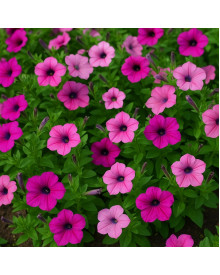
Mixed borders: combines well with marigolds, petunias, ageratum, and cineraria;
Patterned flower beds: looks excellent in complex geometric designs;
Container planting: dwarf varieties decorate terraces, balconies, and entrances.
Successful color combinations:
Red salvia + silver cineraria + yellow marigolds;
Purple salvia + white lobelia + pink petunia;
Blue mealycup sage + white verbena + purple ageratum.
Regional recommendations:
Southern Ukraine: regular watering, mulching, and shading during peak heat;
West and North: drainage, protection from rain, and ventilation;
Central Ukraine: ideal conditions, universal varieties, and minimal care with maximum results.
Salvia is perfectly suited to both urban and rural styles, as well as to classic flower beds and modern compositions. With the right approach, it becomes a true accent of the site, bringing color and mood without requiring excessive care.