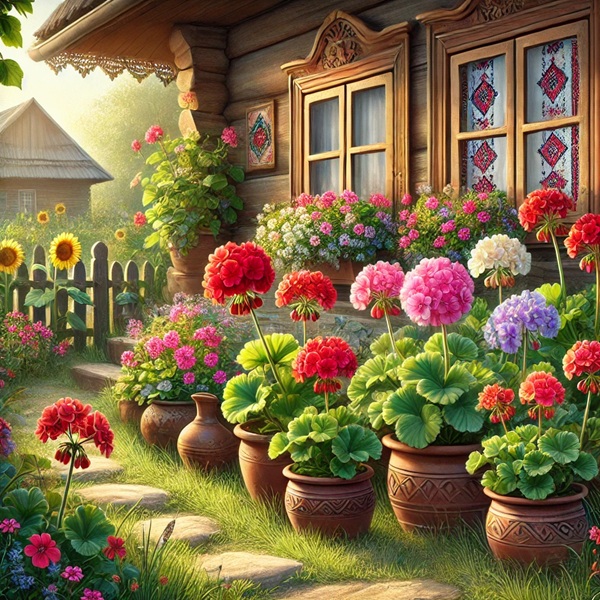
Geranium (Pelargonium, often confused with Geranium, meaning cranesbill) is one of the most beloved ornamental plants among Ukrainian gardeners. Thanks to its unpretentious nature, bright and long-lasting flowering, as well as its wide range of colors and forms, geranium has firmly established itself in both urban and rural landscaping. It is suitable for growing in open ground, flowerpots, balcony boxes, and indoor conditions.
Geranium originates from South Africa, which explains its drought tolerance, love of sunlight, and poor tolerance of excess moisture. In Ukraine, the most commonly grown types are zonal geranium (Pelargonium zonale), ivy-leaved geranium (Pelargonium peltatum) — an ampelous form, and regal geranium (Pelargonium grandiflorum), which is more often grown as a houseplant. Zonal geraniums are the most popular: they form compact bushes, have sturdy stems, and large inflorescences in red, pink, white, purple, and even orange shades.
In ornamental gardening, geranium serves not only an aesthetic but also a practical function. Its essential oils have insecticidal properties, so the plant can repel insects, including mosquitoes. Some varieties are used in aromatherapy as well as in folk medicine — for example, scented geranium (Pelargonium graveolens) is often used to prepare infusions and ointments, and its leaves are applied to wounds and abrasions.
Under Ukrainian conditions, geranium can grow in most regions — from Zakarpattia to Luhansk region, and from Chernihiv region to Kherson region. It thrives on the windowsills of city apartments, in flowerbeds near private homes, and in hanging planters on balconies. In the southern regions, geranium may even overwinter outdoors, although in most areas it is still brought indoors for the winter.
Success in growing geranium largely depends on choosing the right planting time, location, and substrate. In Ukraine, depending on the climatic zone, planting in open ground is carried out from the second half of April (south) to mid-May (center and north), when the danger of late spring frosts has fully passed. If it is to be grown in pots or containers, planting can be done earlier — in March, with the plants then being taken outside on warm days.
Geranium loves light, so open, well-lit areas are chosen for it. The ideal place is the southern or southwestern side, where the plant will receive 6–8 hours of sunlight per day. It can also grow in partial shade, but abundant flowering is possible only in full sun. Excess moisture is geranium’s main enemy, so the site should have good drainage, preferably on a slight elevation or in a place where rainwater does not stagnate.
As for the soil, geranium is not demanding, but it grows best in loose, light, fertile substrates with a neutral or slightly alkaline reaction. To improve the structure of heavy soils, it is recommended to add sand, perlite, compost, or peat. If the seedling was bought from a store, before planting it is worth slightly shortening the roots, removing overcrowded leaves, and carrying out a preventive treatment against fungal diseases, for example with Fundazol or Trichodermin.
Planting is carried out with a spacing of 25–30 cm between bushes — this helps avoid overcrowding and ensures ventilation. If several plants are planted in one flowerpot, the distance between the centers of the rosettes should be at least 15 cm. After planting, geranium is watered generously, but afterwards watering is reduced to moderate levels.
Geranium is valued for its low maintenance, but basic care measures are still essential. Watering should be regular but moderate. Overwatering leads to root rot and the development of diseases. In summer, geranium is watered 1–2 times a week, taking weather conditions into account. In pots, watering is more frequent because the substrate dries out faster. Signs of water deficiency are drooping leaves; signs of excess moisture are yellowing and loss of turgor.
Feeding plays an important role in ensuring long-lasting flowering. From May to September, geranium is fed every 10–14 days. Complex mineral fertilizers with a predominance of phosphorus and potassium are used. Nitrogen in large amounts promotes leaf growth, but may reduce the number of buds. Suitable fertilizers include products such as Bud, Agricola for flowering plants, and Kemira Lux.
Pruning is another essential element of care. It not only gives the plant a neat shape but also stimulates the formation of new flowering shoots. The main pruning is done in spring, before transplanting, by removing elongated, weak, and old stems. During summer, pinching is carried out — the tips of young shoots are removed to encourage branching. All cut parts can be used for propagation by cuttings.
It is also worth regularly removing faded flowers and yellow leaves — this not only improves the decorative appearance, but also prevents the development of rot. In open ground or on a balcony, it is important to make sure that heavy rains do not wash out the soil or cause root rot — sometimes geranium has to be shaded or temporarily moved under cover.
Despite its general hardiness, geranium can suffer from a number of diseases and pests, especially when overwatered, deprived of light, or planted too densely. The most common diseases are root rot, powdery mildew, rust, gray mold, and bacterial spotting. Among the pests are whitefly, aphids, spider mites, and scale insects.
The first step in prevention is proper cultivation practice: moderate watering, good ventilation, removal of plant debris, and control of planting density. To prevent fungal diseases, it is recommended to spray geranium periodically with biofungicides such as Fitosporin-M, Trichodermin, and Planriz. If powdery mildew appears, products such as Topaz and Skor are used; for rust, Horus is recommended.
Pests are especially active in summer, under conditions of heat and dry air. Against whitefly and aphids, systemic insecticides such as Aktara, Confidor, and Biotlin are effective. Against mites, contact-action products such as Neoron, Actellic, and Fitoverm are used. Regular inspections of the plants, especially the undersides of the leaves, make it possible to detect problems in time.
If infestation occurs, severely affected leaves should be removed, and the plant itself should be isolated, especially if it is growing in a flowerpot together with others. In severe cases, it is worth carrying out a transplant with complete replacement of the soil and treatment of the root system.
Geranium is easily propagated vegetatively — by cuttings, and less often by seed. Cuttings are the simplest and most effective method. In August–September or in spring, apical shoots 8–10 cm long with 2–3 nodes are cut. The lower leaves are removed, and the cutting is dried for several hours, after which it is planted in a light substrate of peat and sand. Rooting takes 10–20 days. It can also be rooted in water, though in that case the roots may be weaker.
Seed propagation is more often used to obtain new varieties or hybrids. Seeds are sown in March in moist, light soil, covered with film, and seedlings appear in 5–10 days. When they reach 2–3 true leaves, the seedlings are pricked out into separate pots.
Geranium needs repotting once every 1–2 years. Spring is the optimal time. During transplanting, the old substrate is partially replaced, damaged roots are trimmed, and the plant itself is cut back for renewal. For potted geranium, it is better to use special potting mixes for flowering plants.
In most regions of Ukraine, geranium does not overwinter in open ground, so in autumn it is transplanted into pots and brought indoors to a room with a temperature of +10 to +15 °C. During the dormant period (December–February), the plant is watered rarely and not fed. From the end of February, geranium is brought out of dormancy, pruned, and begins to be watered and fed more often.
Proper preparation for winter ensures a successful start to the next season. In spring, geranium quickly resumes growth and begins flowering as early as May, especially if it has overwintered well, been renewed, and received proper care.