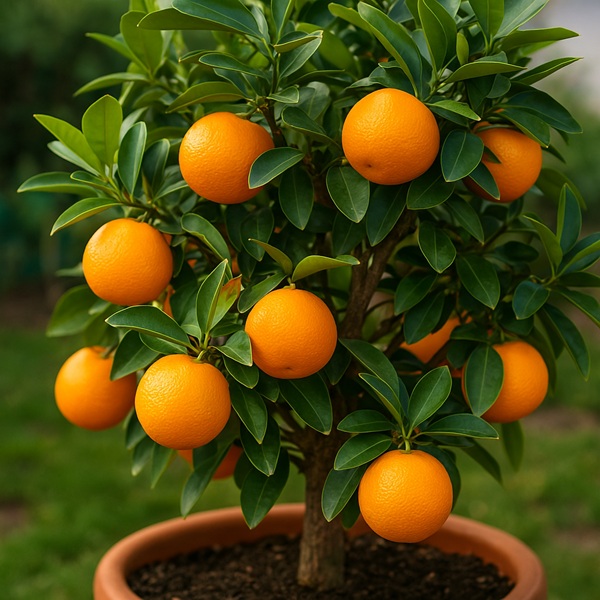
Orange (Citrus sinensis) is one of the most popular citrus crops in the world, a true symbol of sunshine, warmth, and southern exotic charm. In Ukraine, this plant is not a traditional open-ground crop, but it is increasingly grown as a tub or greenhouse plant, as well as an indoor ornamental tree. Thanks to selective breeding, compact varieties have appeared that can tolerate brief drops in temperature and adapt well to home conditions. In Ukraine’s climate, it is entirely possible not only to grow an orange tree, but also to harvest fruit from it, provided it is given the right microclimate, lighting, temperature, and humidity.
In Ukraine’s southern regions, such as Odesa, Mykolaiv, and Kherson, oranges can be grown outdoors in containers if the microclimate is mild and proper protection is provided — taken outside in spring and brought indoors for winter. Greenhouses and winter gardens are also a popular option, where temperatures are kept above +5°C, allowing the plant to remain active throughout the year. The most important requirements are light (up to 12 hours a day), stable temperatures, high humidity, and proper watering.
Ways to grow oranges in Ukraine:
as an indoor container plant — kept indoors year-round, suitable even for apartments;
as a greenhouse crop — in a controlled environment with high humidity;
as a seasonal garden plant — moved outdoors in spring and brought inside for winter;
as a decorative bonsai orange — for collectors and aesthetics enthusiasts.
So, orange is a very realistic crop for Ukraine, provided the right variety is chosen, the plant is cared for attentively, and a stable environment for growth is created.
One of the key factors in successfully growing oranges is choosing the right variety. Today there are many options that differ in tree height, fruit taste and size, ripening time, as well as resistance to disease and temperature fluctuations. For growing indoors or in greenhouses, compact, low-growing varieties that tolerate limited space well are the best choice.
The most popular varieties include:
Washington Navel — large-fruited, self-pollinating, and productive;
Pavlovsky — a traditional indoor variety, very aromatic;
Cara Cara — a red-fleshed variety with a high vitamin C content;
Valencia — a late variety that fruits well with good lighting;
Cold-hardy hybrids — can withstand short-term temperature drops to –5 to –7°C.
Suitable planting material includes:
nursery-grown saplings;
cuttings from a mature plant;
seeds from fruit — they are viable too, though they do not guarantee varietal traits.
Planting tips:
pot size — from 2–3 liters, with drainage holes;
soil — light, рыхкий, slightly acidic (a mix of sod soil, peat, humus, and sand);
drainage — 2–3 cm of expanded clay or fine gravel;
watering — with warm water, without overwatering;
placement — the brightest spot in the house, preferably facing east or south, with some shading during intense heat.
After planting, the plant should be given a week to adapt. During this time, it is important to maintain air humidity, avoid drafts, and not move the pot.
Orange is a light-loving crop, and insufficient light leads to leaf drop, lack of buds, and overall stunted growth. In Ukraine, especially in autumn and winter, additional artificial lighting is needed. The optimal day length is at least 10–12 hours, and special grow lights or LED lighting are suitable for this.
Growing conditions:
temperature — in summer +20 to +25°C, in winter cooler: +10 to +15°C (rest period);
watering — regular, after the top layer of soil dries out. Overwatering and stagnant water are unacceptable;
air humidity — ideally 60–70%, especially during the heating season (spraying, humidifiers);
pruning — formative in spring and sanitary throughout the year, stimulating new shoot growth and shaping a symmetrical crown.
Orange trees are fed from spring to autumn every 10–14 days. Complex mineral fertilizers containing nitrogen, phosphorus, potassium, magnesium, and trace elements are used. Once a month, it is helpful to water with a weak citric acid solution (1 g/l) — this acidifies the substrate slightly and improves iron uptake.
Orange blossom is not only beautiful, but also the first step toward getting your own harvest. Indoors, flowers usually appear in the second or third year after planting if the tree was grown from a sapling. They are white, five-petaled, and strongly fragrant. At home, the plant may bloom twice a year if given proper lighting and temperature conditions. However, hand pollination is necessary indoors for fruit to set.
Key points:
flowering begins from the terminal buds;
for pollination, use a soft brush or cotton swab to transfer pollen from one flower to another;
during flowering, the pot should not be moved or turned, otherwise the flowers may drop;
fruit set forms 3–5 days after pollination and ripens in 6–9 months, depending on the variety.
For fruit set, the tree needs:
a temperature of +18 to +26°C;
at least 10 hours of light a day;
regular feeding with phosphorus-potassium fertilizers;
humid air and crown spraying.
Young plants should not be burdened with too much fruit — 2–3 fruits are enough so as not to exhaust the tree. The fruit may be smaller than store-bought oranges, but it usually has a pronounced aroma and a pleasant taste, often sweeter than commercially sold fruit.
Orange trees need repotting every year when young, or once every 2–3 years when mature. This refreshes the soil, stimulates root formation, and provides more room for growth. The new pot should be 2–4 cm larger than the previous one. Repotting is done in spring, before active growth begins. The root ball should be disturbed as little as possible, since citrus plants react badly to root damage.
Repotting steps:
water the plant the day before;
carefully remove it from the pot with the soil ball intact;
place drainage at the bottom of the new container;
fill with fresh substrate, firm it lightly, and water;
do not fertilize for 2–3 weeks after repotting.
Pruning:
formative pruning — in spring, to create a compact, symmetrical crown;
sanitary pruning — throughout the year, removing weak, dry, and overcrowding branches;
rejuvenating pruning — on mature trees, stimulating the growth of new shoots.
The crown can be shaped into a ball, goblet, pyramid, or even bonsai style. Light should penetrate into the center of the crown — this promotes more even development of leaves and buds.
At home, orange trees often suffer from dry air, lack of light, and temperature fluctuations. This weakens the plant and makes it vulnerable to disease and pests. The most common problems are mites, scale insects, aphids, mealybugs, as well as chlorosis, rot, and leaf spot.
Common pests:
Spider mite — fine webbing, yellowing, and leaf loss;
Scale insect — dark growths on stems and leaves;
Mealybug — white cotton-like fluff in leaf axils;
Aphids — green or black insects clustering on young shoots.
Control methods:
spraying with soapy water;
against mites — Fitoverm or Aktara;
increasing humidity and airing the room;
regular washing of the leaves.
Diseases:
Chlorosis — yellowing leaves. Treatment: iron chelate and citric acid;
Root rot — caused by stagnant water. Repotting is required;
Fungal infections — spots or coating on the leaves. Treated with fungicides.
Wintering:
temperature of +10 to +15°C;
reduced watering (once every 10–14 days);
no fertilizing;
additional lighting.
Proper winter care is the key to abundant blooming in spring. After a few seasons of attentive care, it is entirely possible to enjoy tasty, fragrant, truly homegrown oranges right in a Ukrainian home.