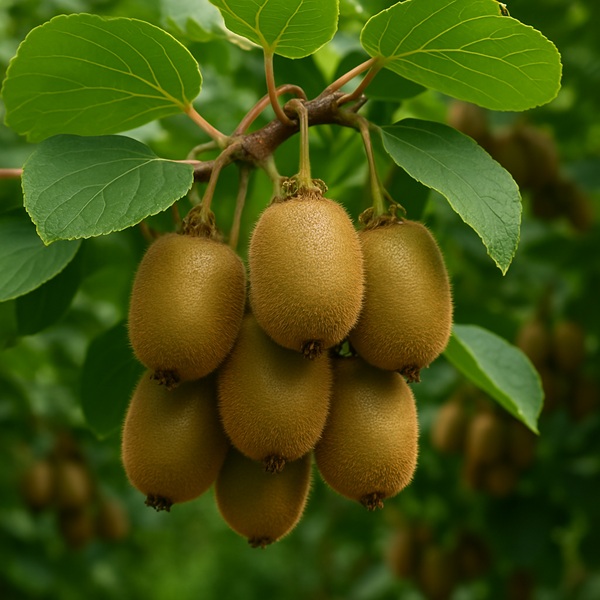
Actinidia is a rare but rapidly growing in popularity crop among Ukrainian gardeners. It is a perennial woody vine often called “mini kiwi” or “kiwi without skin.” The plant belongs to the Actinidiaceae family and is represented by several species suitable for cultivation in a temperate climate. The main advantages of actinidia are its ornamental appeal, productivity, high nutritional value of the fruit, and relative unpretentiousness. In Ukraine, with the right variety choice and basic care, actinidia can become a true highlight of the garden and a source of vitamin-rich harvests.
The most popular species in Ukraine are:
Actinidia kolomikta — the most frost-hardy species (down to -35°C), begins fruiting early, with small fragrant fruits (2–3 cm);
Actinidia arguta — fruits up to 5 cm, needs a warmer climate, grows well in central and southern regions;
Actinidia polygama — an ornamental vine with orange fruits and a spicy taste;
Hybrids — specially bred for the middle zone and for Ukraine, combining frost resistance with large fruit.
Actinidia is not just a fruit plant. Its leaves, especially those of kolomikta, have decorative coloring with white and pink patches that change throughout the summer. This creates the impression that the vine is in bloom all season long. In addition, it is ideal for vertical landscaping — it beautifully covers arches, gazebos, and facades. The fruits are a natural source of vitamins and minerals, especially vitamin C, of which they contain five times more than citrus fruits. The berries are eaten fresh, dried, frozen, and also used for jams, preserves, and fruit leather. Actinidia is especially beneficial for children, older adults, and anyone who cares about healthy nutrition.
Actinidia is light-loving, but it does not tolerate direct midday sun, especially in the southern regions. That is why the best planting site is a lightly shaded area with morning or evening light, protected from drafts and northern winds. The southern or southwestern walls of a house are ideal, as they create a favorable microclimate and retain warmth. It is essential to provide a support or trellis, since actinidia is a vine and needs room for vertical growth.
The soil should be:
light, loose, and well drained;
slightly acidic or neutral (pH 5.5–6.5);
rich in organic matter (humus, peat, compost);
free of lime — excess calcium causes chlorosis;
with good drainage — standing water is fatal to the roots.
Site preparation:
digging the area 2–3 weeks before planting to a depth of 30–40 cm;
adding humus (10 kg/m²), ash (200 g/m²), and mineral fertilizer;
digging planting holes 50×50×50 cm, with drainage at the bottom (crushed stone, broken brick);
filling them with a mixture of garden soil, compost, and sand;
spacing plants 1.5–2 m apart.
It is important to know that most actinidias are functionally dioecious, which means you need at least one male plant for every 5–6 female plants for fruit set. Without a male pollinator, female vines may grow well but will not bear fruit. Some hybrid varieties, such as certain arguta forms, can be self-fertile, but even in that case the presence of a pollinator significantly increases yield. When buying, always уточнюйте the sex of the plant and plan the planting layout accordingly.
Like all vines, actinidia needs shaping and proper support; otherwise, it becomes too dense and tangled, which worsens ventilation and reduces yield. During the first 3–5 years, it is especially important to focus on developing the correct plant form. With the right approach, actinidia not only fruits actively but also remains decorative for decades.
The most common training methods are:
trellis form (single-arm or double-arm) — the main shoots are directed horizontally, similar to grapes;
fan form — several main branches spread out from the central trunk;
free vine form — for decorating gazebos and fences, though fruiting is usually weaker.
Types of pruning:
Formative pruning — in spring before bud break or in summer after harvest; weak and overcrowding shoots are removed.
Rejuvenation pruning — every 4–5 years, old branches are cut back “to the ring” to stimulate young growth.
Sanitary pruning — dry, diseased, or damaged parts are removed throughout the season.
Important: do not prune in spring during active sap flow, otherwise the plant will “bleed,” releasing excess sap that weakens it. The best time for main pruning is summer after fruiting or late autumn. All cuts should be made with clean tools to avoid infecting the vine. Tying is done with soft material, leaving room for the stems to thicken.
Actinidia responds well to fertilizers, especially during periods of active growth and fruiting. To get large, sweet fruits, the plant needs sufficient nutrients, but it should not be overloaded with nitrogen, which stimulates only green growth.
Feeding:
Spring — nitrogen (nitrate fertilizers, manure infusion, or poultry manure infusion);
Before flowering — complex fertilizers (NPK with phosphorus and potassium);
After flowering — wood ash, potassium solutions, herbal infusions;
In autumn — phosphorus-potassium fertilizers without nitrogen, to prepare for winter.
Watering:
moderate, 1–2 times a week during drought (30–40 liters per bush);
avoid stagnant water — the roots are sensitive to waterlogging;
after watering, mulch to retain moisture and suppress weeds.
Pests:
aphids, leafrollers, and weevils — damage leaves and ovaries;
cats — especially dangerous for young kolomikta shoots;
slugs and caterpillars — eat leaves and may gnaw the bark.
Diseases:
powdery mildew, gray mold, and late blight — found in dense plantings;
prevention: ventilation, pruning, moderate watering;
treatment: spraying with Fundazol, Topaz, or copper sulfate.
For protection, both chemical treatments and folk remedies are used — infusions of wormwood, tobacco dust, and garlic. To protect against cats, gardeners install physical barriers such as mesh or thorny branches, and rub strong-smelling substances onto the lower part of the vine.
Actinidia begins to bear fruit in the third or fourth year after planting. Flowering occurs in May–June, and harvesting lasts from late August to October depending on the variety and region. Ripe berries are soft and have a characteristic aroma. They can be picked by hand or gently shaken onto fabric spread under the vine.
Harvesting features:
ripe fruits are carefully picked by hand;
unripe ones can be left to ripen in a dry place;
they keep in the refrigerator for up to 10 days, and in the freezer for up to 6 months;
they are suitable for jams, jelly, preserves, fruit leather, syrups, and juice.
After harvest, the following is done:
pruning fruiting branches that have finished bearing;
loosening the trunk circle;
the final feeding without nitrogen;
mulching with peat, leaves, or straw if needed.
In the first years of life (1–3 years), plants are vulnerable to frost. They are covered with spruce branches, nonwoven material, or dry leaves. Mature vines, especially actinidia kolomikta, overwinter without cover and can withstand frosts down to -35°C. Under favorable conditions,