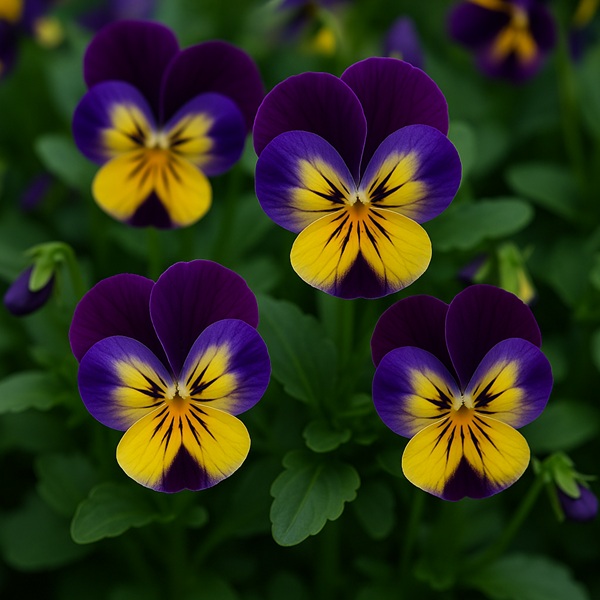
Tricolor violet is one of the most beloved and recognizable flowering plants in Ukrainian gardens. Behind this delicate folk name stands Viola tricolor and its many hybrid forms, which are grown as annuals, biennials, or perennials depending on the variety and planting method. The plant belongs to the violet family and is widely used in landscaping thanks to its early flowering, low maintenance, and incredibly rich palette of shades — from white-yellow tones to purple, deep violet, and even almost black. The blotch at the base of the petals resembles little eyes with lashes, which is exactly what inspired the poetic name “pansy.”
In Ukraine, tricolor violet is used for:
border plantings, flower beds, rabatkas, and city parks;
creating colorful floral carpets in public spaces;
spring landscaping thanks to its tolerance of cool weather;
planting in pots and container arrangements for balconies and terraces.
One of the main advantages of this plant is its quick adaptation to growing conditions. In different regions of Ukraine, it is planted in different ways: in the south (Odesa, Mykolaiv, Kherson regions) as an annual or as a biennial with autumn flowering; in the central and western regions — mostly as a classic biennial. The violet blooms from April to July, and with proper care can continue until October. Modern varieties have improved heat and frost tolerance, large flowers (up to 10 cm in diameter), exotic colors including bi- and tricolor variations, as well as double and ruffled forms.
Successful cultivation of this crop depends greatly on choosing the right variety, one that matches the region’s climate, the landscaping purpose, and the characteristics of the site. In Ukraine, both traditional varieties and modern hybrids from international breeding companies are available. They differ in flower size, bush shape, flowering duration, and disease resistance.
The most popular series are:
Delta F1 — early flowering, compact, and cold-tolerant;
Penny F1 — hardy against temperature fluctuations, blooms until frost;
Matrix F1 — flowers up to 9 cm, highly ornamental, ideal for urban flower beds;
Frizzle Sizzle — with fringed, strongly ruffled petals;
Joker and Swiss Giants — classic large-flowered types.
Tricolor violet prefers sunny or slightly shaded places, especially in regions with strong summer sun. In full shade, the plant becomes leggy, produces fewer buds, and the flowering itself becomes pale. Excess moisture should also be avoided, since standing water encourages rot.
Optimal conditions:
Soil — loose, fertile, slightly acidic (pH 6.0–6.5);
Location — protected from strong wind;
Drainage — essential in heavy or low-lying areas;
Predecessors — do not plant after nightshades or buttercup-family crops.
Before planting, the site is dug over and enriched with humus or compost, wood ash, and mineral fertilizers containing phosphorus and potassium. Acidic soils are neutralized with dolomite flour. Mulching is also recommended to preserve moisture, suppress weeds, and stabilize the microclimate.
In Ukraine, tricolor violet can be grown in two ways: through seedlings or by direct sowing in open ground. Both methods are effective, but the seedling method makes it possible to get earlier and more abundant flowering and also allows better control over seedling quality. Since the seeds are small, they are sown on the surface or only lightly covered with soil — sowing too deeply reduces germination.
The seedling method:
Sowing time — February to March, depending on the region;
Substrate — light, loose, and moisture-retentive (peat, sand, humus);
Depth — no more than 0.5 cm, or surface sowing under glass or film;
Germination temperature — +18 to +22°C;
After emergence (7–14 days), the temperature is lowered to +14 to +16°C;
Pricking out — at the stage of 2–3 true leaves.
Seedlings are planted in open ground in April–May, once stable warmth has set in. The spacing between plants is 15–25 cm. After transplanting, provide thorough watering and light shade for 2–3 days to help them adapt. In central and southern Ukraine, seedlings can even be raised in open cold frames from March onward.
Direct sowing into open ground is also possible — in April or in July–August for spring flowering the following year. This option is ideal for southern Ukraine, where the mild climate allows plants to adapt quickly. In northern and western regions, however, the seedling method is more reliable and gives more predictable results.
Tricolor violet responds to care with long, bright, continuous flowering. The main cultivation practices are regular watering, scheduled feeding, removal of faded buds, as well as loosening and mulching the soil. In Ukraine’s temperate climate, this gives excellent results: the violet forms a spreading bush and blooms right up to the first frosts.
Care recommendations:
Watering — 1–2 times a week during drought. The soil should remain moist, but not waterlogged. Regular watering is especially important during bud formation.
Feeding — every 10–14 days. Suitable options include complex mineral fertilizers (such as NPK 10:10:10), wood ash infusion, and potassium humate solution.
Removing faded flowers — stimulates the appearance of new buds and improves the overall look of the flower bed.
Loosening — gently, to a depth of up to 3 cm, after watering or rain.
Mulching — peat, straw, or dry leaves. This helps retain moisture and suppress weed growth.
In southern regions of Ukraine, such as Zaporizhzhia and Kherson, it is important to provide midday shade to prevent petal scorch. In conditions of high humidity, as in western Ukraine, regular ventilation and good drainage are especially important.
Like most violets, tricolor violet can suffer from fungal and bacterial infections, as well as insect pests. High humidity, overcrowded planting, and excessive nitrogen feeding are the main risk factors. But with proper care, most problems can be avoided or quickly managed.
The most common diseases:
Powdery mildew — a white coating on the leaves. Treatment: Topaz, Fundazol, or dusting with ash.
Gray mold — appears in rainy weather, especially in shade. Prevention: treatment with copper-based products such as HOM or Bordeaux mixture.
Blackleg — affects seedlings. Prevention: sterile substrate and watering with potassium permanganate solution.
Leaf spot — bacterial or fungal. Fungicides help.
Pests:
Aphids — multiply quickly, suck sap, and cause leaf curling.
Spider mite — produces webbing and causes yellowing of the leaves.
Slugs — damaging in wet weather. Hand collection and ash barriers are effective.
Thrips and caterpillars — less common, but still possible.
Prevention:
keeping proper spacing between plants;
planting in well-ventilated places;
moderate watering without stagnant moisture;
regular inspection and sanitary pruning.
With proper care, tricolor violet can bloom from April to October. In southern regions of Ukraine, the flowering period may last until the first frosts. To prolong the growing season, it is important to:
remove spent flowers regularly;
pinch stems to encourage branching;
renew plantings in the second half of summer.
To collect seeds, leave 3–5 of the strongest bushes. Once the seed capsules mature, they are carefully collected, dried, and stored in paper bags at a temperature of +5 to +10°C. Hybrid varieties may not retain their parental traits.
Wintering:
In southern and central regions, tricolor violet often overwinters without problems, especially if sown in July–August.
In northern and western regions, it is better grown as a biennial: sow in summer, overwinter under snow, bloom in spring, then replace the plants.
When grown in containers, plants are transplanted into pots in autumn and moved to a cool loggia or cellar.
After the first year of flowering, the plant’s ornamental value declines, so for the most attractive flower bed display, tricolor violet is best grown as an annual or biennial crop with yearly renewal.