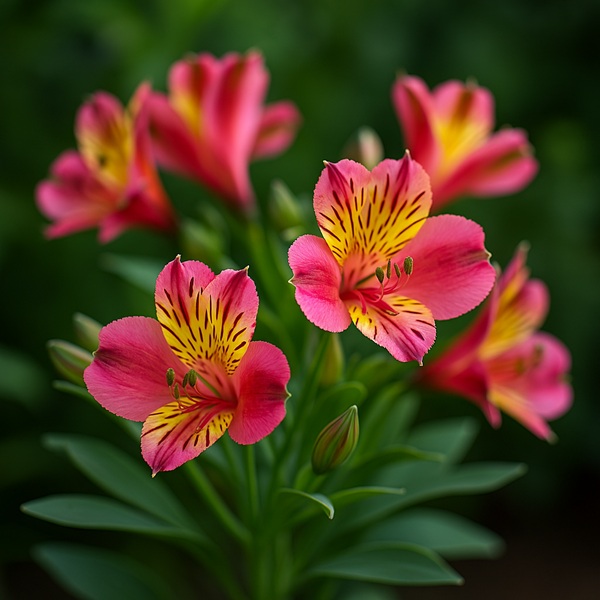
Alstroemeria, also known as the Peruvian lily, is an elegant perennial that is appearing more and more often in Ukrainian gardens and greenhouses. It belongs to the alstroemeriaceae family and stands out for its exotic appearance, long flowering period, and rich color palette ranging from soft pastels to bright contrasting tones. Its flowers resemble both an orchid and a lily at the same time, which is why it is especially valued in floristry. Despite its South American origin, alstroemeria adapts well to Ukraine’s climate with proper care, especially in the central and southern regions.
Alstroemeria’s popularity in Ukraine is driven by several factors:
Long flowering — from June to September, and in greenhouses until November;
High ornamental value — cut flowers stay fresh for up to 2 weeks;
A wide range of varieties — dwarf, medium, and tall forms from 30 to 120 cm;
Relative ease of cultivation — with proper planting, it adapts well to open ground.
In Ukraine, alstroemeria can be grown as a garden plant, a container plant, or a greenhouse crop for cut flowers. It establishes especially well in regions such as Kyiv, Vinnytsia, Poltava, Odesa, and Cherkasy, where summers are moderately warm and winters are mild. In the west of the country, successful cultivation is possible with winter protection. The northern and eastern regions require a more careful approach: greenhouse or container growing with the plant moved outdoors during the warm season. This makes alstroemeria a versatile plant for private plots and commercial flower production.
Choosing the right alstroemeria variety is a key step that affects the success of the entire growing process. In Ukraine, both large-flowered hybrid varieties suitable for cutting and compact forms ideal for borders, flower strips, and alpine gardens are available. When choosing, it is important to look not only at decorative qualities, but also at frost resistance, flowering period, and bush height. For open ground, varieties that tolerate temperature fluctuations are better suited, while greenhouse types require a more stable climate.
The most popular varieties include:
Inca Ice — bicolored pink and cream petals, up to 70 cm tall;
Indian Summer — bronze-brown flowers, hardy and decorative;
Casablanca — pure white flowers, ideal for bouquets;
Ligtu Hybrids — a tall-growing series with varied colors;
Princess Lilies — low-growing plants for balconies and pots.
The planting site should be bright but protected from the harsh midday sun, especially in the southern regions. In shade, the plant becomes leggy, loses color intensity, and blooms less generously. Wind can also damage its delicate stems. The ideal location is near an eastern or southern wall of a building, close to shrubs or trees that provide light shade.
Main requirements:
No stagnant water;
Fertile, light, slightly acidic soil (pH 5.5–6.5);
Drainage and regular loosening;
The possibility of winter protection in moderate and northern climates.
Alstroemeria prefers structured, fertile soils that hold moisture well but do not retain it excessively. In heavy clay or waterlogged areas, the roots rot, growth slows, and flowering is almost absent. Loamy and sandy loam soils enriched with humus, compost, and peat are best. Before planting, the area should be dug over, organic matter added, and perennial weeds removed.
Soil preparation:
Deep digging to 30–35 cm;
Applying humus at 4–5 kg/m²;
For heavy soils, adding sand at about one bucket per 1 m²;
If needed, adding complex fertilizers such as nitroammophoska or superphosphate;
Mulching after planting.
Planting:
The best time is spring, April to May, after the last frosts;
Distance between plants — 30–40 cm, row spacing — 50 cm;
Planting depth for tubers — 10–15 cm;
Watering should be moderate, followed by loosening after planting.
After planting, it is worth monitoring emergence. Depending on the variety, shoots appear in 10–20 days. In the first year, one or two flowering waves are possible, while from the second season the bush shows its full potential. When grown in containers, proper drainage and a light substrate made of peat, perlite, humus, and sand are essential.
For alstroemeria to grow actively and bloom generously, it needs regular and balanced care. Despite its exotic origin, this plant is not overly demanding, but it does require stable moisture, a nutritious growing medium, and loose, breathable soil. Special attention is needed during bud formation and flowering, since both excess and lack of moisture can weaken the plant or cause flower stalks to drop.
Watering:
Once or twice a week in dry weather;
Only at the root, avoiding wetting the leaves;
In hot weather, it is helpful to moisten the air around the plant by spraying;
From August onward, watering is reduced to prepare for winter.
Feeding:
The first feeding is 2 weeks after planting, using a solution of a complex fertilizer;
After that, every 10–14 days, alternating organic and mineral fertilizers;
Before budding, use superphosphate, ash, and potassium fertilizers;
From late August, nitrogen is excluded, leaving only phosphorus and potassium.
Mulching:
Helps retain moisture and suppress weeds;
Pine needles, peat, straw, or shredded bark can be used;
The layer should be 5–7 cm thick, but not pressed directly against the stems;
Renew every 4–6 weeks.
In addition, faded flowers should be removed regularly to encourage new buds, and the soil should be loosened after watering. Tall varieties need staking, especially in windy weather or during flowering.
Alstroemeria can be propagated in two main ways — by dividing the rhizome and by seed. In Ukrainian conditions, both methods work well, but each has its own features. Seeds are more often used by breeders or enthusiasts who enjoy experimenting, while division is a more practical and faster way to preserve the variety.
Division:
Carried out in spring or autumn;
The bush is dug up and the rhizome is cut into sections with growth buds;
The divisions are treated with stimulants such as Kornevin or Heteroauxin;
Then they are planted in prepared holes.
Advantages:
Preserves varietal characteristics;
The first flowering can occur in the same season;
Rejuvenates the bush — recommended every 3–4 years.
Growing from seed:
Sowing is done in January or February;
Stratification is required for 30–40 days at +2 to +4°C;
Germination takes 3–6 weeks;
Seedlings are pricked out when 2–3 true leaves appear;
Planted into the ground in May, with flowering in the second or third year.
Plants grown from seed may not retain the exact traits of the parent variety, but this is a great way to produce a new variation in flower color or petal shape.
Alstroemeria has moderate frost resistance. In Ukraine, wintering in open ground is possible only in the southern and central regions with proper protection. In the northern, western, and eastern regions, it is recommended to dig up the tubers for winter or grow the plant in containers that can be moved into a cool room.
Preparing for winter:
Cut back the above-ground part after the first frosts;
Mulch with dry leaves, peat, or straw;
In regions where temperatures fall below –10°C, add extra protection with agrofabric;
Store dug tubers in boxes with sand at +2 to +5°C.
Diseases:
Root rot, gray mold, and fusarium;
Caused by excessive moisture, overcrowded planting, and cool damp weather;
Treatment includes fungicides, drainage improvement, and preventive pruning.
Pests:
Thrips, aphids, and spider mites — common in hot weather and in greenhouses;
Slugs and snails — especially after rain.
Prevention:
Loosening, moderate watering, and good ventilation;
Biological products such as Fitosporin, Trichodermin, and ash sprays;
Regular inspection of plantings and removal of affected parts.
Alstroemeria is a unique combination of beauty, resilience, and practicality. With proper care, it rewards you every year with an abundance of blooms, decorates a garden or terrace, and also provides fresh flowers for bouquets. It fully deserves a place in a Ukrainian garden as a symbol of lightness, elegance, and harmony.