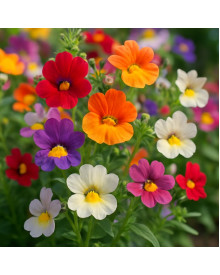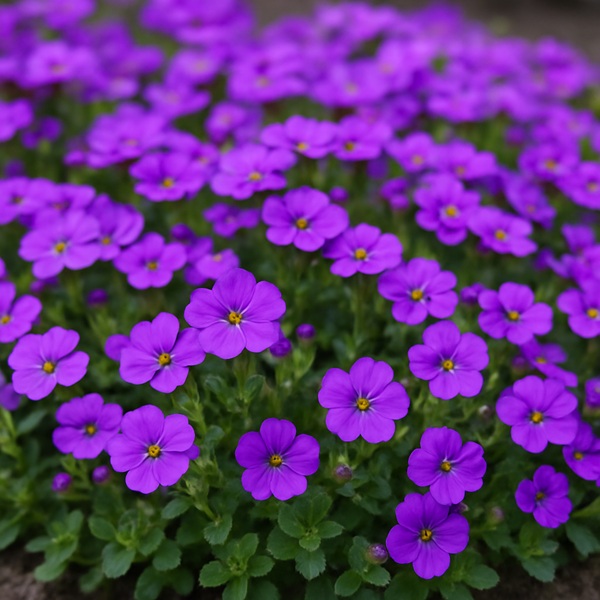
Aubrieta (Aubrieta) is a perennial herbaceous plant from the cabbage family that has long been popular among landscape design enthusiasts. Its main advantage is its ability to form a continuous flowering carpet that shimmers in shades of violet, lilac, pink, and blue in spring. In Ukrainian gardens, aubrieta thrives thanks to its resilience to temperature fluctuations, drought, and wind. It is ideal for decorating alpine slides, rock gardens, retaining walls, borders, and also for growing in containers. At the same time, this plant is completely undemanding, provided the basic rules of planting and care are followed.
Aubrieta originates from the regions of Southern Europe and Asia Minor, where it grows in rocky crevices and on limestone slopes. For this reason, the plant is highly resistant to dry conditions and poor soils. This quality makes it an excellent choice for the drier regions of Ukraine, especially the southern and central oblasts. Aubrieta prefers well-drained soils with a neutral or slightly alkaline reaction, while excessive moisture and heavy loams may suppress its growth. Despite its small size, the plant needs plenty of sunlight, as the abundance of its bloom depends on it.
Its flowering period is another major advantage. Aubrieta begins blooming in April, as soon as the snow melts, and pleases the eye for about 30–40 days. After flowering ends, it does not lose its decorative value, forming a dense cushion of bluish-green foliage. Some gardeners encourage repeat flowering in autumn by pruning the plant immediately after its spring bloom. The shoots grow back quickly, and the bush blooms again, though less abundantly. Thanks to its dense turf and resistance to light foot traffic, aubrieta can also be used as a groundcover plant.
A properly chosen location is the key to active growth and abundant flowering in aubrieta. As a typical inhabitant of alpine landscapes, it loves sunny, open areas. The site should receive light for at least 6–8 hours a day. Even slight shade, for example from a fence or trees, may shorten the flowering period or cause the bush to become sparse. Slopes, terraces, and the southern or southwestern sides of flower beds are ideal. Unlike most perennials, aubrieta does not need rich soil — on the contrary, excessive fertility leads to active leaf growth at the expense of buds.
The best soils are light sandy soils, sandy mixtures, and rocky substrates with additions of chalk, gravel, or crushed brick. Good drainage is extremely important, since water stagnation around the roots is one of the main causes of rot. Clay soils should be lightened by adding sand and humus in a 2:1 ratio. For mineral enrichment, a small amount of ash or lime may be added, especially on acidic soils. Site preparation should be completed 1–2 weeks before planting so the soil has time to settle.
Step-by-step soil preparation:
Dig the area to a depth of 20–25 cm.
Remove weeds and the roots of perennial plants.
Add drainage materials such as fine gravel, sand, and lime.
If needed, lime the soil or mulch the surface with stone chips.
A helpful tip: aubrieta thrives in slightly “stressful” conditions. It should not be overfed or transplanted frequently — on a modest diet, it blooms more brightly and for longer.
Aubrieta can be propagated in several ways: by seed, by cuttings, or by dividing the bush. Each method has its own advantages and is suitable for different purposes.
Sowing seeds.
Seeds are sown either for seedlings or directly into the soil. The optimal timing is March for seedlings and April to early May for open ground. The soil is moistened, and the seeds are lightly pressed into the surface without covering them, since they need light to germinate. At a temperature of +18 to +22 °C, seedlings appear in 10–15 days. After 2–3 true leaves appear, the seedlings are pricked out, and in May they are planted into the flower bed. Seed propagation does not guarantee preservation of varietal traits, but it is convenient for large-scale sowing.
Cuttings.
This is the best method for preserving the variety. In June, green cuttings 5–7 cm long are taken, the lower leaves are removed, and they are rooted in a substrate of peat and sand. The container is covered with film and placed in a shaded spot. After 3–4 weeks, roots appear, and the young plants are transplanted to a permanent location.
Dividing the bush.
This method is used less often because aubrieta does not tolerate transplanting well. The bush can be divided in late August to September by carefully lifting it with a clump of soil and separating it into sections. Each section is planted with drainage and watered moderately. The advantage is quick establishment and flowering as early as the following year.
Spring planting into the ground is done once stable warmth has arrived. The spacing between plants should be 20–30 cm depending on the variety. After planting, the soil is firmed and watered. The surface can be mulched with pebbles — this imitates aubrieta’s natural environment and enhances the decorative effect of the bed.
Despite its reputation as an undemanding plant, aubrieta still needs regular care, especially in the first year after planting. The main tasks are proper watering, timely pruning, and maintaining the right growing conditions.
Watering. Once established, the plant can withstand long droughts. Watering is only needed during extended dry periods or during a dry spring. Excess moisture, especially in cool weather, may cause rot. Water should be applied at the base, avoiding the leaves.
Feeding. It is recommended twice a year:
in spring, with a fertilizer low in nitrogen and moderate in phosphorus and potassium;
after pruning, with a compound fertilizer for perennials to stimulate repeat flowering.
Pruning. This is done after the first wave of flowering, in late May to early June. The shoots are shortened by two-thirds, which encourages denser growth and possible repeat blooming in autumn. Regular trimming also improves the shape of the bush and prevents it from becoming bare in the center.
Loosening and weeding. Aubrieta does not tolerate competition. The soil around it should be loosened regularly after rain or watering, and weeds should be removed by hand carefully so as not to damage the roots.
Under Ukrainian conditions, aubrieta shows good frost resistance, especially when snow cover is present. Still, there are several important details to consider when preparing the plant for winter.
✔ Mulching. After the first frosts, it is advisable to mulch the soil around the plants with dry leaves, small pebbles, or pine needles. This protects the root system from sudden temperature changes.
✔ Autumn pruning is not recommended. The summer shoots perform a protective function. In spring, they can be shortened carefully to refresh the crown.
✔ Moisture control. In November, it is important to avoid overwatering, especially on sloped sites. If necessary, drainage can be improved or extra substrate can be added.
For container growing:
in winter, the pots are moved to a sheltered place such as a warm balcony or greenhouse;
or insulated by wrapping them in burlap and covering them with hay or sawdust.
Even in containers, aubrieta survives winter well as long as the roots do not become waterlogged and are protected from direct rain and wind.
Of the roughly 12 known species, ornamental gardening in Ukraine mainly relies on deltoid aubrieta (Aubrieta deltoidea) and its garden hybrids. They stand out for their bright, long-lasting bloom and their strong adaptability to open-ground conditions.
The most popular varieties:
‘Cascade Purple’ — a rich violet variety that forms a dense carpet up to 15 cm high.
‘Royal Blue’ — a compact form with a deep blue color, ideal for containers.
‘Aubrieta hybrida mix’ — a color mix suitable for mass plantings.
‘Blaumeise’ — frost-hardy, excellent for northern Ukrainian winters.
‘Axcent Light Blue’ — an early-flowering variety, especially beautiful in cooler regions.
When choosing a variety, consider:
– winter hardiness and growing region;
– height (up to 10 cm for borders, up to 15 cm for slopes);
– flowering time (early varieties from late March, later ones from mid-April);
– the possibility of repeat flowering.
Combining several varieties makes it possible to create colorful spring compositions. Aubrieta pairs beautifully with alyssum, moss phlox, stonecrop, primroses, and dwarf irises. That makes it indispensable in the spring landscape.