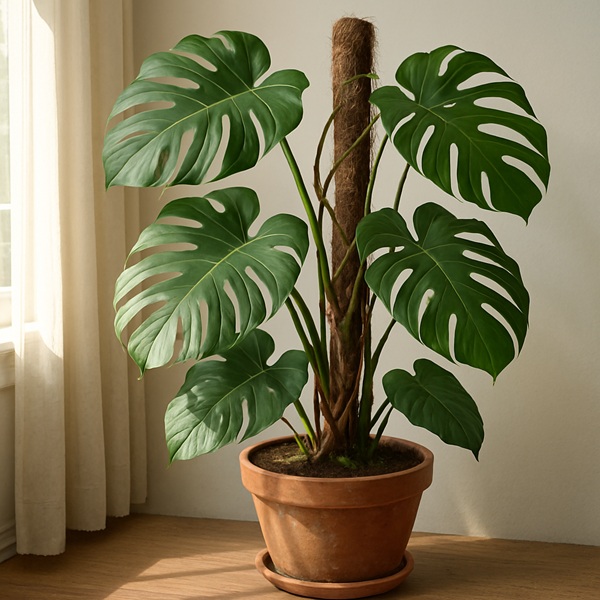
Monstera is one of the most popular ornamental plants grown in homes and offices in Ukraine. Its recognizable large leaves with elegant splits and aerial roots create the atmosphere of a tropical forest, reminding us of its natural habitat — the humid jungles of Central and South America. In Ukraine’s climate, monstera can only be grown as a houseplant, since it is very sensitive to low temperatures and cannot tolerate even short-term frost. The optimal temperature for its growth is between +18 and +25°C, so in summer it can be placed on a balcony or terrace, but only if it is protected from drafts and direct sunlight.
Lighting plays a key role in shaping monstera’s decorative appearance. The plant prefers bright, diffused light and does not tolerate either deep shade or direct sun well. In low light, the leaves become smaller and lose their characteristic splits, while strong sunlight may cause burns. The best place for monstera is near east- or west-facing windows, and with southern exposure it is better to use curtains for shading. In winter, when daylight hours become shorter, especially in northern regions of Ukraine, extra lighting with grow lamps may be needed.
To grow normally, monstera needs a stable level of air humidity. During the heating season, indoor humidity can fall to 30–40%, which negatively affects the plant’s condition. To prevent the leaf edges from drying out and to stimulate new growth, it is recommended to spray the plant regularly with soft water, use a humidifier, or place containers of water nearby. Monstera also responds well to wiping the leaves with a damp cloth — this not only improves its appearance but also supports better photosynthesis.
Monstera needs a light, fertile, and well-drained potting mix. At home, it is best to use a ready-made universal substrate for aroids or prepare the soil mix yourself from turf soil, leaf mold, peat, humus, and sand in a ratio of 2:1:1:1:1. It is important to maintain the proper acidity level — monstera prefers slightly acidic or neutral soil with a pH of 5.5–6.5. To improve aeration, perlite, coconut substrate, or charcoal can be added to the mix. A drainage layer 2–3 cm thick made of expanded clay or small pebbles should always be placed at the bottom of the pot.
Planting monstera begins with choosing a suitable pot. Since the plant grows quickly, the container should have extra room. Repotting is done by the transshipment method, keeping the root system intact. Young plants up to 3 years old are repotted every spring, while mature ones are repotted once every 2–3 years. At the same time, it is advisable to renew the top layer of soil every year to prevent acidification and nutrient depletion. After planting, the plant should be watered well, making sure water does not stagnate in the saucer.
Monstera has strong aerial roots that serve for additional nourishment and support. They should not be cut off — instead, it is better to guide them into the soil or into moist moss wrapped around a support. For this, sphagnum moss or coconut fiber fixed to a plastic or bamboo pole is commonly used. Such a system not only supports vertical growth but also allows the plant to absorb extra moisture from the air. In apartment conditions, support is essential: without it, monstera sprawls across the floor and loses its decorative appeal.
Watering monstera should be moderate but regular. In the warm season, the plant is watered 1–2 times a week, while in winter no more than once every 7–10 days, depending on the room temperature. The main rule is to water only after the top 2–3 cm of soil has dried out. Excessive watering leads to root rot and the development of fungal infections, especially at lower temperatures. It is best to use settled water at room temperature, preferably soft. Cold tap water should be avoided, as it can cause stress and disease in the plant.
Feeding monstera begins in March and continues until September. During the active growing season, fertilizers are applied every 2–3 weeks. Complex liquid fertilizers for decorative foliage plants containing nitrogen, potassium, phosphorus, and trace elements are used. It is important not to exceed the recommended dosage — an excess of nutrients leads to leaf deformation and loss of visual appeal. In winter, during the dormant period, feeding is stopped or reduced to no more than once a month, especially if the indoor temperature is lower.
Seasonal care includes sanitary pruning, removing yellow or damaged leaves, and monitoring for pests, especially scale insects, spider mites, and mealybugs. If necessary, the plant is treated with insecticides or the leaves are wiped with a soap solution. In spring, formative pruning is also possible — pinching the tops to stimulate side shoots and maintain a more compact shape. With proper care, monstera grows quickly, and its leaves develop their characteristic decorative appearance and large size.
Monstera is fairly easy to propagate in an apartment or house using top or stem cuttings, air layering, or division of the plant. The most common method is propagation by cuttings. For this, a section of stem with one or two buds and a leaf is used. The cutting is taken in spring or early summer, left to dry in the air for 1–2 hours, and then placed in water or moist moss with the addition of charcoal. At a temperature of +22 to +25°C, roots usually appear within 2–3 weeks.
Once the root system has formed, the cutting is planted in a small pot with a light, nutritious soil mix. At the initial stage of development, it is advisable to create a greenhouse effect by covering the plant with a clear bag or jar. Under favorable conditions, the young plant develops quickly. This method is convenient for indoor propagation because it makes it possible to obtain healthy plants well adapted to home conditions. Sometimes monstera also produces side shoots, which can be used as planting material.
Air layering is another effective propagation method. A node with an aerial root is selected on the stem, wrapped in moist moss, and secured with plastic film. After a few weeks, when the root begins to develop actively, this section is cut off and planted in a pot. Division of the plant is used only for large, well-grown specimens. During repotting, an adult monstera is divided into 2–3 parts with separate growth points and root systems. This is a more traumatic method, but it allows you to obtain full-fledged new plants.
Monstera is quite resistant to disease, but improper care can lead to various problems. The most common cause of illness is overwatering. Under such conditions, root rot develops, showing itself through wilting, darkening at the base of the stem, mold, and an unpleasant smell. In this case, the plant should be urgently removed from the pot, the damaged parts cut away, treated with a fungicide, and repotted into fresh substrate with good drainage.
Dry air creates favorable conditions for spider mites. Their presence is indicated by fine webbing on the underside of the leaves and tiny pale dots that later turn into yellow spots. To control them, acaricides are used, or the leaves are wiped with a soap solution with added alcohol. Scale insects and mealybugs are also common; they suck sap from the leaves and petioles, weakening the plant. In cases of severe infestation, several insecticide treatments are carried out, and the plant’s hygiene is carefully maintained.
For prevention, it is important to keep watering moderate, maintain proper air humidity, and regularly inspect monstera for signs of pests or disease. The pot should not be placed near radiators, air conditioners, or in drafts. It is also necessary to avoid an excess of mineral fertilizers, which may damage the root system. If the basic care rules are followed, monstera remains healthy and decorative and will brighten the home for many years.
Monstera adapts well to the conditions of Ukrainian apartments, but it does require attention to seasonal changes. In winter, when heating is on, the air becomes too dry, which affects the plant badly. In summer, it is important to avoid overheating and the soil drying out completely. Regular spraying, monitoring moisture in the substrate, and placing the pot correctly are the keys to success. If space is limited, monstera’s growth can be restrained by pruning or by using a smaller pot, which slows the development of the root system.
Interestingly, monstera is not only an interior decoration but also a natural air filter. It cleans the air of harmful substances such as formaldehyde and benzene, humidifies the space, and creates an atmosphere of harmony. In many cultures, monstera symbolizes health, well-being, and longevity. However, it should be remembered that the plant’s sap contains calcium oxalates, which may cause irritation. For this reason, it is not recommended to keep it within reach of small children or pets.
For many Ukrainian lovers of houseplants, monstera is not just a green accent but a living part of the home. It adds coziness, purifies the air, and inspires care for nature. With proper care, even a beginner can grow a lush and healthy plant. Monstera is perfectly suited to apartments, winter gardens, offices, and public spaces. Its versatility, beauty, and relative ease of care make it one of the most beloved plants in Ukraine.