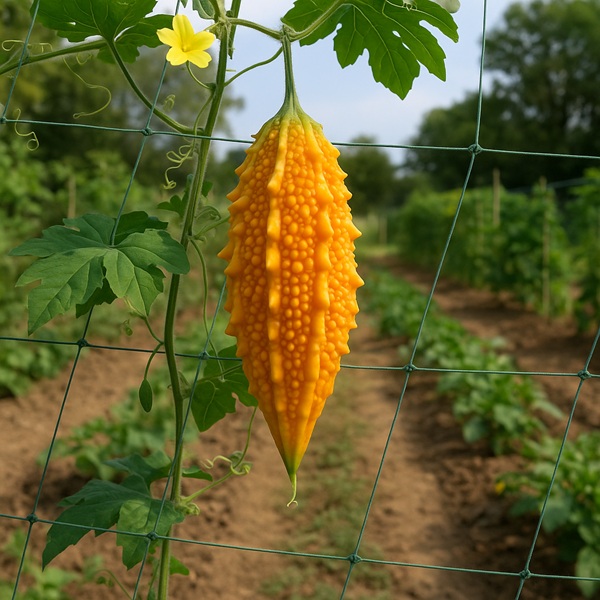
Momordica, or bitter melon, is becoming increasingly popular in Ukraine thanks to its ornamental qualities, taste, and health benefits. This heat-loving crop, native to the tropical regions of Asia, requires special attention when choosing a growing site. The best place to plant momordica is a sunny, well-ventilated area protected from northern winds. The plant is very sensitive to cold, so even in the southern regions of Ukraine it is planted in open ground only after the threat of frost has completely passed — usually in late May or early June. In cooler regions, it is recommended to grow the crop in greenhouses or under covers.
The soil should be loose, fertile, and well-drained. Momordica does not tolerate stagnant moisture, so it should not be planted in places with a high groundwater level. Light loams or sandy loam soils with a neutral or slightly acidic reaction are ideal. Two to three weeks before planting, the plot is dug to a depth of 25–30 cm, and humus (3–4 kg per m²), wood ash (100–150 g per m²), and a комплексне mineral fertilizer are added. If the soil is heavy, sand or peat is added to improve its structure.
Since momordica is a climbing vine, it requires vertical support. Trellises, nets, or frames up to 2 meters high are installed in advance. This helps maintain healthy air circulation, prevents overcrowding, and makes harvesting easier. It is worth remembering that momordica is an annual crop that must be sown anew each year. However, with proper soil preparation and a well-chosen site, it is possible to obtain a rich harvest even in open ground. One of the key success factors is pre-sowing seed germination and hardening of the seedlings, which will be discussed below.
Under Ukrainian conditions, momordica is most often propagated by seed. The seeds have a dense оболонка and good germination, but preliminary preparation is recommended to speed up sprouting. Ten to twelve hours before sowing, the seeds are soaked in warm water (+25...+30°C); growth stimulants such as humate or Epin may also be used. After that, the seeds are germinated in a moist cloth or sawdust until sprouts appear, which usually takes from 2 to 5 days.
For raising seedlings, individual containers with a volume of at least 0.5 liters are best, as this helps avoid root damage during transplanting. The soil mix should consist of humus, garden soil, and sand in equal parts. The seeds are sown to a depth of 1.5–2 cm, after which the containers are covered with film and placed in a warm, bright location. The optimal temperature for germination is +24...+28°C. After the seedlings emerge, the cover is removed and the temperature is lowered to +20°C to prevent the plants from becoming leggy. Watering should be moderate: the soil must not be allowed to dry out, but excess moisture is also undesirable.
At the age of 3–4 weeks, when the seedlings reach 10–15 cm and have several true leaves, they can be planted in open ground or in a greenhouse. Five to seven days before transplanting, hardening is essential: first, the plants are taken outdoors for 1–2 hours, gradually increasing the time spent outside. Given momordica’s sensitivity to cold, transplanting is carried out only in stable warm weather, when nighttime temperatures do not fall below +15°C. Following these rules will help produce strong and resilient seedlings that will begin growing quickly after transplanting.
Momordica is a vigorously growing crop that requires regular care. It is important to tie the shoots to the support in time, guiding them upward and to the sides. This promotes even lighting, better ventilation, and prevents the planting from becoming too dense. Training begins after 5–6 true leaves appear: the main stem is pinched to stimulate the development of side shoots, on which the fruits are formed.
Watering is important at all stages of vegetation. Before flowering begins, the soil should be kept moderately moist. Regular moisture is especially critical during budding and fruit filling. However, excessive watering can cause root rot and fungal diseases. The best option is drip irrigation or watering into furrows in the morning or evening. After each watering, it is advisable to lightly loosen the soil to improve oxygen access to the roots.
Fertilizing is carried out every 10–14 days, alternating organic and mineral fertilizers. At the stage of active growth, nitrogen compounds are used (mullein infusion, urea), and with the beginning of budding, potassium-phosphorus mixtures are applied. Ash infusion or complex vegetable fertilizers may also be used. Thanks to regular nutrient application, momordica actively builds leaf mass and produces abundant yields. It is also worth systematically inspecting the plants for pests — the main threats are aphids, spider mites, and whiteflies. In case of infestation, garlic or onion infusions, or insecticides, are used.
Momordica begins to flower 35–50 days after being planted in open ground. Its flowers are unisexual, but both are located on the same plant. Male flowers appear first, and female flowers follow 7–10 days later. Effective pollination is necessary for fruit formation. In open ground, this is ensured by insects — bees, bumblebees, and wasps — but in greenhouses manual pollination is needed. To do this, a male flower is picked and gently applied to a female flower, which has a visible ovary. The best time for this is in the morning during dry, warm weather.
If pollination is successful, the ovary quickly increases in size. In just 10–12 days, the fruits can already be eaten, although they reach full ripeness a little later. It is important not to allow overripening: such fruits become bitter and may crack open on their own, scattering seeds. To avoid this, the crop is harvested regularly, every 2–3 days. The fruits are removed carefully, without damaging the vines and ovaries, in order to stimulate further fruiting.
Momordica continues flowering almost until the first frosts. In the southern regions of Ukraine, fruiting may continue until October. It is important to watch the weather forecast — if cold weather threatens, the plants should be covered with agrofibre, especially at night. This makes it possible to extend the growing season and gather an additional harvest. In greenhouses, momordica can be grown as a crop with extended fruiting, which is especially convenient for gardeners seeking a stable harvest.
Momordica fruits have an unusual appearance — oval or elongated, with bright yellow or orange bumpy skin. Inside are bright red seeds surrounded by a sweetish pulp. The tastiest fruits are those at the technical ripeness stage, when they are still firm and slightly underripe. In this condition they are eaten fresh, stewed, fried, pickled, or preserved. They combine wonderfully with vegetables, meat, and spices — especially in Eastern cuisine.
It is worth noting that overripe fruits can have pronounced bitterness, especially the skin and the inner white membranes. To reduce bitterness, sliced fruits are recommended to be soaked in salted water for 15–20 minutes before heat treatment. The seeds are also edible when ripe, though they are usually used for sowing. For this, the largest and darkest specimens are selected, washed, dried, and stored in a dry place at room temperature. Seed germination remains viable for up to 3–4 years.
In addition to its culinary use, momordica is widely used in folk medicine. Its fruits, leaves, and even roots are used to prepare tinctures, decoctions, and ointments with antiseptic, anti-inflammatory, and blood-sugar-lowering properties. However, such remedies should be used with caution, especially by people with chronic illnesses. Momordica is also not recommended during pregnancy or in cases of individual intolerance. When used reasonably, it is a true treasure for health.
After the season ends, all plant residues should be completely removed from the plot, especially if diseases or pests were noticed. The vines, roots, and leaves are destroyed, the soil is dug over, and if necessary organic as well as phosphorus-potassium fertilizers are applied. It is also advisable to change the planting site the following year to prevent the buildup of disease agents. Momordica should not be planted in the same place again earlier than after 3–4 years.
Among the main difficulties in growing momordica are diseases caused by excessive moisture: powdery mildew, root rot, and fungal leaf infections. For prevention, it is important to control watering, ensure ventilation, and treat the plants with biofungicides or infusions of ash and garlic. In open ground, there is also a risk of pests appearing — aphids, whiteflies, and spider mites. In cases of severe infestation, it is worth using biological products or insecticides permitted in Ukraine.
Despite its exotic origin, momordica has adapted quite well to Ukrainian conditions. The main thing is to take into account its love of warmth and its requirements for nutritious soil, and also to organize care properly, especially at the initial stages. For many summer residents, growing momordica is not only an exciting hobby, but also a way to diversify their diet, decorate the plot, and strengthen their health. Thanks to its ornamental value and high productivity, this crop rightfully holds a worthy place among the promising plants for household cultivation in Ukraine.