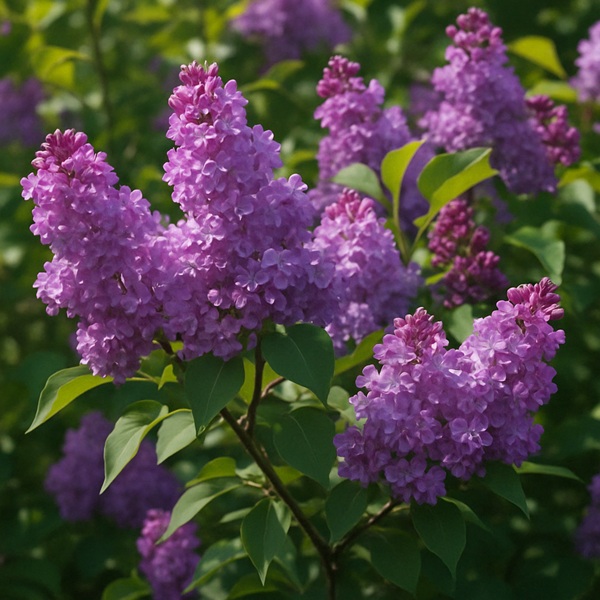
Lilac (Syringa) is one of the most beloved and best-known ornamental shrubs, valued for its lush bloom, vivid fragrance, and ease of care. In Ukraine, it can be seen both in private gardens and in urban landscaping — in parks, along avenues, near schools, hospitals, and churches. The genus includes about 30 species, but in gardens the most commonly grown is common lilac (Syringa vulgaris) along with its numerous cultivars and hybrids. It blooms in May to early June, and the color range of its flower clusters varies from white to pink, lilac-violet, and even rich purple.
Lilac is a deciduous shrub 2 to 5 meters tall, with a spreading crown and dense dark-green foliage. It stands out for its high winter hardiness, drought tolerance, and ability to adapt to different soil types. It performs best in sunny locations with light, fertile soil. Its root system is strong but not aggressive, which means lilac can be planted in mixed borders, hedges, near fences, walls, and paths. The main thing is not to place it too close to trees with shallow root systems.
Lilac is valued not only for its ornamental beauty but also for its wonderfully pleasant fragrance, which can fill the garden with spring freshness. Thanks to long-term breeding, there are now more than 1,000 varieties — from dwarf to giant forms, with different flower shapes, sizes, and degrees of doubleness. In Ukraine, especially popular varieties include ‘Beauty of Moscow,’ ‘Katherine Havemeyer,’ ‘Mulatka,’ ‘Sensation,’ as well as white-flowered forms that pair beautifully with other spring plants. With proper planting and care, lilac can bloom for decades, improving its appearance year after year.
Choosing the right location and following the proper planting schedule are the key to forming a beautiful, abundantly flowering shrub. Under Ukrainian conditions, the best time to plant lilac is from late August to early October. Autumn planting is better than spring planting, because the plant has several weeks before frost to root well, and in spring it immediately begins active growth. In spring, lilac often faces early heat, establishes less successfully, and may lag in development. If the seedling has a closed root system (in a container), it can also be planted in April to early May.
A place for lilac is chosen based on three main factors:
Light. The shrub should receive at least 6 hours of sunlight each day. In shade, lilac blooms poorly.
Soil. Light loam or sandy loam with a neutral or slightly alkaline reaction. Acidic or waterlogged soils are unsuitable.
Wind protection. Lilac does not like strong drafts, especially in the first year after planting.
The planting pit should measure 60×60×60 cm. If the groundwater level is high, drainage made of crushed stone or broken brick is essential. Humus, wood ash, and a small amount of superphosphate are added to the soil mix. The seedling is placed so that the root collar is level with the ground. After planting, it must be watered thoroughly (10–15 liters of water per shrub) and the root zone should be mulched with humus, peat, or cut grass.
In the first year after planting, the main task is to help the plant establish its roots. During this time, watering should be moderate but regular. In the southern regions of Ukraine, additional moisture is desirable during summer heat — water at the base, avoiding the leaves. The frequency is about once a week or whenever the soil noticeably dries out. Water stagnation is dangerous, because the roots may rot, especially in heavy soils.
Pruning is an important part of care. Lilac responds well to both sanitary and formative pruning. In spring, before bud break, damaged, weak, and inward-growing branches are removed. After flowering, the faded flower clusters should always be cut off — this prevents the shrub from wasting energy on seed production and helps it set flower buds for the following year. If desired, lilac can be trained into a standard form, which is a popular choice in landscape design. But even a regular bush looks no less impressive when pruned correctly.
Feeding begins in the second year after planting. In spring, nitrogen fertilizers are applied, such as urea; in summer, compound fertilizers with phosphorus and potassium are used. Lilac responds well to organic feeding: manure infusions, ash infusions, and herbal infusions. It is important not to overfeed — excess nitrogen produces lush foliage but suppresses flowering. All fertilizers should be applied after watering or rain. With the start of autumn, feeding is stopped — the plant needs to prepare for winter rather than produce new shoots.
Lilac is easy to propagate in several ways: by dividing the bush, by root suckers, by cuttings, and by grafting. The most accessible method for most gardeners is separating root suckers. As early as 2–3 years after planting, young shoots appear around the bush; in autumn or early spring, they can be carefully separated with part of the root and transplanted to a new place. It is important not to damage the main plant in the process.
Another common method is green cuttings. In June–July, cuttings 10–15 cm long are taken with 2–3 pairs of leaves, treated with a rooting stimulator such as Kornevin or Heteroauxin, and planted in a greenhouse or under plastic film in a light sandy substrate. At a temperature of +22 to +25 °C and with constant moisture, rooting takes place in 3–4 weeks. This is the most effective method of propagating varietal lilac, as it preserves all the traits of the parent plant.
Grafting is also used in ornamental nurseries. The rootstock is usually common lilac or Hungarian lilac. Grafting is done in early spring by copulation or cleft grafting. This method is more complex, but it allows growers to cultivate rare or demanding varieties that do not produce root suckers. Other options include propagation by layering and by seed. The seed method is mainly relevant for breeders: it is lengthy and does not guarantee preservation of varietal traits.
Although lilac is considered a hardy crop, under certain conditions it can suffer from diseases or pests. The most common are fungal and bacterial infections:
Gray mold — appears as dark spots on leaves and flowers, and the affected parts become covered with a fuzzy coating.
Bacteriosis — causes shoots and buds to blacken, making the plant look as though it has been scorched.
Mosaic — a viral disease that causes mottled, irregular spotting on the leaves; there is no treatment, and affected bushes must be uprooted.
Among the dangerous pests are:
Lilac moth. Damages buds, leaves, and flowers. The caterpillars feed inside the flower clusters.
Spider mite. Attacks young leaves, which become covered with pale dots and fine webbing.
Aphids. Settle on the tips of shoots, deform the leaves, and stunt growth.
For prevention, it is advisable to carry out spring spraying with fungicides such as Bordeaux mixture, Topaz, or HOM, and in summer, if needed, use insecticides such as Fufanon, Actellic, or Fitoverm. All affected parts should be removed and burned. It is equally important to ventilate plantings regularly, avoid overcrowding, and remove old, dried shoots and fallen leaves in time. A healthy, well-maintained shrub is less likely to be affected by disease and will flower more actively.
Lilac is a true all-rounder in garden design. It can be used as a specimen plant, in hedges, mixed borders, or avenues. Thanks to its wide palette of varieties — from classic violet to white, pink, and double-flowered forms — lilac fits harmoniously into any style, from country gardens to formal classic parks. Planted near a terrace, bench, or pathway, it not only decorates the space but also fills it with fragrance.
For small plots, dwarf and standard-form lilacs are ideal. They can even be grown in tubs or containers on a balcony. Group plantings of lilac combine effectively with peonies, irises, tulips, fritillaries, and phlox beds. After lilac has finished flowering, hydrangeas, spireas, viburnum, or roses can take over the decorative relay.
A particularly interesting design solution is contrast planting: white lilac against a dark-green thuja hedge, or lilac-pink flower clusters beside juniper or barberry. Lilac also looks beautiful in natural-style gardens together with perennials and ornamental grasses. Thanks to its resilience, longevity, and refined beauty, lilac is rightly considered a classic of the Ukrainian flower garden.