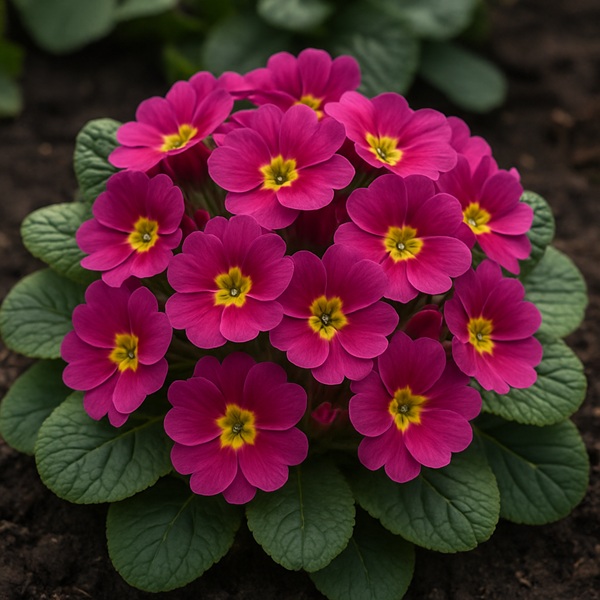
Primrose (Primula) is one of the first signs of spring in the garden. Thanks to its wealth of forms, colors, and tolerance of cool climates, this plant has firmly earned its place in Ukrainian flower beds, alpine rock gardens, and borders. The genus includes more than 400 species, many of which are successfully cultivated as ornamentals. In Ukraine, especially popular species include cowslip (Primula veris), drumstick primrose (Primula denticulata), common primrose (Primula vulgaris), and Julia’s primrose (Primula juliae).
The main feature of primrose is its extremely early flowering. As early as late March to early April, depending on the region, bright flower clusters begin to appear, often still set against patches of snow. Flowering continues until May, and in some species it repeats in September. Thanks to this life rhythm, primroses are ideal for spring garden displays, when other perennials are only just beginning to wake up.
Given Ukraine’s climate, primrose establishes itself very well in most regions — from Lviv to Luhansk, from Kyiv to Odesa. It loves a cool spring, moderately moist soil, and partial shade. It is important to keep in mind that primrose does not tolerate intense heat or drought, so in the southern regions it is better grown in shade or with additional watering. With the right choice of site and minimal care, primrose rewards gardeners with reliable flowering for many years, while its dense leaf rosettes decorate the garden even outside the blooming period.
Successful primrose cultivation begins with a properly prepared site. This plant prefers loose, organic-rich, well-drained soil. On heavy clay soils, primrose feels stunted: the leaves turn yellow, buds form weakly, and root rot may occur. That is why sand, compost, or leaf mold must be added when planting in such soil. The optimal acidity is slightly acidic to neutral, with a pH of 6.0–7.0.
The choice of location depends on the type of primrose. Most varieties prefer partial shade, especially spring-flowering forms. The ideal placement is under the canopy of deciduous trees or near north-facing walls. There, the plants receive plenty of light in spring while the trees are still bare, and in summer they are protected from direct sunlight. At the same time, there are species that grow well in full sun too, such as Julia’s primrose, provided they receive enough watering. In open sites, it is advisable to provide protection from wind and drying out.
Planting time also matters. In Ukraine, primrose is planted either in spring, from late March to early May, or in late summer to early autumn, from August to September. Autumn planting allows the plant to establish well before frost, while spring planting helps it begin growing more quickly. The spacing between plants is 20–30 cm, depending on the species and planting density. During planting, it is important to preserve the integrity of the root ball and water the plant thoroughly. After planting, it is best to mulch the surface with humus or peat.
Primrose is not a plant that requires excessive care, but with a little attention it can reward you with luxurious flowering and long-lasting декоративність. The main focus is watering. In Ukrainian conditions, especially in the southern and central regions, spring can be dry, so the plant needs additional moisture. Water regularly but moderately: the soil should stay moist, but not waterlogged. The most important period is bud formation and flowering, since a lack of moisture at that time sharply reduces the plant’s ornamental value.
Feeding is also very important. The first application is made in early spring, as soon as the leaves begin to grow: a nitrogen fertilizer such as ammonium nitrate or mullein infusion works well. During budding and flowering, complex fertilizers with a higher proportion of phosphorus and potassium are applied — this encourages abundant flowering and prolongs the process. In August, one more feeding can be given to stimulate repeat flowering in autumn. The main thing is to avoid too much nitrogen in the second half of summer, so that flower bud formation is not disrupted.
Care also includes sanitary and formative pruning. After flowering, it is advisable to remove faded flower stalks so the plant does not waste energy on seed production, unless seed collection is planned. Leaves are trimmed only if they dry out or become affected by disease. In autumn, after the end of the growing season, the leaves are not cut back completely — in regions with severe winters, the above-ground part serves as natural protection. Additional light covering with dry leaves or agrofabric is also recommended in the absence of snow.
Propagating primrose is simple and accessible even for beginners. The most reliable and fastest method is division of the clump. This not only provides new plants, but also rejuvenates older specimens that gradually lose their decorative quality over time. The best time for division is immediately after flowering, from late spring to early summer, or in early autumn. In Ukraine, summer division is practiced more often, especially in regions with early autumn frosts.
To divide the plant, the clump is carefully dug up, trying not to damage the roots. The rhizome is divided into 2–4 parts, with each section having a growth point and a cluster of roots. If necessary, the cut surfaces are dusted with ash or crushed charcoal. The freshly divided parts are planted in a moist, light substrate, shaded, and watered regularly. Such plants usually flower the following season.
The second option is seed propagation. Seeds are either collected by hand or purchased from specialized stores. They are sown superficially in containers or nursery beds, without covering them, but only lightly pressing them into the moist soil. A necessary condition is stratification: the seeds are kept at a temperature of +2 to +5 °C for 3–4 weeks. Seedlings appear in 2–4 weeks. This method is more labor-intensive, but it makes it possible to obtain a large number of young plants. Some primrose species are prone to self-seeding, especially in moist, semi-shaded areas. This can be controlled by thinning the seedlings or transplanting them to the desired places.
Although primrose is considered a fairly resilient crop, under unfavorable conditions or with care mistakes it may become vulnerable to diseases and pests. The most common fungal diseases include:
Powdery mildew — appears as a white coating on the leaves. Sulfur- or copper-based fungicides are used for control.
Gray mold (Botrytis) — affects the above-ground parts when moisture stagnates and plantings are overcrowded. It requires removal of damaged parts and treatment with Bordeaux mixture.
Fusarium and root rot — cause yellowing, wilting, and plant death. Prevention includes good drainage, seed treatment, and soil disinfection.
Among the pests, the following are especially dangerous:
Slugs and snails — actively feed on leaves in cool, damp weather. Ash dusting, traps, and biological products are effective against them.
Spider mites — appear in high temperatures and dry air. Raising humidity and spraying with acaricides helps.
Aphids and thrips — suck sap from young shoots. Soap solution, garlic infusions, or insecticides are used in severe infestations.
For prevention, it is important to maintain the proper watering regime, avoid overcrowding, and regularly remove weeds and dead leaves. It is also advisable to change the planting site of primrose every 4–5 years so that disease pathogens do not accumulate in the soil. In autumn, after the season ends, the above-ground parts are partially cut back, plant debris is cleared away, and the area can be treated with a weak solution of copper sulfate or with biofungicides.
In addition to being grown outdoors, primrose grows beautifully in containers and pots, which makes it a highly versatile plant. Especially popular among indoor forms are obconica primrose, acaulis primrose, and malacoides primrose. They bloom during winter and early spring, from December to March, and can then be transplanted into open ground.
For container growing, a light, airy substrate is used — garden soil, peat, sand, and a little compost in a ratio of 1:1:0.5. A drainage layer is essential. Lighting should be bright but diffused, without direct sun; east- or northeast-facing windows are ideal. Watering should be moderate, after the top layer dries out, but without allowing the soil to dry out completely or water to stagnate. Feeding is done every 2–3 weeks with liquid fertilizer for flowering plants, in a reduced concentration.
After flowering, indoor primrose can be moved outside: planted in partial shade or sunk into the ground in its pot until autumn. Indoors, the plant enters a short dormant period — watering is reduced, after which new growth is stimulated. Most hybrids do not tolerate being kept for many years, so seasonal cultivation or yearly renewal is usually practiced. Container-grown primrose is especially effective for greening balconies, terraces, urban courtyards, and even office interiors — compact, bright, and undemanding.
Є одна дрібна правка: в абзаці про догляд залишилось слово “декоративність”. Правильно англійською тут буде “ornamental value”.
Отже, фраза має бути:
“...it can reward you with luxurious flowering and long-lasting ornamental value.”