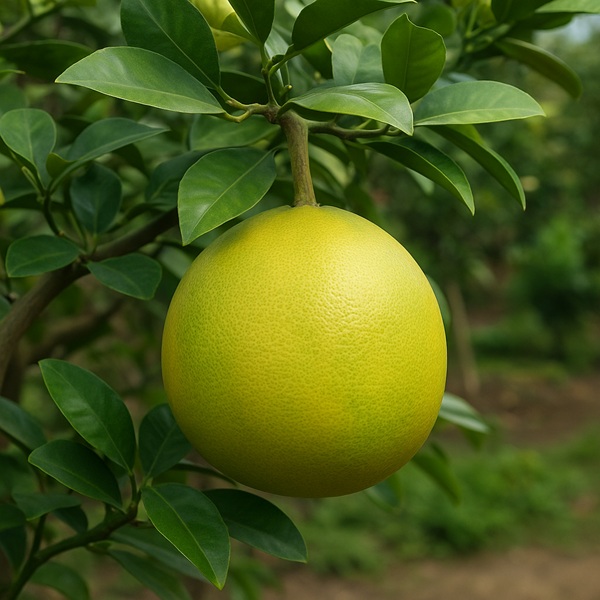
Pomelo (Citrus maxima or Citrus grandis) is one of the largest members of the citrus family. Its fruits can weigh 2–3 kg, and in favorable conditions even more. This plant is native to Southeast Asia, but thanks to its resistance to drought and diseases, pomelo has become popular in other regions of the world as well. In Ukraine, growing pomelo in open ground is still limited by the climate; however, it does very well in greenhouses, winter gardens, on insulated balconies, or as a container plant.
The main task for a Ukrainian gardener is to create conditions for pomelo that are as close as possible to its natural environment. This means plenty of light, no drafts, warmth, and moderate air humidity. The optimal temperature range for active growth is from +22 to +30°C. Even at +18 to +20°C, however, the plant continues to develop if it receives enough light. In the southern regions of Ukraine, pomelo can be grown in heated greenhouses or in protected spaces such as loggias, verandas, and winter gardens.
It should be understood that under Ukrainian conditions pomelo is grown mainly as a container crop. This offers a number of advantages: the plant can be moved outdoors in summer, brought into warmth in winter, the soil can be controlled, and pests can be dealt with quickly when they appear. With proper care, the first fruits can be expected as early as 4–6 years after planting from seed or from a grafted sapling. Grafted varietal plants imported from China, Thailand, or the Mediterranean are generally more productive and more consistent in fruit quality and flavor.
The first step toward successful pomelo cultivation is choosing the right planting material. In Ukraine, it is best to buy grafted saplings from reliable nurseries that are adapted to container growing. It is also possible to grow the plant from seed, but such specimens bear fruit later and do not retain varietal characteristics. If you choose seed propagation, the seed should be washed, slightly dried, and planted in a moist peat-and-sand mixture, lightly pressing it into the substrate.
The best time for planting is spring, when active vegetation begins. The container for a young plant should hold at least 10–12 liters, with the prospect of gradually repotting it into larger pots. A drainage layer is essential — expanded clay or fine gravel — with fertile soil placed above it. Soil mix for pomelo:
– turf soil — 2 parts;
– humus or compost — 1 part;
– coarse sand — 1 part;
– optionally, a little charcoal or wood ash.
When planting, it is important not to bury the root collar. After transplanting, the plant should be watered generously with warm, settled water and placed in partial shade for 7–10 days to adapt. Only after that should it be gradually introduced to sunlight. Pomelo is very sensitive to sudden changes in conditions, so everything related to light and moisture should be done carefully, without stressing the plant.
Pomelo care in Ukraine varies depending on the season and the stage of development. In spring and summer, during active growth, regular but moderate watering is necessary. The soil should remain slightly moist, without waterlogging. Watering is done with warm, soft water, preferably rainwater or settled water, avoiding sharp temperature differences. Excess moisture can lead to root rot and fungal diseases.
From March to October, systematic feeding is recommended. The best options are complex fertilizers for citrus plants or universal formulas with a higher nitrogen content in spring and more potassium and phosphorus from summer into autumn. Feeding is done twice a month. It is important not to exceed the dosage: an excess of minerals makes citrus plants more vulnerable to pests, while shoots become brittle and watery.
Crown formation is also necessary. Pomelo tends to stretch upward and grow one-sided when there is not enough light. For that reason, it is advisable to pinch back shoot tips from a young age in order to create a compact and symmetrical crown. In autumn or early spring, sanitary pruning is carried out by removing dry, weak, or damaged branches. In pot culture, the container should be turned toward the light with different sides every 1–2 weeks so the crown develops evenly.
Pomelo can be propagated in several ways, but under Ukrainian conditions the two most effective methods remain seed growing and cuttings. Growing from seed is a long process, but an engaging one. Seeds are taken from a ripe fruit, washed, and planted immediately without drying in order to preserve germination. Sprouts appear in 7–14 days at a temperature of +24 to +26°C. However, such a plant does not retain varietal characteristics and bears fruit much later — after 7–10 years.
A more reliable method is cuttings. Semi-woody shoots 10–15 cm long are cut in spring or early summer, treated with a rooting stimulant, and planted in a light substrate of peat and sand. With stable humidity and temperature, roots form in 3–4 weeks. This method preserves the varietal traits of the parent plant, but it requires greenhouse-like conditions and careful attention.
As for repotting, young trees are transferred to a larger container every year, while mature ones are repotted once every 2–3 years. Each year, it is also advisable to renew the top 3–5 cm of soil. The new container should be slightly larger than the previous one and must have a drainage layer. After repotting, the plant is placed in partial shade for a few days, and it should neither be overfed nor overwatered. It is important to avoid burying the root collar, as this may cause rotting.
One of the most critical aspects of growing pomelo in Ukraine is wintering. Once the cold season begins, in October to November, the plant must be moved indoors to a place with a temperature of +10 to +15°C. Ideally, this would be a glazed loggia, a warm basement, or a winter garden. During this period, growth stops, watering is reduced to a minimum, and feeding is stopped. The soil should dry out to about two-thirds of its depth between waterings.
In rooms with dry air, humidity needs to be increased: place containers of water near the plant, set the pot on a tray with moist expanded clay, or use a humidifier. If the humidity is too low, leaf drop may occur. Drafts and sudden temperature changes should also be avoided, as they affect citrus plants negatively.
The most common pests and diseases:
– spider mite — often appears in dry air; regular misting and acaricides are effective;
– scale insects and aphids — appear when the plant is weakened; soapy water or special insecticides work well;
– root rot — a consequence of overwatering and poor drainage;
– chlorosis — yellowing of leaves due to iron deficiency or excess lime in the soil; it is treated with iron chelates.
Hygiene is the foundation of plant health. Wipe the leaves regularly, remove dust, prune dry parts, disinfect tools, and when repotting, always check the roots for signs of rot.
Pomelo is a crop that requires patience. The first fruits appear 4–6 years after planting from seed. In grafted plants, fruiting begins sooner — in the second or third year. Flowering usually starts in spring. Large white fragrant flowers appear on young branches, either singly or in clusters. In indoor cultivation, artificial pollination is essential — pollen is transferred between flowers using a soft brush or a cotton swab.
After pollination, fruits begin to set within 2–3 weeks and then take a long time to ripen — up to 6–9 months. During all this time, the plant requires care, branch supports so they do not break under the fruit’s weight, regular feeding, and moderate watering. One pomelo plant in good conditions can produce up to 5–7 fruits each year. Ripe fruits are heavy, from 0.5 to 2 kg, the peel turns yellow, becomes rougher, and the aroma intensifies.
The harvest is gathered with sharp secateurs or a knife so as not to damage the branch. After picking, the fruits can be ripened indoors for another 1–2 weeks. Pomelo stores well — in a cool, dry place for up to 2 months without losing its flavor. So growing pomelo at home in Ukraine is not just an exotic hobby, but a realistic, accessible, and highly rewarding pursuit.