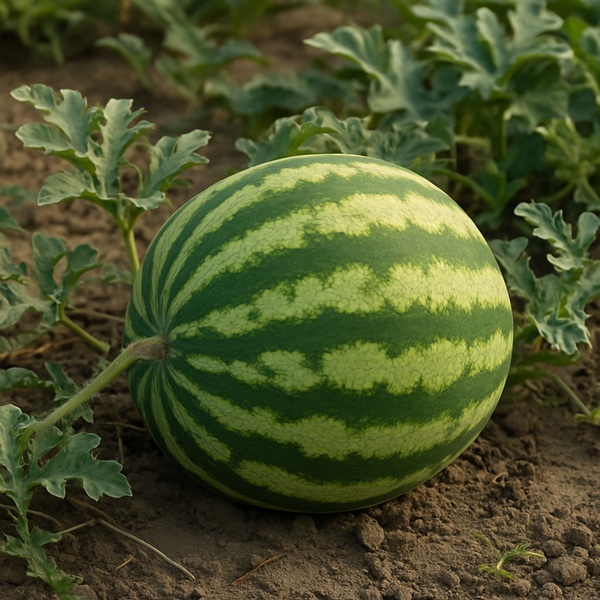
Watermelon (Citrullus lanatus) is one of the most beloved melon crops in Ukraine. It is widely grown both in home gardens and on commercial farms, especially in the southern and central regions. This heat-loving crop requires plenty of sunlight, well-warmed soil, and stable air temperatures. However, with the right approach, watermelon can be grown not only in the Kherson, Mykolaiv, or Odesa regions, but also farther north — from Vinnytsia to Cherkasy, and with the use of seedlings and temporary covers, even in the Kyiv region.
Watermelon is an annual plant with long trailing vines, a powerful root system, and high temperature requirements. Seeds need at least +15°C to germinate, while full development of stems and fruits requires temperatures from +22 to +30°C. The plant tolerates even short-term frosts poorly, especially at the seedling and budding stages. Even so, with proper care, watermelon grows well even in a temperate climate, producing fruits weighing from 2 to 10 kg or more.
The following watermelon varieties and hybrids are especially popular in Ukraine: ‘Ogonyok,’ ‘Crimson Sweet,’ ‘Madin F1,’ ‘Bonta F1,’ and ‘Sorento F1.’ They are characterized by early ripening, good keeping quality, and resistance to the main diseases. When choosing a variety, it is important to consider not only taste and fruit size, but also the length of the growing season. For northern regions, it is better to choose ultra-early varieties (65–75 days), while in the south mid-season ones (80–90 days) can also be grown. It is best to plant several varieties at the same time — this increases yield and helps offset weather-related risks.
For growing watermelon, you should choose the sunniest possible site, protected from the wind. Southern slopes and areas with light sandy loam or loamy soils are ideal. Watermelon absolutely does not tolerate standing water, heavy, acidic, or waterlogged soils. The best preceding crops are winter cereals, legumes, as well as cabbage, carrots, and onions. Watermelon must not be planted after other cucurbit crops because of the risk of shared diseases and pests.
The soil is prepared in autumn: organic fertilizers such as well-rotted manure or compost are applied, deep digging is carried out (25–30 cm), and liming is done if necessary. In spring, the site is leveled, harrowed, and loosened again. To improve aeration and water permeability, sand and wood ash are added. If cultivation is carried out on light sandy soils, it is advisable to add peat or humus to improve moisture retention and fertility.
The optimal pH level for watermelon is 6.5 to 7.5. On poor soils, 7–10 days before planting, compound fertilizers such as nitroammophoska or ammophoska are applied at a rate of 30–40 g/m². It is recommended to add 1 teaspoon of superphosphate and a handful of humus to each planting hole. Good drainage is essential, especially in areas with frequent rain — stagnant water causes root rot and crop loss. An added advantage is mulching with agrofabric or black plastic film, which helps the soil warm up faster and reduces weed growth.
In Ukraine, watermelon can be grown in two ways: by direct sowing into open ground or through seedlings. In southern and steppe zones, direct sowing is practiced from late April to early May, when the soil warms up to +14 to +16°C. In the central and northern regions, the seedling method is more practical, as it allows harvest 2–3 weeks earlier.
For growing seedlings, peat cups or cell trays are used so the roots are not damaged during transplanting. Seeds are sown 25–30 days before the planned transplanting into open ground, usually in late March or early April. Before sowing, the seeds are soaked in warm water, sometimes with added growth stimulants. Seedlings appear in 4–6 days, and about 10 days later the first feeding with a compound fertilizer is carried out. One week before planting, the seedlings must be hardened off by gradually exposing them to open air.
Planting into the soil, or sowing seeds directly, is done according to the following pattern: 100–150 cm between rows and 70–100 cm between plants within the row. With a strip system, two rows are placed 50–60 cm apart, with up to 140 cm between strips. Before planting, 1 liter of warm water is poured into each hole. After planting, the plants can be covered with agrofabric or film to create a favorable microclimate. This is especially important during unstable spring weather, when night temperatures may drop below +10°C.
Proper care is the key to a high watermelon yield. The greatest attention should be paid to watering, especially during active growth, flowering, and fruit formation. Watering should be infrequent but abundant, so that moisture penetrates 20–30 cm deep into the soil. Surface watering is ineffective because it encourages the development of a shallow root system and reduces the plant’s drought resistance. Watering is done 1–2 times a week depending on the weather, using warm water no cooler than +22°C, preferably in the morning or evening.
At the fruit-ripening stage, watering frequency is reduced, and before harvest it is stopped altogether. Excess moisture during this period leads to cracking and worsens the taste. After watering, the soil should be loosened carefully so as not to damage the surface roots. Vine formation involves leaving 2–3 main shoots and pinching off the rest. No more than 2 fruits are left on each vine — this makes it possible to obtain large and sweet watermelons.
The first feeding is carried out at the stage of 2–3 true leaves: nitrogen fertilizers are used, such as a urea solution or manure infusion. The next feeding is done during budding, this time with a greater emphasis on phosphorus and potassium, such as monopotassium phosphate or an ash solution. It is important to alternate organic and mineral feedings, not to exceed the dosage, and not to apply fertilizers to dry soil. Feeding is best done in the evening or in cloudy weather, followed by lightly rinsing the leaves with water.
Despite watermelon’s general resistance to pests, under Ukraine’s unstable climate the crop may suffer from diseases. The most common are:
Powdery mildew. A white coating appears on the leaves and spreads quickly in humid weather.
Fusarium wilt. A fungal infection that affects the root system — the leaves wilt and dry out, and the plant dies.
Anthracnose. Causes spots on leaves and fruits, especially in rainy weather.
Prevention includes crop rotation, returning watermelon to the same site no earlier than after 4–5 years, pre-sowing seed treatment, growing resistant varieties, and applying fungicides such as Ridomil, HOM, or Bordeaux mixture. Watering should be done only at the root, without wetting the leaves. Excessively dense planting encourages the spread of infection, so it is important to keep the recommended spacing.
Among the pests, the most dangerous are:
Aphids. They suck sap from young shoots and can carry viruses.
Spider mites. Active in hot weather, they cause the leaves to shrivel.
Thrips and wireworms. They damage the root system and shoots.
To protect the plants, biological products such as Fitoverm and Aktofit, insecticides such as Confidor and Actellic, as well as folk remedies like garlic, tobacco, and soap infusions are used. Planting hygiene, regular weeding, removal of affected plants, and good air circulation between rows help reduce the risk of problems.
The ripening time of watermelons depends on the variety, weather, and growing region. In southern Ukraine, the first fruits can be harvested as early as late July, while in the central regions harvest usually begins in mid-August. The main signs of ripeness are:
– a dull sound when tapped;
– a dry stem;
– a clearly visible yellow spot on the side where the watermelon rested on the ground;
– a strong contrast between the dark and light stripes on the rind.
Watermelons are cut with a sharp knife or pruners, leaving a stem 3–4 cm long. They are best stored in a dry, well-ventilated room at a temperature of +8 to +12°C. Under such conditions, medium-late varieties can be stored for up to 2 months. It is very important to avoid impacts and cracks, as these significantly shorten storage life.
Given climate change and the expansion of warmer zones, watermelon cultivation in Ukraine is becoming increasingly promising even in the central and northern regions. Thanks to modern agricultural practices such as drip irrigation, mulching, and growing under agrofabric, both yield and fruit quality improve significantly. Watermelon is not only a tasty but also a healthy berry, rich in lycopene, potassium, magnesium, and vitamins. Growing it is a worthwhile investment both for home gardeners and for farmers.