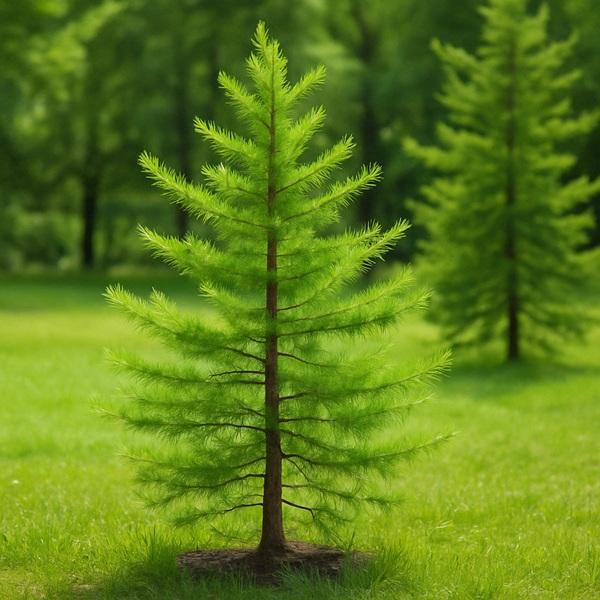
Larch is one of the few coniferous trees that sheds its needles for the winter. This unique feature makes it especially attractive in ornamental landscaping. The genus Larix includes about 10 species distributed across the Northern Hemisphere. In Ukraine, the most commonly grown are European larch (Larix decidua), Siberian larch (Larix sibirica), and Japanese larch (Larix kaempferi). Each of these species has high ornamental value, cold hardiness, resistance to disease, and longevity. The average lifespan of larch is 500–700 years, which makes it a truly long-lived tree in parks, squares, and botanical gardens.
Larch adapts well to the climatic conditions of most regions of Ukraine. In the Carpathians and Polissia, it feels especially comfortable thanks to sufficient moisture and cool summers. In the central and eastern regions, greater care is needed when choosing a planting site, since these areas suffer from drought more often. Southern Ukraine is also suitable for growing larch, especially Japanese or European larch, but it is important to ensure regular watering during the first years after planting. This tree looks excellent both in group and solitary plantings and is suitable for creating avenues, hedges, or specimen accents in landscape design.
The uniqueness of larch lies in its seasonal change. In spring, the needles emerge bright green; in summer, they take on a rich emerald shade; and in autumn, they turn golden. After needle fall, the crown is revealed, and the elegant structure of the branches becomes visible. This gives the tree a striking appearance throughout the year, which designers value highly. Larch also improves air quality, has antiseptic properties, and favorably affects the microclimate of a site. Its wood is strong, resistant to decay, and highly valued in construction and furniture making.
Larch is light-loving, and this is the key factor when choosing a site for planting. It tolerates prolonged shade poorly, especially at a young age. Lack of light slows growth, causes shoots to become stretched, and weakens needle development. The ideal place is an open, well-lit space protected from strong winds. Both flat ground and slopes with well-drained soil are suitable. It is not recommended to plant larch in lowlands where water may stagnate, because its root system is sensitive to a lack of oxygen.
Soil preparation is one of the most important stages. Larch prefers light, loose, slightly acidic or neutral soils. Heavy clay soils are improved by adding sand, peat, and humus. If the soil is highly acidic (pH < 5.5), lime or dolomite flour is added. On plots with a high groundwater level, a drainage layer of crushed stone, expanded clay, or broken brick 15–20 cm thick must be created. A planting pit 60–80 cm deep and wide is dug and filled with a mixture of turf soil, humus, and sand in a 2:1:1 ratio.
Larch saplings are planted in spring (April) or in autumn (September to early October). The main condition is the absence of frost and a moderate temperature. When planting, it is important not to bury the root collar — it should remain level with the soil surface. After placing the sapling, the pit is filled with the soil mix, firmed, and watered generously with 10–15 liters of water. The root zone is mulched with peat, needles, or wood chips — this preserves moisture, prevents weed growth, and protects the roots. The distance between trees is 2–4 meters depending on the variety and its role in landscaping.
In the first years after planting, regular watering is the most important task. Especially during dry periods, larch needs stable moisture. It is watered once or twice a week with 10–15 liters of water per tree, depending on the weather. After watering, it is advisable to loosen the soil around the trunk to a depth of 5–10 cm to improve aeration of the root system. This also breaks up the crust that forms after rain or watering and interferes with air exchange. The mulch layer is renewed every year, especially in spring, with added organic components.
Feeding begins in the second year of the tree’s life. In spring, complex mineral fertilizers with a predominance of nitrogen are applied, for example nitroammophoska, to stimulate shoot and needle growth. In June–July, it is advisable to add potassium-phosphorus mixtures to strengthen tissues, increase frost resistance, and protect against disease. In autumn, organic matter such as humus or compost is preferably added and mixed into the soil in the trunk circle. At the same time, excess fertilization should be avoided: larch does not like overfeeding, especially with nitrogen compounds.
Special attention should be paid to the condition of the needles. If they yellow out of season or fall too early, this indicates a problem: possible overwatering, nutrient deficiency, or disease. Young trees should be inspected regularly for pests. The greatest threat comes from caterpillars, aphids, and spider mites. At the first signs of damage, spraying with insecticides or biological products is used. In general, larch is a resilient tree that develops well with minimal care and rarely becomes diseased.
Larch has a beautiful, airy crown which, depending on the species, may be pyramidal, weeping, or spreading. Most varieties form an attractive shape on their own and do not require special pruning. But in ornamental gardening, especially for creating avenues or hedges, pruning can be useful. It is carried out in late winter or early spring, before sap flow begins. Dry, frost-damaged, injured, or poorly positioned branches are removed. Excessively long shoots may also be shortened to maintain symmetry.
For garden plots, grafted forms of larch are often chosen — dwarf forms or those with drooping branches. Such varieties are excellent for small gardens, alpine hills, or bonsai-style compositions. They tolerate trimming well while retaining their decorative value. At the same time, larch tends toward rapid vertical growth, so without control it can quickly exceed its planned size. In cities, this can be a drawback, so it is advisable to shape the crown with the surrounding space in mind.
In landscape design, larch is a versatile option. In spring, it pairs well with tulips, daffodils, and peonies; in summer, with roses, hostas, and conifers. In autumn, it becomes a striking golden accent. In winter, especially in a snowy garden, it looks graphic and architecturally interesting. Thanks to its ability to purify the air, it is planted near schools, kindergartens, and sanatoriums. It is suitable both for solitary planting and for group compositions with birches, spruces, pines, and thuja.
Larch has high frost resistance and winters without difficulty in most regions of Ukraine. The hardiest are Siberian and European larch — they can withstand frosts down to –40°C. However, young trees during the first 2–3 years after planting need some protection. The root zone is mulched with peat, leaves, or needles in a layer 10–15 cm thick. The trunk is wrapped with burlap or agrofibre to prevent frost cracks and sunscald in late winter. In spring, the cover is removed gradually.
In snowy winters, snow should be carefully shaken off the branches, especially on weeping varieties or grafted forms, to avoid breakage. If necessary, shoots can be tied up or wooden supports installed. In regions with frequent thaws, larch is treated with anti-stress preparations such as Epin or Zircon to support its immunity. It is also important to check the root collar after a thaw — excess moisture there may cause rotting.
Starting from the second year of life, larch usually does not require special covering. It develops a deep root system that allows it to extract moisture even in severe winters. If the tree is grown from seed under Ukrainian conditions or adapted to the local climate, it becomes more resilient with every year. Later, larch grows practically without intervention and winters successfully even in the coldest regions of the country.
Larch can be propagated by seed (generatively) or by cuttings and grafting (vegetatively). The seed method is most often used in nurseries and forestry. Seeds are collected in autumn, stratified in a refrigerator for about 2 months at +2 to +5°C, and sown in spring in boxes with a light substrate. They are covered with a thin layer of sand and then with film. Seedlings appear in 2–3 weeks, and the following year they can be planted into the ground.
Vegetative propagation is used mainly for ornamental forms — dwarf, weeping, or grafted ones. The most reliable method is grafting onto seedlings of common or Siberian larch. Scions are prepared in winter, stored in moist sand, and grafted in spring by improved copulation or behind the bark. Layering can also be used, but this method is slower. Ornamental forms, with proper care, live 50–70 years, while wild species live more than 300 years.
Larch is a symbol of strength, longevity, and resilience. It only becomes more beautiful with age, purifies the air, benefits the environment, and decorates the site. It looks excellent in solitary plantings, hedges, or as bonsai. With proper care, it requires almost no intervention. Its hardiness, minimal growing requirements, and ornamental qualities make larch one of the most promising trees for Ukrainian gardens.