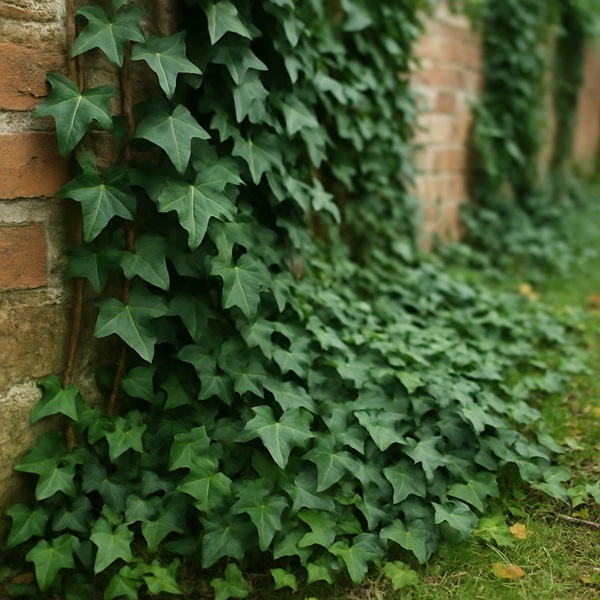
Ivy, or hedera (Hedera), is an evergreen vine that is highly popular both in open ground and in indoor gardening thanks to its hardiness and decorative qualities. In Ukraine, ivy is often used for vertical landscaping: it wraps around fences, house walls, arches, gazebos, and trellises, creating a dense cover of glossy foliage. However, it is important to keep in mind that not all ivy species are equally resistant to the climatic conditions of every region. This is especially relevant for the central and eastern parts of the country, where winters can be harsher than, for example, in Zakarpattia or in the south.
The most common species planted outdoors in Ukraine is common ivy (Hedera helix) — a frost-hardy and drought-tolerant species that takes pruning well and easily adapts to different lighting conditions. When choosing a variety, it is worth considering not only winter hardiness but also ornamental traits: leaf color and shape, growth rate, and ability to cling to supports. Varieties with variegated or deeply cut leaves are usually more sensitive to temperature fluctuations and require winter protection. It is also important to consider how aggressively the plant grows: ivy can crowd out other plants if its spread is not kept under control.
Ukrainian gardeners are using ivy more and more often in landscape design, but it is worth remembering that in some cases it may have a negative effect on buildings. For example, when growing on brick walls, its roots may gradually penetrate the joints in the masonry and damage them. That is why, if vertical greening with ivy is planned, it is better to provide a metal or wooden support from the start rather than directing the plant straight onto the wall of a house. At the same time, ivy’s dense green cover helps protect a structure from overheating in summer and partly from wind, which is especially relevant in the southern and steppe regions of Ukraine.
Planting ivy outdoors in Ukraine can be done both in spring and in autumn. Spring planting is preferable, especially in regions with severe winters, as it allows the plant to root and strengthen before frost arrives. Still, with proper soil preparation and correct winter protection, autumn planting is also possible, especially in the southern and western regions where winter is milder. The main rule is to avoid planting during periods of intense heat or in late autumn, when the temperature is already consistently below +10°C.
Ivy prefers loose, moderately moist, fertile soils with good air permeability. The best option is loam enriched with humus or compost. Before planting, the site is dug over to a depth of at least 30 cm, organic matter is added if necessary, and sand is incorporated to improve drainage. On heavy clay soils, a drainage layer of crushed stone or expanded clay is essential. Ivy does not tolerate stagnant water well, so low-lying areas with constant dampness are a poor choice. At the same time, the plant is resistant to short periods of drought, especially once it has rooted.
The choice of site depends on the intended use. If ivy is used as a groundcover plant, it is better to choose areas with light partial shade: in deep shade, growth slows down, while under scorching sun the leaves may lose their rich color and suffer sunburn. For vertical greening, it is best to plant it on the northern or eastern side of buildings. The optimal distance between plants is 30 to 50 cm, depending on the variety and the desired planting density. After planting, the plant is watered generously and the root zone is mulched with organic material — this helps retain moisture and protects the roots from overheating.
Caring for ivy in Ukrainian conditions is not difficult, but it does require consistency and an understanding of the climate of the specific region. During the first few months after planting, it is especially important to monitor soil moisture. Young plants are watered as the top layer dries out — usually once or twice a week, depending on the weather. Mature ivy becomes more drought-tolerant and can do without frequent watering, especially if it grows in partial shade or shade. However, in a dry summer, watering is necessary — overly dry soil may lead to leaf drop and slower growth.
Pruning is an important part of care. It is carried out in spring and throughout the growing season as needed. Its main purpose is to restrain overgrowth, shape the plant, and remove old or damaged shoots. If ivy is used decoratively on facades or arches, pruning helps maintain a neat appearance and prevents excessive spread. In regions with cold winters, such as Sumy, Chernihiv, or Kharkiv oblasts, it is recommended in autumn to shorten long shoots, bend them to the ground, and cover them with spruce branches or agrofabric.
Ivy needs feeding only in moderate amounts. In spring and early summer, nitrogen fertilizers are used to stimulate green growth. In autumn, phosphorus-potassium blends can be applied to improve winter hardiness. Excess fertilization is undesirable — too many nutrients make the shoots brittle and more vulnerable to disease. Slow-release compound fertilizers have proven especially effective and are usually applied once or twice per season. It is important to remember that ivy develops best with balanced care: moderate watering, sensible pruning, and careful feeding.
Ivy is one of those plants that can be propagated easily even at home. Thanks to its ability to root from shoots and cuttings, propagating ivy does not require special knowledge or equipment. The most reliable and convenient methods are as follows.
Cuttings. This is the most common method. Cuttings 10–15 cm long with 2–3 internodes are taken from the parent plant in spring or summer. The lower leaves are removed, and the cutting is placed in water or moist sand. Roots usually appear within 2–3 weeks at room temperature. Once rooted, the young plant is transplanted into open ground or a container.
Layering. This method is suitable for groundcover forms. One of the shoots is bent down to the soil, fixed with a staple, and covered with moist earth. After some time, roots form at the point of contact with the soil. Once rooted, the layer is separated from the parent plant and transplanted.
Division of the bush. A mature plant, especially one growing in a container, can be divided into several parts, each of which should have its own roots and shoots. Division is done in early spring before active growth begins.
All of these methods work well under Ukrainian climatic conditions and are used both outdoors and in indoor growing. The best time for rooting is from April to August. It is important to maintain moderate moisture and avoid direct sunlight during the rooting period, especially in the southern regions.
Despite its general hardiness, ivy can still suffer from diseases and pests. Problems most often arise in weakened plants growing under unfavorable conditions — for example, with stagnant moisture, overly dense planting, or a lack of light. The basis of prevention is careful observation of the plant’s condition and timely action. Among the main threats are the following.
Spider mite. Especially active during hot and dry periods. Its presence can be recognized by fine webbing and a marbled pattern on the leaves. Treatment with garlic infusions, green soap, or acaricides such as those based on abamectin is effective.
Scale insects and aphids. These often settle on young shoots. The leaves become sticky and lose their shine. Spraying with tobacco or onion infusions helps, and in severe cases insecticides are used.
Fungal diseases. Powdery mildew and gray mold develop when there is too much moisture. The leaves become coated and curl. The affected parts should be removed, and the plant treated with fungicides, such as copper-based products.
It is also important to ensure good ventilation, especially in dense plantings, in order to prevent stagnant air and moisture. Regular moderate watering, sanitary pruning, and proper lighting help avoid most problems.
The winter hardiness of ivy depends on the variety, the region, and the exact growing conditions. In the western and southern regions of Ukraine, ivy grown outdoors often does not need additional protection, especially if it is planted in a sheltered place near a wall or under the canopy of trees. In the central and northern regions — including Kyiv, Poltava, Cherkasy, and farther east — winter protection is essential.
In autumn, the shoots are bent to the ground.
The plant is covered with agrofabric, spruce branches, or dry leaves.
The root zone is mulched with a thick layer of peat or humus.
In spring, the covering is removed gradually to avoid burns and rotting.
In indoor culture, ivy is also undemanding. It adapts well to different light levels, but it feels best in bright, diffused light. In winter, it should be protected from the hot air of radiators, and the soil should not be allowed to dry out completely. The optimal temperature is +12 to +18°C. At higher temperatures and in dry air, the risk of pests increases. The plant should be sprayed regularly and repotted every 2–3 years.
Indoor ivy responds well to pinching — this stimulates branching and makes the plant fuller. It can be grown on a support, trained along a wall, or used as a trailing plant in hanging pots. So ivy is a truly versatile crop: it is equally suitable for landscaping a garden plot and for decorating the interior of a home, office, or winter garden.