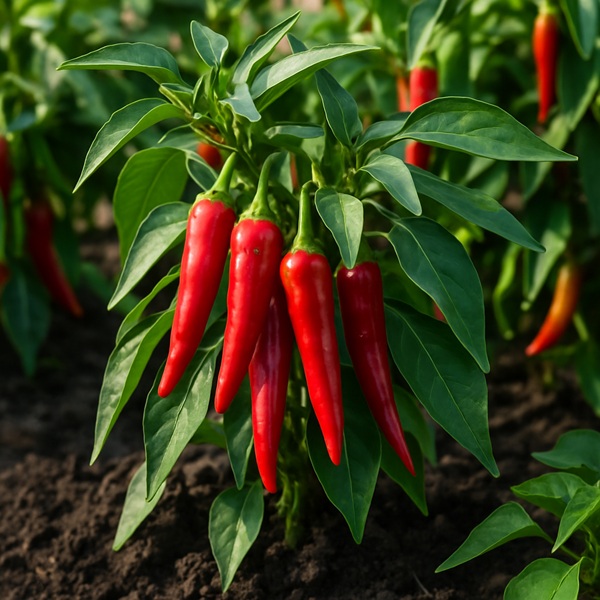
Hot pepper, known as chili pepper (Capsicum annuum, Capsicum frutescens, and others), has long moved beyond its native Central and South America and has confidently taken root in the garden beds of Ukrainian growers. This crop is valued not only for its piquant flavor, but also for its ornamental appeal, medicinal properties, and versatility in cooking. Growing chili peppers in Ukraine is becoming increasingly popular thanks to the large number of varieties that adapt well to our climate — in open ground, in greenhouses, and even in pots on a windowsill.
Chili is a perennial plant in the tropics, but in Ukraine it is mostly grown as an annual crop. The height of the bush depends on the variety and growing conditions, ranging from 30 to 100 cm. The fruits are pods of various shapes — conical, cylindrical, or round — from 2 to 10 cm long, and they may be green, red, yellow, purple, or even black. Heat is measured on the Scoville scale (SHU): for chili peppers, it can range from 10,000 to 500,000 units or more.
Popular varieties in Ukraine include Chilean Fountain, Fire, Dragon, Cayenne, Jalapeño, Bird’s Eye, Ogonyok, and Rocoto. Some are well suited to open-ground cultivation, while others are suitable only for greenhouses or balcony growing. Chili pepper needs warmth, light, fertile soil, and regular care. But with proper growing practices, it produces a stable harvest and becomes a true decoration of the plot thanks to its bright fruits against a mass of dark foliage.
To grow a healthy and productive chili pepper bush, it is essential to choose the site carefully and prepare the soil properly. The plant loves light and warmth and does not tolerate waterlogging. In Ukraine, it is important to consider the microclimate of the site: the amount of sun, exposure to wind, and how quickly the soil warms up. In the central and northern regions, chili peppers are recommended to be grown from seedlings; in the south, direct sowing is also possible.
Optimal conditions:
Light: a southern exposure, with at least 10–12 hours of sunlight a day.
Temperature: ideal for growth is +18 to +25°C. At +10°C, growth stops, and at +5°C, the plant may begin to die back.
Soil: light, fertile, well-drained, with a pH of 6.0–6.8. Sandy loam or light loam is best.
Soil preparation:
In autumn, the site is dug over and enriched with humus (up to 5 kg/m²), ash (100–150 g/m²), and superphosphate.
In spring, the soil is loosened, leveled, and supplemented with compost or biohumus.
In greenhouses, it is advisable to add coconut substrate or vermiculite to improve moisture retention.
Placement:
In open ground — a sunny place protected from drafts.
For balcony growing — a south- or southwest-facing side, with large pots required.
In a greenhouse — drip irrigation and regular ventilation are desirable.
Proper site preparation is the key to a strong bush, active flowering, and abundant fruiting. It is not recommended to grow chili peppers next to other nightshades — crop rotation is a better practice.
Under Ukrainian conditions, chili peppers are usually grown from seedlings. The reason is the long growing season and the plant’s requirements for soil temperature. Direct sowing in open ground is possible only in the southern regions, and even then only with pre-germinated seeds and protective covering at the start.
Sowing dates:
The optimal period is mid-February to early March.
Sowing in April is suitable only for balcony growing or greenhouses.
Seeds germinate in 5–12 days at a temperature of +24 to +28°C.
Technique:
Seeds are soaked for 8–12 hours in warm water or a growth stimulant.
They are sown in containers or peat tablets to a depth of 0.5–1 cm.
After two true leaves appear, the seedlings are pricked out into individual cups.
Care:
Lighting — 12–14 hours a day; supplemental lighting is necessary.
Watering — moderate, without stagnant moisture.
The first feedings are applied after the 3rd–4th leaf: first nitrogen-based, then complex fertilizers.
Ten to fourteen days before transplanting, the seedlings are hardened off: they are taken outdoors every day, with the duration gradually increased. Hardened seedlings form stronger bushes and establish themselves better.
After strong seedlings have been grown, one of the most important stages begins — transplanting the plants into open ground or a greenhouse. In Ukraine, this is most often done in mid-May, when the risk of night frosts has passed and the soil temperature remains steadily above +15°C. Cold is the main enemy of chili pepper: even a short drop in temperature can slow growth and affect fruiting.
Planting layout:
The distance between plants is 30–40 cm, and between rows 50–60 cm.
Humus, ash, and a little water are added to each hole, then the seedlings are transplanted with the root ball intact.
After planting, the area is mulched with peat, grass, or straw — this helps retain moisture and suppress weeds.
Care:
During the first week, the plants are shaded and kept evenly moist.
Watering is done 1–2 times a week, and more often during flowering and fruit filling.
Weeding and loosening are carried out regularly, especially after rain.
Bush formation:
In greenhouses and with tall varieties, the top is pinched above the 6th–8th leaf.
Side shoots are removed from the lower part of the bush to improve ventilation.
Avoid pruning fruiting branches — this is where the main crop sets.
Proper bush formation improves yield, makes care easier, and reduces the risk of disease thanks to better ventilation and light penetration inside the plant.
Chili pepper naturally has a certain resistance to disease, but under high humidity, dense planting, or sudden temperature changes, the plant can still become sick. Problems arise especially often in protected cultivation, particularly in greenhouses. The best way to avoid trouble is regular inspection and preventive care.
The most common diseases:
Fusarium and verticillium wilt: fungal infections that cause wilting. Protection includes seed disinfection, crop rotation, and treatment with biological products.
Late blight: brown spots on leaves and fruits, especially dangerous in cool summers. Treatment with Fitosporin or Bordeaux mixture is recommended.
Damping-off: threatens seedlings under excessive watering. Prevention includes sterile soil and moderate moisture.
Pests:
Aphids and thrips: suck sap and deform the leaves. Aktofit and Biotlin are used against them.
Spider mites: appear in hot weather and leave webbing. Spraying with garlic infusion or a soap solution can help.
Whitefly: especially dangerous in greenhouses. Sticky traps are used, and insecticides are applied if needed.
Prevention:
Do not overcrowd the plantings.
Regularly remove weeds and damaged leaves.
Use biological protection such as Trichodermin, Planriz, and wood ash.
Timely detection of problems and gentle control methods will preserve the harvest and minimize the need for chemicals. It is especially important to monitor the condition of the leaves, since they are the first to signal danger.
The first chili pepper harvest usually ripens 100–120 days after sowing. The fruits can be picked either at technical ripeness, when they are green, or at biological ripeness, when they are bright red, yellow, and so on. Regular harvesting stimulates the formation of new fruits and extends the fruiting period.
Harvesting:
The fruits are cut with secateurs or scissors, without damaging the stem.
The harvest is gathered every 3–5 days.
For drying, it is better to use ripe fruits with firm skin.
Storage:
Fresh chili keeps in the refrigerator for up to 10–14 days.
For long-term storage, drying is best — in the air, in the oven, or in a dehydrator.
Freezing, pickling, and making sauces are also suitable options.
Yield:
One bush produces 20–50 fruits, depending on the variety and care.
In the southern regions, the harvest continues until the first frosts.
In pots, chili can be grown as a perennial crop, provided it is kept warm through the winter.
Chili pepper is not just a “fiery” crop — it is also useful, decorative, and, most importantly, rewarding to grow. It is perfectly suited to Ukrainian conditions and will become a real highlight of your garden or windowsill.