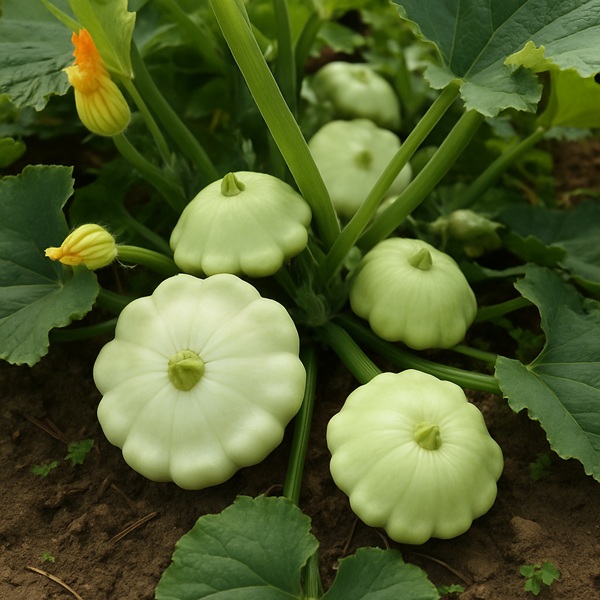
Pattypan squash (Cucurbita pepo var. patissoniana) is an interesting variety of gourd crop whose shape resembles a flying saucer. Its unusual form, compact size, and excellent taste have made it popular not only among cooks but also among gardeners. Pattypan squash is heat-loving and prefers fertile, well-warmed soil. In Ukraine, it grows well across almost the entire country — from Zakarpattia to the southern regions — provided the basic rules of cultivation are followed.
The diversity of varieties makes it possible to grow white, yellow, green, and striped pattypan squash. The most popular are early-maturing varieties: White 13, Sunny Bunny, Cheburashka, Ufimsky, as well as hybrids such as Polo F1, Hahat F1, and others. Yields reach 3–5 kg per bush, and the first fruits can be harvested as early as 45–50 days after emergence. Young pattypans have tender flesh that is ideal for preserving and frying, while mature fruits are suitable for long-term storage and are excellent for stuffing.
Pattypan squash is valued not only as a food crop but also as an ornamental one: thanks to the original shape of its fruits, it decorates garden beds and serves as an element of autumn arrangements. The plant forms a dense green mass that suppresses weeds. It is resistant to most diseases affecting gourd crops, but it still needs regular care, especially during ovary formation and periods of sharp weather changes. For beginners, pattypan squash is a good alternative to zucchini or courgettes.
Like most gourds, pattypan squash needs warmth and sunlight. It grows best in areas protected from wind, with well-drained, light soil rich in organic matter. Excess moisture and shade negatively affect flowering and fruiting.
Site requirements:
Lighting: at least 10 hours of sunlight a day. In shade, plants become leggy and fruit formation declines.
Soil: sandy or light loam with a slightly acidic to neutral reaction (pH 6.5–7.2).
Previous crops: the best are cabbage, legumes, and root vegetables. Undesirable predecessors are other gourds such as zucchini, cucumbers, and pumpkins.
Bed preparation:
In autumn, apply humus or well-rotted compost (up to 5 kg/m²).
In spring, dig over the area with the addition of ash (100–150 g/m²) and superphosphate (30–40 g/m²).
Form planting holes or furrows 60–80 cm apart.
Compact pattypan varieties can be grown on balconies or in containers with a volume of 10 liters or more. In open ground, it is recommended to mulch the beds with straw or cut grass to retain moisture and prevent crust formation after rain.
Pattypan squash can be grown either by direct sowing in open ground or through seedlings. Both options are suitable for the Ukrainian climate. In the southern and central regions, seeds are often sown directly into the soil in late April or early May. In the northern and western regions, the seedling method is better.
Seedling method:
Sow in late March or early April in individual pots with a volume of 300–500 ml.
The substrate should be loose and nutritious: peat, humus, and sand.
Seeds are planted 3–4 cm deep, with a germination temperature of +24 to +26°C.
Seedlings appear in 5–7 days. After 2 true leaves form, hardening begins.
Seedlings are transplanted into open ground at 20–25 days old, once the threat of frost has passed. Before transplanting, the plants are watered to preserve the root ball and are moved using the transshipment method.
Direct sowing:
Seeds are planted 4–5 cm deep in warmed soil (soil temperature no lower than +15°C).
They can first be soaked for 12 hours in warm water or a growth stimulant.
In cold weather, germination slows down, and sprouts may be affected by root rot.
To speed up emergence, the bed is covered with agrofabric or film. Once the sprouts appear, the cover is removed. During the first 2–3 weeks, it is important to maintain moisture, weed regularly, and loosen the row spacing.
After seedlings emerge or transplants take root, the main period of plant care begins. Pattypan squash is not overly demanding, but regular care significantly affects the harvest. The most important things are timely watering, proper feeding, and loosening the soil.
Watering:
Pattypans are moisture-loving and should be watered 1–2 times a week depending on the weather.
During flowering and fruit filling, moisture is especially important because it stimulates ovary formation.
Water at the root, avoiding the leaves, which lowers the risk of powdery mildew.
In hot weather, water early in the morning or in the evening, using warm water.
Feeding:
The first feeding is given 7–10 days after transplanting: organic or nitrogen-based, such as mullein infusion or ammonium nitrate.
The second is during the budding stage: a complex phosphorus-potassium fertilizer.
After that, feed every 2–3 weeks. Mineral and organic feedings can be alternated.
Plants respond well to ash infusions and green fertilizers.
Formation:
If the plants become too dense, remove some of the lower leaves and weak shoots.
Place boards or straw under large fruits to prevent rot.
Loosen the row spacing after every watering or rain.
Mulching with straw, sawdust, or bark helps retain moisture, suppresses weeds, and reduces temperature fluctuations around the root zone. This is especially effective on light soils that dry out quickly.
Despite their overall resistance, pattypan squash can suffer from diseases and pests, especially in unfavorable weather or under high humidity. The main diseases are the same as those affecting zucchini and pumpkins. Prevention, plant inspection, and crop rotation are essential.
Typical diseases:
Powdery mildew: a white coating on the leaves. Treatment: fungicides such as Topaz or Bayleton.
Downy mildew: yellowish spots and a gray coating. Ridomil Gold and Previcur are used.
Fusarium and bacterial disease: wilting and rotting. Prevention includes seed disinfection and crop rotation.
Pests:
Aphids: suck sap from young leaves.
Spider mites: tiny pests that leave pinpoint damage.
Slugs: damage fruits in wet weather.
Protection:
Folk remedies: ash dust, soap solution, garlic and mustard infusions.
Biological products: Fitoverm, Bikol.
Insecticides: in case of severe infestation, Actellic or Confidor, strictly according to instructions.
To minimize risks, avoid overcrowding the planting, overwatering, and leaving plant debris in the garden after harvest, since all of this becomes a source of infection for the following season.
Pattypan squash is an early-maturing crop. The fruits form just 6–8 weeks after emergence. Regular harvesting stimulates the formation of new ovaries and extends fruiting right up to the first frosts.
Harvesting:
Young fruits are picked every 2–3 days when they reach 5–7 cm in diameter.
Overripe fruits become hard and less tasty and slow the growth of new ones.
Cut the fruits with secateurs or a knife, leaving the stem attached.
Storage:
Young pattypans keep in the refrigerator for 7–10 days.
Mature fruits can be stored in a cool room for up to 2–3 months.
They can also be preserved, frozen, or used for stuffing.
Yield:
On average, 3–5 kg is harvested from one bush, sometimes up to 7 kg per season.
Regular picking is the key to continuous fruiting.
The final harvest is carried out before the first frosts.
Pattypan squash is an easy-to-grow, nutritious, and decorative crop that thrives in the Ukrainian climate. It will brighten not only the garden bed but also the table, becoming a source of inspiration for both the gardener and the cook.