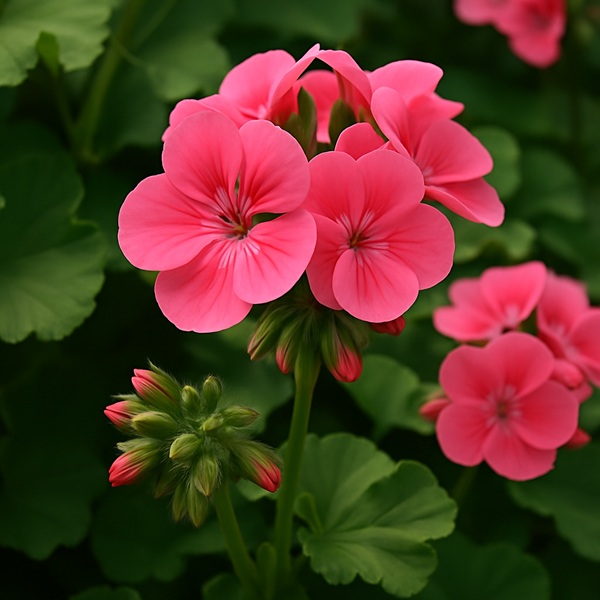
Pelargonium is one of the most beloved and popular plants among both beginner flower growers and experienced landscape designers. It is often mistakenly called geranium, although botanically it is a separate genus within the geranium family. Pelargonium’s main advantage is its versatility: it thrives both indoors and outdoors. In Ukraine, pelargonium is most often grown as a potted plant, displayed on balconies, terraces, or in the garden during summer, and then brought back into a warm room for the winter.
Pelargonium stands out for its wide range of varieties: zonal, ivy-leaved, scented, regal, tulip-flowered, cactus-flowered — each has its own ornamental value. The most common are zonal varieties with rounded leaves edged by a characteristic dark band and bright flower clusters on long stems. Regal varieties are more demanding, but they produce large velvety flowers with wavy petals. Ivy-leaved types are perfect for hanging baskets. The color palette is exceptionally broad — from snow white to deep burgundy, including double and variegated forms.
In Ukrainian conditions, pelargonium develops beautifully from April to October, especially in regions with a moderately warm climate. Even in the northern and eastern regions, it can be grown successfully if a few rules are followed: warmth, plenty of light, and no excess moisture. Pelargonium does not like heavy or waterlogged soils, but it responds gratefully to minimal care, flowering generously and forming dense, bushy plants.
Pelargonium can be grown from cuttings, from seed, or purchased as ready-made seedlings. The fastest and most reliable method is propagation by cuttings, since it preserves all the traits of the variety. The seed method is useful if you want to grow many plants or experiment with hybrids. Both methods have their own features that are worth considering depending on growing conditions.
Cuttings:
The best time is February–March or August–September.
Take a cutting 7–10 cm long, remove the lower leaves, and leave 2–3 upper ones.
Let the cut dry for 2–3 hours, then root it in a light substrate or in water.
The rooting temperature should be +20 to +22°C, without direct sunlight. Roots appear in 2–3 weeks.
Sowing seeds:
The best period is January–March.
Seeds are sown 0.5 cm deep in a moist, loose substrate such as peat, sand, and vermiculite.
At a temperature of +21 to +24°C, seedlings appear in 5–10 days.
Once 2–3 true leaves appear, the seedlings are pricked out.
Substrate and containers:
Substrate: turf soil, humus, peat, and sand (2:1:1:1).
Drainage is essential — expanded clay or gravel.
Pots should be small — pelargonium blooms more abundantly when slightly pot-bound.
For outdoor planting — in containers, boxes, or flower beds — it is important to provide drainage and protection from wind. The spacing between plants should be 20–30 cm to ensure free air circulation and help prevent fungal diseases.
Pelargonium is native to South Africa, so its main requirements reflect its adaptation to a warm, dry climate. It does not tolerate waterlogging and will not bloom properly in shade. With the right placement and watering routine, you can achieve continuous flowering from spring until autumn.
Light:
It needs at least 6 hours of direct sunlight per day.
With insufficient light, pelargonium becomes leggy, the leaves grow pale, and flowering weakens.
The ideal placement is on south- or southeast-facing windowsills or in sunny flower beds.
Temperature:
The optimal summer temperature is +20 to +25°C; in spring and autumn, it should not drop below +12°C.
A short-term drop to +5°C is possible, but undesirable.
The winter resting period should be at +8 to +12°C, without watering or feeding.
Humidity and watering:
Pelargonium does not like high air humidity, so misting is undesirable.
Water moderately, after the top layer of soil has dried out. Excess water causes rot.
Feed once every 10–14 days during active growth, from March to September.
To encourage bushier growth, the shoot tips are pinched. It is also important to remove faded flower clusters — this extends the decorative period and stimulates the formation of new buds.
With proper care, pelargonium can bloom for many years in a row. However, repotting and correct wintering are essential if you want to preserve the plant’s vitality and ornamental quality. In the Ukrainian climate, these steps are especially important, since winter temperatures do not allow pelargonium to remain outdoors.
Repotting:
Done in spring — in late February or early March.
Young plants are repotted every year, mature ones every 2–3 years.
During repotting, it is better not to disturb the root ball: the best method is transshipment.
The new pot should be slightly larger than the previous one and must have drainage holes.
Wintering:
In October, gradually reduce watering and stop fertilizing.
Plants that have been outdoors should be brought inside before frost begins.
The ideal wintering temperature is +8 to +12°C. Light should be diffused but sufficient.
If natural light is lacking, grow lights are recommended.
Some growers use “dry” wintering: the bushes are removed from their pots, pruned, and stored in paper bags in a cool, dry room. This method is mainly suitable for zonal pelargoniums, but it requires experience.
Pelargonium grows quickly, and without regular shaping it may lose its decorative appeal. The shoots become elongated, the foliage thins out, and flowering decreases. To maintain a lush shape and support active blooming, the plant should be pinched and pruned on time.
Pinching:
Done at the stage of 5–7 leaves.
It encourages the formation of side shoots and creates a fuller bush.
The procedure is repeated every 3–4 weeks depending on the growth rate.
Pruning:
The main pruning is done in autumn, in September–October, before wintering.
Weak, diseased, and elongated branches are removed, leaving 3–4 internodes.
In spring, light corrective shaping and sanitary pruning are carried out.
Rejuvenation:
A full rejuvenation is recommended once every 2–3 years — all shoots are cut back hard.
After that, the plant recovers quickly, forms strong branches, and blooms actively.
Regular crown shaping not only improves the plant’s appearance but also helps prevent fungal infections by ensuring good air circulation between the leaves.
Thanks to its long-lasting flowering, wide variety of forms and shades, and resistance to heat and drought, pelargonium is an ideal element in landscape design. It combines well with other flowers and also looks excellent as a specimen plant or in container arrangements.
Ways to use it:
On balconies: ivy-leaved varieties decorate hanging baskets and boxes.
In flower beds: zonal and dwarf varieties are suitable for borders and mixed beds.
In containers: it pairs well with lobelia, petunia, salvia, and dichondra.
Harmonious combinations:
With ornamental grasses, verbena, and bacopa.
Scented varieties work especially well near terraces, gazebos, and garden benches.
White and pink shades contrast beautifully with blue or purple companions.
Advantages for landscaping:
Resistant to drought and heat.
Blooms continuously until the first frosts.
Easy to grow and propagate.
Pelargonium is not just a houseplant, but a true decoration for any space — from a country courtyard to a modern urban balcony. It is easy to care for, and in return it offers luxurious flowering, fragrance, and mood in generous and lasting measure.