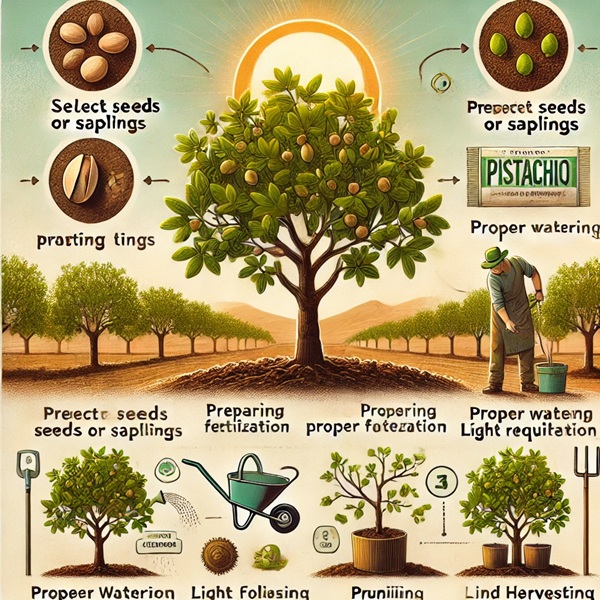
The pistachio tree is a perennial plant valued for its nutritious nuts, drought tolerance, and decorative appearance. In nature, pistachios grow in warm regions with hot climates, but with proper care they can also be grown in cooler areas. This tree requires patience, since the first harvest can be obtained only after 5–7 years, while maximum productivity is reached after 15 years. However, the plant’s longevity, which can extend up to 100 years, makes pistachio a worthwhile crop to grow. In this article, we will look at every stage, from choosing planting material to harvesting and caring for the tree.
Pistachio is a dioecious plant, which means that for fruiting you need at least one male tree and several female trees. The optimal ratio is 1 male tree for every 6–8 female trees.
The most popular varieties for cultivation are:
Kerman — one of the most productive varieties, producing large nuts and showing good disease resistance.
Peters — most often used as the male tree for pollination.
Sirora — a variety with high flavor quality that is suitable for cooler climates.
Pistachios can be propagated in three main ways:
From seed — the longest method, since the tree will begin to bear fruit only after 10–12 years.
From seedlings — the better option, because the trees retain varietal traits and produce fruit within 5–7 years.
Grafting onto rootstock — speeds up fruiting and makes the plant more resilient.
If you decide to grow pistachios from seed, the seeds need to be stratified: soak them in water for 24 hours, then keep them in moist sand in the refrigerator at +4°C for 6 weeks.
Pistachios prefer a hot and dry climate, but they can tolerate short-term frosts down to -10°C. For successful growth, they need at least 300 sunny days per year.
The best planting conditions are:
Light, sandy, or loamy soil with a pH of 6.5–7.5.
The groundwater level should be no closer than 3 m, since pistachios do not tolerate stagnant moisture.
The site should be well ventilated, because the tree grows poorly in humid regions.
Seeds are best planted in spring, when the air temperature reaches 20–25°C.
Planting depth is 3–5 cm, with 5–7 m between seeds.
After planting, the soil should be well moistened.
Seedlings are planted in autumn or early spring.
The distance between trees should be 6–8 m, since pistachios have a very well-developed root system.
The planting hole should be 50–60 cm deep, with a drainage layer such as expanded clay or pebbles placed at the bottom.
After planting, the young tree is tied to a support and watered.
A pistachio tree does not require complicated care, but to achieve a good harvest, several rules should be followed.
Pistachios are drought-resistant, but when young they need regular watering:
During the first year after planting, water once every 7–10 days, using 20–30 liters of water per plant.
In the following years, water once every 3–4 weeks, and reduce watering in autumn and winter.
During periods of extreme heat, mature trees are watered once every 6 weeks to prevent premature fruit drop.
Crown formation begins in the 2nd or 3rd year after planting:
Remove weak and intertwined branches.
Shape 3–5 main scaffold branches to give the tree stability.
During the fruiting period, carry out sanitary pruning by removing dry branches.
In spring, apply nitrogen fertilizers to stimulate leaf growth.
In summer, apply phosphorus-potassium fertilizers for flowering and fruit set.
In autumn, apply organic fertilizers such as humus or compost to strengthen the root system.
Pistachios bloom in spring, but for fruit set it is important that male and female trees flower at the same time. Pollination occurs by wind, so in calm weather artificial pollination is recommended by shaking pollen from the male trees onto the female ones.
The fruits ripen in late August to early September. When the shells begin to split open, harvesting can begin.
Spread cloth or netting under the tree.
Shake the branches so the nuts fall down.
Remove the outer hulls and dry the nuts in the sun for 3–4 days.
When dried, they can be stored for up to 12 months in an airtight container.
When frozen, they can be stored for up to 2 years.
Fruit drop — lack of moisture or insufficient pollination.
Solution: increase watering and carry out artificial pollination.
Yellow leaves — excess moisture or nitrogen deficiency.
Solution: reduce watering and apply nitrogen fertilizer.
Root rot — stagnant water.
Solution: improve soil drainage and avoid overwatering.
Small nuts — lack of nutrients.
Solution: apply a balanced fertilizer with phosphorus and potassium.
Growing pistachios is a long-term process, but thanks to their high productivity and drought resistance, this tree can become a valuable addition to the garden. By following the rules of planting, watering, pruning, and pollination, you can grow healthy plants and achieve a stable harvest of tasty and nutritious nuts.