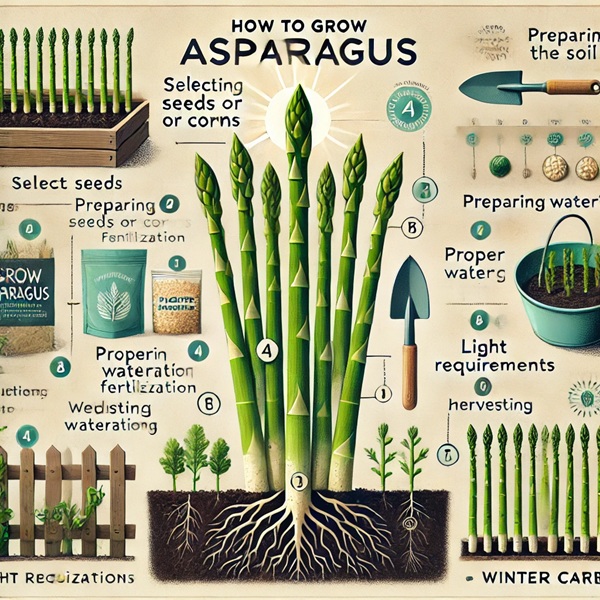
Asparagus is a perennial plant valued for its tender and nutritious shoots. Growing asparagus requires patience, since the first full harvest can only be obtained in the third year after planting, but this is offset by the plant’s high productivity and longevity. Asparagus can grow in one place for more than 10 years, and with proper care it will produce a stable and high-quality harvest. In this article, we will look at all stages of growing asparagus, from choosing planting material to harvesting and caring for the plant.
There are several main types of asparagus, which differ in appearance and taste qualities:
Green asparagus is the most popular type and is grown without protection from sunlight. Its shoots are rich in chlorophyll and have a pronounced flavor.
White asparagus is grown in complete darkness, which keeps it tender and free of any bitter aftertaste.
Purple asparagus stands out for its high antioxidant content and sweeter flavor.
When choosing a variety for planting, it is worth considering the climate. For example, frost-resistant varieties such as Argenteuil and Maria are suitable for colder regions, while Tsarskaya or Wellington are better for warmer areas.
Asparagus can be grown in two main ways:
From seed — this is a lengthy process that takes 2–3 years before the first harvest.
From crowns (seedlings) — a faster method, since the plants are already developed and a harvest can be obtained within a year.
Before planting, asparagus seeds are soaked in warm water for 24–48 hours, then germinated in a moist cloth until sprouts appear. To grow seedlings, the seeds are sown in a light substrate and kept at a temperature of 25–28°C.
Asparagus prefers light, fertile, and well-drained soil. The best option is sandy or loamy soil with neutral acidity (pH 6.5–7.5).
The soil is dug over to a depth of 40 cm, adding humus at 5–6 kg per 1 m².
Wood ash is added at 200 g per 1 m², along with compound fertilizers containing potassium and phosphorus.
In spring, before planting, the soil is loosened again and beds 100–120 cm wide are formed.
At the beginning of April–May, the seeds are sown in a greenhouse or in open ground under plastic cover.
Planting depth is 2–3 cm, with 50 cm between rows and 30 cm between plants.
After emergence, the seedlings are thinned out, leaving the strongest plants.
The spacing between rows should be 70–80 cm, and between plants 40–50 cm.
The crowns are planted 15–20 cm deep, the roots are spread out, and then covered with soil.
After planting, they are watered generously.
Asparagus needs moderate but regular watering, especially during the first years of growth.
During the period of active growth (May–July), it is watered 2–3 times a week, using 30–40 liters of water per 1 m².
In autumn, watering is reduced, and in winter it is stopped completely.
In spring, nitrogen fertilizers are applied, such as mullein infusion or ammonium nitrate.
In summer, the plants are fed with compound mineral fertilizers containing phosphorus and potassium.
In autumn, it is beneficial to add humus or compost.
Weeds should be removed regularly, since they can suppress young shoots.
After each watering, the soil should be loosened to improve aeration.
To protect asparagus from diseases, biological products against fungal infections are used, and against pests such as the asparagus beetle and nematodes, insecticides are applied.
Asparagus begins to bear shoots in the second or third year after planting.
The harvest period lasts 6–8 weeks, from April to June.
The shoots are cut when they reach 15–20 cm in height.
In the first harvest year, only 2–3 shoots are taken from each plant so that it can become stronger.
In autumn, dry stems are cut back, leaving 5 cm above the ground.
Phosphorus-potassium fertilizers are applied to strengthen the root system.
The beds are mulched with humus or peat in a layer 5–7 cm thick.
Slow growth of young shoots — lack of nutrients or insufficient watering.
Solution: apply nitrogen fertilizer and increase watering.
Yellowing leaves — a sign of fungal disease or magnesium deficiency.
Solution: treat with fungicides and add magnesium fertilizer.
Rotting at the base of the stem — excess moisture.
Solution: reduce watering and improve drainage.
Twisted shoots — pest damage, such as asparagus beetles or aphids.
Solution: treat with insecticides.
Growing asparagus requires patience, but this plant will repay the effort. It will not only provide a healthy harvest for many years, but also decorate the garden with its ornamental greenery. With proper care, asparagus will produce fresh and tasty shoots every year, making it an excellent addition to a healthy diet.