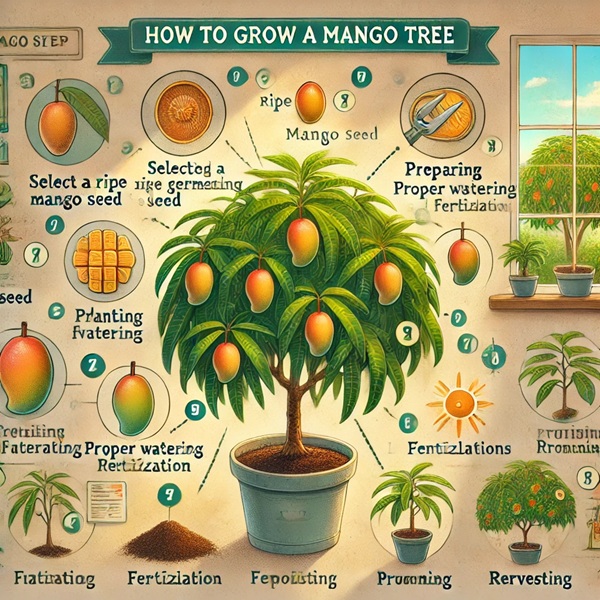
Mango is one of the most popular tropical fruits, known for its sweet taste and aromatic flesh. In the wild, mango trees can grow up to 30 meters tall and live for as long as 300 years, but with proper care they can also be grown at home. Despite its exotic origin, mango can be adapted to indoor growing or even to a garden if the climate allows. Growing mango is an engaging process that requires patience, since the plant develops slowly. In this article, we will take a detailed look at every stage of growing mango, from choosing planting material to caring for a mature tree.
Mango can be grown in three main ways:
From seed — this is the longest path, since a tree grown from a pit may begin to bear fruit only after 6–10 years. In addition, the fruits may differ from the parent variety. However, seed-grown plants are more resistant to local conditions.
From a seedling — a faster method, since seedlings begin producing fruit within 3–5 years. If the plant was grown in a nursery, it is often already adapted to container growing.
From a grafted tree — grafted mango trees are the best option for those who want fruit in the shortest possible time, usually within 2–3 years. They are also more compact and better suited for growing at home.
If you decide to grow mango from a pit, it is important to choose a ripe, healthy fruit. Organic mangoes are the best choice, since store-bought fruits are often treated with chemicals that can interfere with seed germination.
After the mango has been eaten, remove the pit and clean off any remaining flesh. Then follow these steps:
Opening the pit — carefully cut into the shell with a knife and remove the inner seed. This speeds up the germination process.
Soaking — the seed can be soaked in warm water for 24 hours or wrapped in a damp napkin and left in a warm place for 2–3 days.
Planting in soil — the seed is planted horizontally or at a slight angle, burying it 2–3 cm deep.
The optimal soil mix for mango is:
50% garden soil,
30% peat or humus,
20% sand or coconut substrate.
After planting, the pot is covered with film or glass to create a mini greenhouse. The first shoots appear in 2–4 weeks.
Mango is a light-loving plant. It needs at least 12–14 hours of light per day. The best place is a south-facing window, and in winter additional lighting with grow lamps will be necessary.
The air temperature should remain within 22–28°C, without sharp fluctuations. It is important to protect the young tree from drafts.
Watering should be moderate. The soil should always remain slightly moist, but not wet. In summer, mango is watered 2–3 times a week, and in winter once every 7–10 days.
To increase air humidity to no less than 60%, you can:
regularly mist the leaves,
use a humidifier,
place a container of water nearby.
When the mango seedling reaches 10–15 cm, it is transplanted into a pot 20–25 cm in diameter. Every 1–2 years, the plant is moved into a larger container.
Crown formation is necessary for compact growth:
When the tree reaches 50 cm, the top is cut off to stimulate the growth of side shoots.
Every spring, weak, dry, and damaged branches are removed.
In summer, young shoots are pinched back to create a fuller crown.
In spring, nitrogen fertilizers are applied to promote leaf growth.
In summer, phosphorus-potassium fertilizers are used to support flowering.
In autumn, organic fertilizers such as humus or ash are added.
Mango begins to flower after 4–6 years. The flowers are small, fragrant, and gathered in large clusters.
In nature, mango is pollinated by insects, but at home artificial pollination can be done with a soft brush by transferring pollen between flowers.
Fruiting begins 3–6 months after flowering. Ripe fruits become soft and develop their characteristic aroma.
Yellow leaves — lack of moisture or nutrients.
Solution: increase watering and apply fertilizer.
Flower and fruit drop — insufficient pollination.
Solution: carry out artificial pollination.
Leaf curling — dry air.
Solution: mist the plant regularly.
Root rot — excess moisture.
Solution: improve drainage and reduce watering.
Lack of growth — insufficient light.
Solution: move the plant to a brighter location.
Growing mango at home is an interesting activity that requires patience and proper care. By following recommendations for watering, lighting, feeding, and crown shaping, you can grow a beautiful and healthy tree. Under favorable conditions, it will become not only an attractive decorative plant, but also produce delicious fruit.