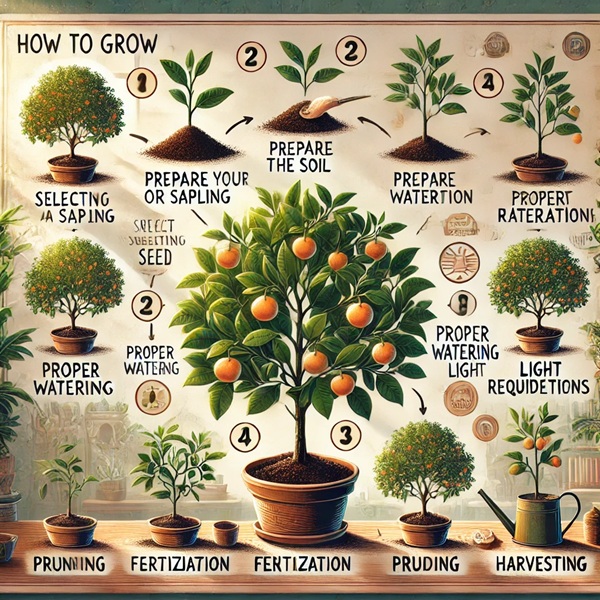
Mandarin is one of the most popular citrus plants and can be successfully grown at home or in the garden. Thanks to its attractive appearance, fragrant blossoms, and delicious fruits, a mandarin tree can serve not only as a decoration but also as a useful plant. It does not require overly complicated care, but for successful growth and fruiting, several important rules should be followed. In this article, we will take a detailed look at the process of growing mandarins, from choosing planting material to caring for a mature tree.
Mandarin can be grown in several ways:
From seed — this is the longest method, since a tree grown from seed will begin to bear fruit only after 6–10 years. In addition, the fruits may differ from the parent variety, although such plants are usually more resistant to environmental conditions.
From a seedling — this method allows you to get fruit within 2–3 years. It is best to choose grafted seedlings, since they preserve the characteristics of the parent plant.
From cuttings — a fast propagation method in which the tree retains the properties of the parent plant, but it requires careful attention during the rooting stage.
If you decide to grow a mandarin from seed, it is important to choose a ripe and healthy fruit. The seeds are removed, washed free of pulp, and planted in the soil immediately, since they quickly lose viability. To speed up germination, the seeds can be soaked in warm water for 24 hours.
A mandarin tree needs light, fertile, and well-drained soil. The optimal substrate mix is:
50% turf or leafy soil,
30% humus or compost,
20% sand or coconut substrate.
The pot should be spacious and have drainage holes, since the mandarin root system is sensitive to stagnant water. A drainage layer such as expanded clay or fine gravel is placed at the bottom.
The seeds are planted at a depth of 1–1.5 cm, the soil is moistened, and the pot is covered with film to create a greenhouse effect. The pot is then placed in a warm location with a temperature of 22–25°C. The first seedlings appear after 3–6 weeks.
If a seedling is used, it is planted in the prepared pot without burying the root collar. After planting, the plant is watered and placed in a bright location.
For successful growth, several important conditions must be maintained.
Mandarin needs bright, diffused light for at least 10–12 hours a day. It grows best on south-facing or southeast-facing windows. In winter, grow lights should be used.
In summer: 20–25°C.
In winter: 12–16°C, so the plant can rest before flowering.
Mandarin does not tolerate sudden temperature changes or drafts well, so it should not be placed near heating appliances.
In summer, mandarin is watered 2–3 times a week.
In winter, it is watered once every 7–10 days.
The water should be warm and settled.
To maintain air humidity at no less than 60%, the plant should be sprayed periodically or kept near a container of water.
During the active growing period, fertilizers are applied once every 2 weeks, and in winter once a month.
In spring, nitrogen fertilizers are used to stimulate leaf growth.
In summer, phosphorus-potassium fertilizers are applied for flowering and fruit formation.
In autumn, organic fertilizers such as humus and wood ash are useful for strengthening the plant’s immunity.
Young mandarin trees are repotted every year, while mature trees are repotted once every 2–3 years. The new pot should be 2–3 cm larger than the previous one. Repotting is done by careful transfer without damaging the root system.
In spring, weak and damaged branches are removed.
In summer, long shoots are shortened to form a compact crown.
In autumn, sanitary pruning is carried out by removing old and dried branches.
Mandarin begins to bloom in the third or fourth year after planting if grown from a seedling. The flowers are white and pleasantly fragrant.
To obtain fruit, pollination is necessary. At home, this can be done with a small brush by transferring pollen from one flower to another.
The fruits develop within 6–9 months. When the peel turns bright orange and firm, the mandarins can be harvested.
Yellow leaves — iron or magnesium deficiency.
Solution: apply iron chelate or magnesium fertilizer.
Falling ovaries — lack of nutrients or insufficient humidity.
Solution: feed the plant and increase air humidity.
Leaf curling — lack of moisture or dry air.
Solution: increase humidity and water more regularly.
Root rot — overwatering.
Solution: reduce watering and check drainage.
No flowering — lack of light or nutrients.
Solution: move the plant to a brighter place and apply fertilizer.
Growing mandarin is an interesting and rewarding activity. With proper care, you can get not only a beautiful ornamental tree but also tasty, fragrant fruits. By following recommendations for planting, watering, feeding, and crown shaping, it is possible to achieve abundant flowering and fruiting even at home.