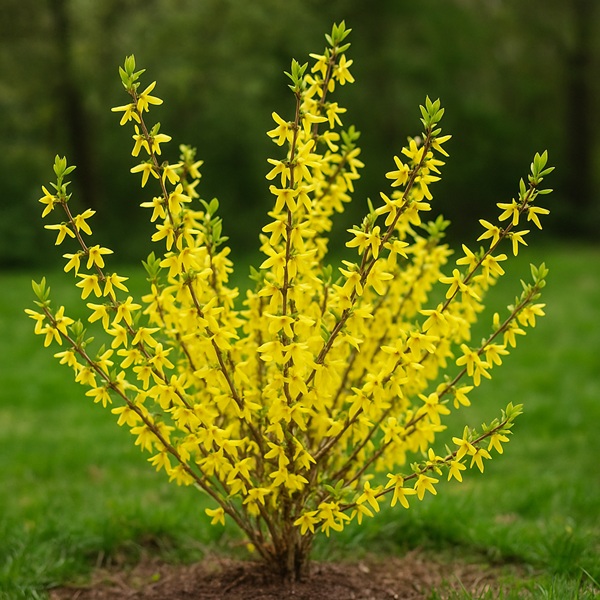
Forsythia (Forsythia) is one of the first heralds of spring, decorating gardens with bright yellow flowers even before the leaves appear. This striking shrub, native to East Asia and Southern Europe, has adapted beautifully to the Ukrainian climate thanks to its hardiness and low maintenance needs. Forsythia is ideal for greening private gardens, city parks, and public squares, especially in the southern, central, and western regions of Ukraine.
The shrub has a compact, spreading form and reaches a height of 1 to 3 meters depending on the variety. Its greatest ornamental value lies in its abundant flowering: the branches are literally covered with golden blossoms in March–April, when most plants are only beginning to awaken after winter. The leaves appear later, after flowering has ended. In summer, forsythia remains decorative thanks to its dense green foliage, and in autumn it impresses with vivid yellow, purple, or orange shades.
Forsythia is not only beautiful but also highly practical. It is used in specimen and group plantings, for hedges, borders, mixed borders, and compositions with other shrubs. With proper care, the plant can live up to 50 years and delights with luxurious flowering every year. It is worth noting that young plants may not bloom until the third or fourth year after planting, once the shrub has become established.
For successful cultivation, it is important to choose the right place. Sunny sites or light partial shade are best. In deep shade, flowering will be sparse and the shrub’s ornamental value will be greatly reduced. The plant also needs protection from strong winds, especially in regions with cold winters. The beauty and longevity of the shrub depend on proper site selection and adherence to planting recommendations.
Planting forsythia requires careful preparation, especially if the goal is to ensure a long and healthy life for the plant. Experienced gardeners recommend planting it in spring or early autumn, when the air temperature is mild and the soil contains enough moisture.
Stages of site preparation:
Choosing the location. Open sunny areas provide the most abundant flowering. In regions with hot summers, planting in partial shade is acceptable.
Soil. Forsythia prefers light, well-drained loam. The acidity should be neutral or slightly alkaline (pH 6.5–7.5). If necessary, the soil is limed.
Drainage. On heavy or waterlogged soils, drainage is essential: a layer of crushed stone or broken brick 10–15 cm thick is placed at the bottom of the planting hole.
Step-by-step planting instructions:
Dig a hole measuring 50×50×50 cm for one shrub.
Place a drainage layer on the bottom, followed by a fertile mix of garden soil, humus, and sand in a 2:1:1 ratio.
Set the seedling in the center of the hole, carefully spreading the roots.
Fill the hole with the prepared substrate so that the root collar remains at soil level.
Water generously after planting, using at least 10–15 liters of water per shrub.
Mulch the root zone with humus or wood chips to retain moisture.
In autumn, planting should be completed 3–4 weeks before the expected frost so the plant has time to root. In spring, planting is done before active sap flow begins. After planting, young shrubs should preferably be tied to temporary supports so they can better withstand spring winds.
Forsythia is easy to care for, but to maintain its ornamental quality, several basic rules should be followed. In Ukraine, where the climate ranges from moderately continental to steppe, proper care becomes especially important.
Watering. Forsythia is drought-tolerant, but during long hot periods it needs additional watering. On average, shrubs are watered once every two weeks, using about 10–12 liters of water per plant. During bud formation (March–April), watering is especially important. In the hottest months, watering is increased as needed.
Feeding. For active growth and abundant flowering, forsythia is fertilized three times per season:
In early spring — with organic fertilizers such as humus or compost.
At the beginning of flowering — with mineral fertilizers high in phosphorus and potassium.
After flowering — with phosphorus-potassium fertilizers to prepare the plant for winter.
Pruning is an important stage of care:
In spring, sanitary pruning is carried out by removing damaged and frost-injured shoots.
After flowering, in early summer, formative pruning is done: shoots are shortened by one third, and old and weak branches are removed to stimulate new growth.
Preparation for winter depends on the region. In the south, forsythia winters successfully without cover. In central and northern Ukraine, especially in winters with little snow, it is recommended to bend the branches to the ground and cover them with spruce branches or agrofabric. Young plants must definitely be protected with mulch and nonwoven materials.
Propagating forsythia is quite simple and accessible even for beginners. In Ukraine, the most common way to expand a collection of these bright shrubs is through vegetative methods: cuttings, layering, and division of the bush. Each method has its own characteristics and ideal timing.
Cuttings. This is the most popular and reliable method. Cuttings are prepared in summer, in June–July, using semi-hardwood shoots. They are cut into lengths of 15–20 cm, the lower leaves are removed, and they are planted in a light substrate made of sand and peat. For successful rooting, it is important to maintain high air humidity: the cuttings are kept under film or in a greenhouse. With regular moisture and ventilation, roots appear in 3–4 weeks. In autumn, the rooted plants are transplanted for further growing, and after a year they are moved to their permanent location.
Layering. This is a very convenient method in spring. A flexible lower shoot is bent to the ground, fixed with a metal staple, and covered with soil. During the season, roots form on the buried section. In autumn or in spring of the following year, the young plant is separated from the mother shrub and transplanted.
Division of the bush. This method is used when transplanting mature plants older than 5 years. The shrub is carefully dug up and divided with sharp secateurs or a spade into sections, each of which should have healthy roots and several shoots. Division is carried out in early spring or in autumn, at least one month before frost.
In addition to vegetative methods, forsythia can also be propagated by seed. However, this method is slower and less predictable: the first flowering occurs only after 5–6 years. Seeds are sown outdoors in autumn or in spring after stratification at +2 to +5°C for 1.5–2 months.
Young forsythia plants require careful care: regular watering, mulching of the root zone, protection from weeds, and gradual acclimation to sunlight. In the first year, it is especially important to prevent the soil from drying out and to treat the plants against pests if necessary.
Forsythia is fairly resistant to most diseases and pests, but under unfavorable conditions or with improper care, problems may appear. In the Ukrainian climate, these are most often related to fungal infections and a few kinds of pests.
The main diseases of forsythia are:
Root rot. This develops because of excessive soil moisture and lack of drainage. It appears as wilting, root decay, and eventual plant death. Prevention includes proper planting and moderate watering.
Bacterial infection. This appears as dark spots on leaves and shoots. The affected parts should be removed and burned immediately. Copper-based preparations are used for treatment.
Fungal diseases. Leaves become covered with spots or coating. In spring, shrubs are treated preventively with fungicides such as Bordeaux mixture, Topaz, or HOM.
Common pests include:
Aphids. Small insects that suck sap from young shoots and leaves. In severe infestations, the plant weakens and loses its decorative value. Effective control includes insecticides such as Aktara and Inta-Vir or a soap solution.
Nematodes. They damage the root system, causing deformation and suppressed growth. Crop rotation and pre-plant soil treatment are used for control.
Caterpillars and leaf-eating insects. They may damage the leaves, weakening the plant. Biological products or insecticides are used against them.
Preventive measures:
Proper watering without stagnant water.
Timely sanitary pruning of damaged shoots.
Autumn cleanup of the site from plant debris.
Regular treatments with eco-friendly products.
Following simple cultivation practices makes it possible to preserve the health and beauty of forsythia for many years.
Forsythia is a versatile shrub that suits a wide variety of garden styles. Thanks to its bright early spring flowering, it becomes a true highlight of any site.
Popular ways to use forsythia:
Specimen planting. A single forsythia shrub on a lawn looks very striking, especially during bloom. It is ideal for decorating entrances and open areas.
Group compositions. Forsythia is often planted together with other early-blooming shrubs such as flowering almond, weigela, and magnolia, creating lush spring displays.
Hedges. Forsythia forms a dense flowering wall, especially beautiful in early spring. Medium-sized or fast-growing varieties are used for hedges.
Mixed borders. In mixed plantings, forsythia serves as a bright spring accent among perennials such as peonies, geraniums, and lavender.
Color combinations and design ideas:
The yellow flowers of forsythia contrast beautifully with blue and purple plants such as irises and muscari.
Compositions with tulips, daffodils, and crocuses create vivid spring ensembles.
Pairing with conifers such as juniper and thuja adds structure and color interest to the garden throughout the year.
Ukraine’s climate allows forsythia to be grown in all regions, from the Carpathians to the Black Sea coast. With minimal care, this plant will remain a symbol of spring renewal and joy for decades.