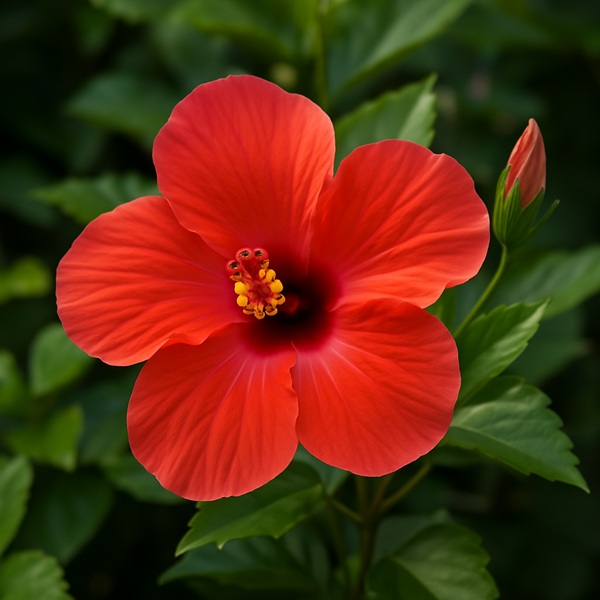
Hibiscus is one of the most beautiful and, at the same time, one of the most undemanding ornamental shrubs, and it is appearing more and more often in the gardens and on the balconies of people across Ukraine. Its large, bright flowers, shaped like gramophones, come in a wide range of shades: from classic reds and pinks to exotic lilacs, blues, and bicolored varieties. Choosing the right variety is the key factor for successful hibiscus growing in Ukraine, since the country’s climate ranges from moderately continental in the north to milder and warmer in the south.
The species considered most suitable for Ukraine are:
Syrian hibiscus (Hibiscus syriacus) — a deciduous shrub up to 2–3 meters tall that can withstand frosts down to –25 °C. This is the species most often used for landscaping gardens, parks, and residential areas. It is suitable for open-ground cultivation in most regions, including Kyiv, Vinnytsia, and Cherkasy regions.
Herbaceous hibiscus (Hibiscus moscheutos) — a perennial with strong shoots that die back for the winter. It is notable for its exceptionally large flowers, up to 25 cm in diameter. It grows well in the central and southern parts of Ukraine.
Chinese hibiscus (Hibiscus rosa-sinensis) — an evergreen shrub that is mainly grown indoors or in greenhouses. It does not survive winter in open ground and requires temperatures no lower than +10 °C during the cold season.
A particular advantage of Syrian and herbaceous hibiscus is their ability to adapt to different soil and climate conditions. They do not require special knowledge or much effort: it is enough to choose the right location, water regularly, and prune them so that you can enjoy abundant flowering from July to September. Chinese hibiscus is more demanding in terms of humidity and lighting, but with proper care it can bloom almost year-round indoors.
In regions with cold winters, such as Lviv, Chernihiv, and Sumy regions, it is more practical to grow Syrian hibiscus with winter protection or to limit cultivation to the container-grown Chinese type. In the southern regions, such as Odesa and Kherson, it is even possible to form hedges from hibiscus. Thanks to the richness of varieties, anyone can choose a hibiscus for any type of space — from compact shrubs for rock gardens to powerful flowering masses for zoning larger areas.
Proper planting is the foundation of active growth and abundant flowering in hibiscus. Although the plant is not considered overly demanding, there are several important details to keep in mind. In Ukraine, hibiscus is planted in spring, once the threat of frost has passed, or in autumn, in September, so the plant has time to root before winter. However, in the northern and western regions, autumn planting is best avoided because of the high risk of winter damage.
Choosing the location: hibiscus prefers sunny sites protected from the wind. It grows best on the southern or southwestern side of a house, near fences, or beside building walls. It is important to provide the plant with at least 6–8 hours of direct sunlight per day — in shade, hibiscus develops more slowly and hardly blooms. If the site is exposed to wind, wind protection should be arranged.
Soil: hibiscus prefers light, fertile, and well-drained soils. Loam or sandy loam with a neutral or slightly acidic reaction (pH 6–6.5) is ideal. The plant does not tolerate stagnant moisture well, so on heavy clay soils it is essential to arrange a drainage layer of gravel, crushed stone, or broken brick. On poor soils, compost, humus, or mineral fertilizer should be added.
Planting technique:
Dig a hole at least 40×40×40 cm in size.
Place drainage at the bottom, then add a mixture of garden soil, compost, and sand in a 2:1:1 ratio.
Set the sapling in place, spread the roots, and fill the hole with soil, leaving the root collar level with the surface.
Water thoroughly and mulch the area around the trunk with peat, bark, or cut grass.
The spacing between plants depends on the variety. For low-growing hibiscus, 60–80 cm is enough; for tall shrubs, 1.5–2 m is better. If you are creating a hedge, plants are placed more densely — at intervals of 40–50 cm. During the first weeks after planting, regular watering is important, especially in dry weather, to help the plant establish itself.
In Ukrainian conditions, hibiscus does not cause much trouble when planted in the right place and given proper care. The main thing is to maintain a balance between moisture, nutrition, and light. Regular care helps keep the plant healthy and stimulates abundant flowering.
Watering: hibiscus prefers moderate moisture. On hot days, it is watered 2–3 times a week, especially in sunny locations. It is important to avoid both drying out and waterlogging. During watering, water should not get on the buds or leaves, as this can trigger fungal diseases. The best time to water is in the morning or evening.
Feeding: from April to August, fertilizers are applied every two weeks. In spring, nitrogen-based feeding is preferred to build green mass; in summer, the focus shifts to phosphorus and potassium to stimulate budding. Complex fertilizers for flowering shrubs work best. In autumn, feeding is stopped so as not to stimulate new growth before winter.
Pruning: annual pruning is the key to a lush shrub and abundant flowering. It is done in early spring, before sap flow begins. Weak, frost-damaged, and overcrowding shoots are removed. Formative pruning allows the shrub to be shaped as desired — into a ball, a column, or a hedge. Rejuvenating pruning is also done from time to time, shortening old shoots to 30–40 cm.
Mulching: a layer of mulch such as peat, bark, pine needles, or straw helps retain moisture, suppress weed growth, and protect the roots from overheating or overcooling. Mulching is especially important in risk-farming areas — in the north and west of Ukraine. In autumn, the mulch layer is increased to 10–15 cm to make overwintering easier.
Tip: if you grow hibiscus in a container, repot it every 2–3 years with partial substrate replacement — this is the key to long-lasting flowering.
Ukraine’s climate requires special attention to hibiscus overwintering. Even though Syrian and herbaceous types are fairly frost-resistant, the plant can still suffer during winters with little snow or sharp temperature swings. Young saplings and specimens planted in autumn, which have not yet had enough time to root well, require particular care.
Syrian hibiscus can withstand frosts down to –25 °C, but only if there is snow cover and the soil remains dry. To protect it, the area around the trunk is mulched in autumn with a layer up to 15 cm thick — dry leaves, straw, or peat are suitable. The shoots are wrapped with nonwoven material such as agrofibre, and in regions with strong winds, a frame is built around the plant and covered with protective material.
Herbaceous hibiscus overwinters differently: the above-ground part dies back, and the plant survives as a rhizome. In late autumn, the stems are cut down to the base, and the planting site is generously covered with mulch — peat, humus, or sawdust — up to 20 cm thick. In spring, the plant forms new shoots, so no complicated preparation is needed.
Chinese hibiscus, which cannot tolerate temperatures below +10 °C, cannot remain outdoors in winter at all. It is grown in containers and moved indoors with the arrival of autumn cold. Before that, weak branches are pruned, watering is reduced, and the pot is placed in a bright, cool location with a temperature of +14...+18 °C. With sufficient light, the plant may continue blooming in winter, although it is usually better to arrange a dormant period for it.
Note: in overly mild winters, hibiscus may not freeze but can rot instead — especially if the soil is waterlogged. In spring, the roots should be checked carefully, damaged parts trimmed away, and the plant treated with a fungicide.
Hibiscus can be propagated in several ways: by seed, cuttings, layering, and division of the rhizome in the herbaceous type. Each method has its own advantages and suits specific conditions. In Ukraine, propagation by cuttings is the most popular, since it is fast, reliable, and preserves varietal characteristics.
Cuttings are taken in spring or early summer. Young shoots 10–15 cm long with 2–3 internodes are cut, the lower leaves are removed, and the cutting is either placed in water with a rooting stimulant such as “Kornevin” or planted directly into a light substrate made of peat and sand. The container is covered with film or a glass jar to create a mini-greenhouse. Rooting takes 3–4 weeks at a temperature of +22...+25 °C. Once roots appear, the plant is transplanted into a pot or into open ground.
Hibiscus is propagated by seed less often because it is a longer process and does not always produce plants with the same characteristics. Seeds are sown in February–March into a moist, sterile substrate and covered with glass or film. At +20...+25 °C, seedlings appear in 10–14 days. When 2–3 true leaves have formed, the seedlings are pricked out. Young plants are planted into open ground only the following year.
Syrian hibiscus can be propagated by layering. In spring, a lower branch is bent to the ground, covered with soil, and fixed in place. After a few months, a root system forms, after which the layer is separated and transplanted. Herbaceous hibiscus is propagated by rhizome division: in spring, the shrub is carefully dug up, divided into parts with a sharp knife, and planted in new places.
Regular propagation is also a way of rejuvenation. Shrubs older than 5–6 years gradually lose flowering intensity, so from time to time they should be renewed — either pruned hard or divided.
Despite its overall resilience, hibiscus can be affected by fungal, bacterial, and viral diseases, especially under improper care. In addition, pests often attack the plant. Regular inspection, timely response, and prevention are the best ways to keep the shrub healthy.
Common diseases:
Gray mold and fusarium — develop due to stagnant moisture; affected shoots become limp and develop spots. Treatment: prune off damaged parts and apply fungicides such as “Fundazol” or “Previcur.”
Chlorosis — leaves turn yellow while the veins remain green. The cause is iron deficiency or disturbed soil acidity. Iron chelates and corrected watering help.
Powdery mildew — a white coating on the leaves, especially during sharp temperature fluctuations. It is controlled with sulfur-based products or biofungicides.
Dangerous pests:
Spider mite — active in heat and dry conditions, leaving webbing and pale spots. Controlled with “Actellic” or “Fitoverm.”
Aphids — suck out plant juices and cause leaf curling. Spraying with a soap solution, garlic infusion, or insecticides helps.
Whitefly — especially active in greenhouses; controlled with sticky traps and systemic treatments.
As a preventive measure, it is worth treating shrubs 2–3 times a season with biofungicides and bioinsecticides. Do not plant hibiscus after diseased plants, follow crop rotation, and avoid overcrowded plantings. Removing old leaves and wilted flowers also reduces the risk of infection.
Tip: in autumn, before overwintering, carry out sanitary pruning and spraying — this will help the plant enter winter strong and healthy.