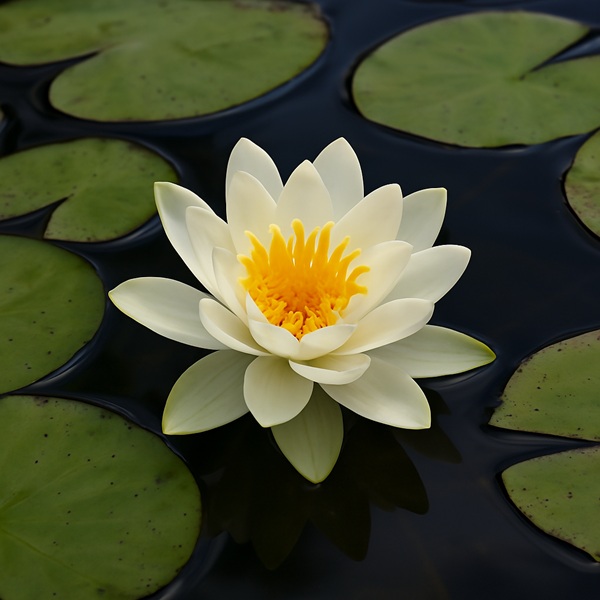
The water lily, also known as the nymphaea (Nymphaea), is not only a decorative adornment for a pond but also a unique aquatic plant with a rich history and complex biology. It combines refined beauty with functionality: large flowers resting on floating leaves not only delight the eye but also help maintain ecological balance. The leaves shade the water surface, protecting it from overheating and slowing the growth of algae, while also serving as shelter for fry. The flowers, which open during the day and close at night, respond to light and become a truly “living” element in the landscape.
Ukraine’s climate is generally favorable for growing water lilies. The temperate continental climate, with warm summers when temperatures remain steadily around +22 to +28 °C, is ideal for this plant’s growing season. Nymphaea feels best in the southern, central, and western regions — such as Odesa, Mykolaiv, Dnipropetrovsk, Vinnytsia, and Lviv regions. In western Ukraine, despite a shorter summer, lilies also grow very well in ornamental ponds and natural bodies of water, provided the pond does not freeze solid in winter. This is especially important when planting them in artificial ponds without heating.
There are both hardy nymphaea species (for example, Nymphaea alba and Nymphaea tetragona), which can overwinter right in the pond beneath the ice, and tropical varieties that must be dug up and stored in a warm place during winter. In Ukraine, it is more practical to plant hardy varieties that do not require relocation. However, enthusiasts can also successfully grow heat-loving types in containers that are submerged in the pond during summer and moved to an aquarium or storage area for winter. This approach makes it possible to enjoy even the most exotic colors — from azure to burgundy-black flowers.
Before starting to grow water lilies, the type of pond should be selected carefully. In a private garden or at a summer cottage, three options are usually used: a natural pond, an artificial reservoir with waterproofing or a plastic form, or a container mini-pool. In each case, the following important conditions must be taken into account:
a depth of at least 40–60 cm for the plant to overwinter;
a water surface area of 1 m² or more;
direct sunlight for at least 4–6 hours a day;
no current and no powerful filtration in the planting zone.
If planting is done in a natural body of water, it is best to avoid places with a silty bottom — in such conditions the rhizomes may rot. Nymphaeas should also not be planted next to fountains or filters that create water movement: this interferes with flower formation and the stable position of the leaves. In an artificial pond, on the other hand, depth, water quality, and level of light can all be controlled. It is best to arrange the bottom in tiers — with different depths (30, 60, 100 cm), which makes it possible to adapt the planting to a specific variety.
Containers are used for planting — plastic or clay vessels without bottoms or with openings. This makes it possible to control rhizome spread and simplifies care. The optimal soil mixture is turf soil with the addition of clay and a small amount of peat or humus. Ordinary garden soil should not be used — it washes out easily, increases water turbidity, and promotes water blooming. The soil surface is often covered with a layer of pebbles or crushed stone to prevent it from floating up. Fertilizers are applied in the form of slow-release granules or tablets, while excess organic matter should be avoided.
The container with the plant is submerged in water at an initial depth of 20–30 cm, and over time is gradually lowered to 60–80 cm. This approach makes it possible to control environmental temperature in the early stages of growth and protect the plant during periods of returning spring frosts. It is especially effective for northern regions and highland areas.
Caring for a water lily is not difficult, but it does require regular attention. During the active growth period, from May to September, it is necessary to monitor water cleanliness and the condition of the leaves and flowers. The following should be removed regularly:
yellow or damaged leaves — to prevent souring and oxygen deficiency;
faded buds — this prolongs the flowering period and prevents self-seeding;
excess algae — especially in ponds without filtration.
The container with the rhizome should be checked periodically: if it has become overcrowded, the plant should be thinned or repotted. Once per season, fertilizing should be applied — special fertilizers in tablet or granule form that break down in the soil without harming the water. Excess organic matter in hot weather provokes water blooming, so it is important not to exceed the recommended dosage.
Several factors affect nymphaea flowering. First, light: with less than 4 hours of direct sun a day, the plant will bloom reluctantly or may fail to form buds at all. Second, water temperature: the optimal range is +20 to +27 °C. During a cold spring or sharp weather changes, buds may fail to open or may drop off. In northern and mountainous areas, shallow-water zones or movable containers are used to stimulate early flowering, since these can be warmed or relocated when needed.
Propagation of the water lily is an important part of long-term cultivation, especially if you want not only to preserve existing plants but also to create new plantings. The most common method is division of the rhizome, carried out in spring (April–May) or early autumn (September), when the plant has either just emerged from dormancy or has finished active growth. Division is best done once every 3–4 years to avoid overcrowding, reduced flowering, and soil exhaustion.
The procedure is not complicated: the container with the plant is removed from the water, the rhizome is cleaned of silt, old woody parts are cut away, and the younger sections with 2–3 living buds and roots are replanted into new containers. In the first year, such young plants often already begin to bloom. It is important to let them adapt: during the first weeks after planting, the container should not be moved to great depth or exposed to direct sunlight. Very young or weakened specimens should not be repotted, as they may not withstand the stress of adaptation.
Another method is seed propagation, although it is much more difficult. It is usually used by breeders to develop new varieties. The seeds require stratification and are germinated in separate containers with warm water, being gradually deepened. Seedlings bloom only in the second or third year and do not always retain the traits of the parent variety. Under natural conditions, nymphaea is capable of self-seeding, but in an ornamental pond this process rarely gives stable results.
Wintering is one of the most important stages in caring for water lilies in Ukraine, especially in regions with cold or unstable winters. The strategy for preparing the plant for winter depends on the variety and the depth of the pond. Hardy nymphaeas (such as Nymphaea alba) can remain in the pond if the rhizome is located deeper than 60–80 cm and the pond itself does not freeze to the bottom. In that case, it is enough to trim off the yellowed leaves in autumn, and the plant will calmly “fall asleep” until spring.
In the southern and central regions (Odesa, Mykolaiv, Kirovohrad, Dnipropetrovsk), this is usually sufficient. In the northern and western regions (Chernihiv, Sumy, Lviv, Ivano-Frankivsk), however, there is a risk that shallow ponds may freeze through. In such places, either deeper zones should be provided in the pond or the plant containers should be removed. After trimming the leaves, the container is moved to a cool place with a temperature of +2 to +6 °C, placed in moist sand or sawdust, and the substrate is moistened from time to time.
Tropical and heat-loving varieties (with violet, blue, or bright red flowers) must always be removed before the first frosts. They are stored in indoor aquariums or heated containers where the temperature is kept no lower than +12 to +15 °C and minimal lighting is provided. This kind of care requires more effort, but it allows rare varieties with striking ornamental value to be grown. In spring, after the water temperature has stabilized, the plants are returned to the pond after first checking the rhizomes for rot or damage.
The water lily is a dominant plant in a pond, and it pairs beautifully with other species to create an elegant composition. To ensure the pond looks harmonious, it is important to choose companion plants that do not suppress nymphaea growth, do not create excessive shade, and do not encourage overgrowth.
Recommended companion plants for nymphaeas:
yellow iris, water calla, hippeastrum — add vertical lines and bright color accents along the banks;
papyrus, cattail, sedge — for the background and for shading the bank;
hornwort, elodea, water mint — submerged plants that improve water quality;
water lettuce, salvinia, limnobium — floating plants that create additional texture.
It is important to avoid overcrowding the pond: too many plants slow water circulation, encourage souring, and reduce oxygen levels. Special attention should be paid to aggressive species (for example, hornwort), which without control can crowd out other plants. It is also important to consider the presence of fish: ornamental carp or crucian carp may damage rhizomes or dig soil out of containers, so the containers should preferably be covered with fine mesh.
As for color combinations, white and yellow nymphaeas harmonize well with purple and blue irises, while pink ones pair beautifully with red reeds or ferns. A carefully designed landscape with contrasts of height, texture, and color creates a complete picture in the pond that pleases the eye from spring to autumn. Decorative elements such as stones, lighting, and mini-waterfalls only enhance the beauty of the lilies and bring the space to life.