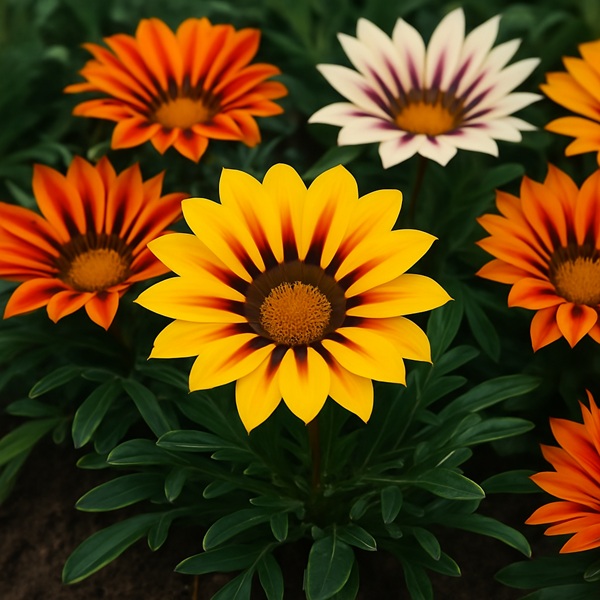
Gazania (Gazania) is a perennial herbaceous plant from the daisy family (Asteraceae), which, under temperate climate conditions, including in most regions of Ukraine, is grown mainly as an annual. This ornamental crop originates from South Africa, which is why it is often called the “African daisy.” Gazania is known not only for its bright appearance and wide range of shades — from golden yellow to purple with a contrasting center — but also for its high drought tolerance, heat-loving nature, and long flowering period. These qualities make it an ideal choice for flowerbeds, borders, alpine gardens, and container growing as well — in flowerpots, balcony boxes, and hanging planters.
Among annuals, gazania stands out for its heat tolerance and ability to remain decorative even when moisture is limited. Gazania flowers open only in bright sunlight and close in the evening or in cloudy weather, which highlights its natural affinity for warmth. In Ukraine, gazania can be grown outdoors in almost all regions, but it performs best in the southern and central regions — such as Kherson, Odesa, Dnipropetrovsk, Kirovohrad, and Poltava. In these areas, the warm and long summer allows gazania to fully reveal its potential, producing dozens of flowers throughout the season.
Despite its southern origin, gazania shows high adaptability. Some varieties, especially hybrid forms (Gazania rigens, Gazania splendens), can withstand short-term temperature drops to −3...−5 °C, which makes it possible to plant seedlings as early as the beginning of May. However, in the northern regions of Ukraine (Lviv, Volyn, Chernihiv), it is more practical to treat this crop strictly as an annual, using the seedling method as a necessity. Under such conditions, gazania should be given sunny, draft-protected sites and grown according to proper cultivation practices to ensure long-lasting flowering and strong resistance to stress factors.
One of the key factors in growing gazania is choosing the right planting site. This plant absolutely does not tolerate shade and reacts negatively to waterlogged soil. The ideal location is a southern or southwestern plot that receives full sun throughout the day. In partial shade, gazania does not die, but its ornamental value decreases: flowers form more slowly, and the stems stretch and become weak. The effect of wind should also be considered: strong gusts can damage flower stalks, so it is desirable for the plant to have natural or artificial wind protection.
Optimal soils for gazania:
light sandy or sandy loam in structure;
well-drained, without moisture stagnation in the root zone;
neutral or slightly alkaline in acidity (pH 6.5–7.5);
with a moderate amount of organic matter, since excess humus reduces flowering;
loose and breathable, because the roots need access to oxygen.
Before planting, the plot is dug to a depth of 20–25 cm, adding sand, wood ash, fine gravel, or perlite if necessary. Organic matter — compost or humus — is applied in minimal amounts (no more than 1–2 kg per m²), since excess nutrition stimulates leaf growth instead of flowering and increases the risk of fungal diseases. Planting in heavy clay soil without prior preparation almost always leads to rotting or poor development.
The site should be not only sunny but also well ventilated to avoid overcrowding and excessive humidity, which promote disease development. It is important that water does not stagnate in the planting area during heavy rains. Good results come from growing gazania in raised beds, rockeries, alpine gardens, and along stone paths, where the soil warms up quickly and does not retain excess moisture. Gazania looks best in group plantings of 3–7 plants, which makes it possible to create contrasting compositions with different colors and petal shapes — from simple to double.
Gazania is propagated exclusively by seed, and for most regions of Ukraine the most reliable method is growing it through seedlings. Direct sowing into open ground is possible only in the south of the country, provided the spring is early and steadily warm. Gazania seeds are small but have high germination rates — up to 85–90% with proper preparation. Sowing for seedlings is carried out from late February to early April depending on the region. In northern areas, it is more practical to aim for mid-March.
For seedlings, a light mix is used: peat + sand + perlite in a ratio of 2:1:1. The substrate is disinfected with a weak potassium permanganate solution or biofungicides. The seeds are spread over the surface, pressed in slightly (depth up to 0.5 cm), and covered with film or glass. Germination takes place on days 5–7 at a temperature of +20...+22 °C and moderate humidity. After sprouts appear, the cover is removed, and the seedlings are moved to a windowsill or under a lamp.
The seedlings are pricked out at the stage of 2–3 true leaves into cups of 200–300 ml. It is important not to damage the taproot, which forms very early. Therefore, transplanting should be done with a clod of soil. Ten to fourteen days before planting in a permanent place, the seedlings are hardened by gradually taking them outdoors. Transplanting into the ground is carried out from late April to late May, depending on the region, once the threat of return frosts has passed.
After transplanting seedlings into open ground, gazania does not require complicated care, but the regularity of cultivation measures directly affects the duration and abundance of flowering. The main elements of care are watering, loosening, removing faded buds, and feeding. Gazania has high drought tolerance, but for intensive growth and active flowering it needs a sufficient amount of moisture, especially during the budding phase. On sandy soils, watering is carried out 2–3 times a week, and more often in the absence of rain.
It is critically important not to allow overwatering: even short-term stagnation of water can cause root collar rot. Watering is best done in the morning or evening, strictly at the root, so as not to wet the leaves and flowers. After each watering, it is recommended to loosen the soil, especially in open sunny sites, to improve aeration and prevent the formation of a soil crust. Mulching with sawdust, peat, or fine gravel gives a good effect, as it helps retain moisture and suppress weeds.
To maintain a long decorative effect, faded flowers must be removed, especially if gazania is used in borders or containers. This stimulates the formation of new buds. There are self-cleaning varieties, but most require manual removal of faded parts. In container growing, additional formative pruning is carried out: elongated or weakened shoots are removed, which promotes bushiness and overall rejuvenation of the plant.
Gazania is usually not prone to widespread damage from diseases or pests, but problems may appear when cultivation practices are нарушені. To ensure healthy plants and abundant flowering, it is worth organizing a proper feeding system and preventive disease-control measures.
Feeding schedule:
10–15 days after planting — a complex mineral fertilizer with an emphasis on phosphorus and potassium (for example, NPK 10:20:20);
at the beginning of mass flowering — repeated application of a potassium fertilizer (potassium sulfate, potassium monophosphate);
every 2–3 weeks until the end of August — alternating organo-mineral blends with ash infusion and fermented herbal extracts.
Excess nitrogen should be avoided, as it stimulates leaf growth at the expense of flowering. On poor soils, it is advisable to use slow-release fertilizers (“AVA,” “Osmocote”), especially in container growing. In flowerpots, gazania depletes the soil faster, so feeding is carried out more often — every 10–14 days.
Possible diseases:
root rot — caused by overwatering;
powdery mildew — caused by shade and high air humidity;
alternaria — brown spots on leaves in wet weather.
For prevention, fungicides (“Topaz,” “Hom,” “Fundazol”) as well as biological products (“Fitosporin,” “Trichodermin”) are used. Among pests, the most harmful are aphids, mites, and thrips. They can be controlled with insecticides (“Actellic,” “Fitoverm,” “Bi-58”) or folk remedies — onion infusion, soap, or garlic.
In most regions of Ukraine, gazania is grown as an annual plant. However, if the proper temperature regime is maintained, it can be preserved as a perennial — especially in container form. To do this, in autumn (September–October) the plants are carefully dug up with a clod of soil, transplanted into pots or boxes, and moved to a bright, cool room (loggia, veranda, warm greenhouse) with a temperature of +8...+12 °C. Watering is minimal — once every 10–14 days, without overwatering.
In spring, after the soil has warmed up, gazania is planted out into open ground again. It can also be kept in greenhouses with supplemental lighting, where it may continue flowering even in winter. Another option is cuttings from mature plants in August–September: rooting is done in moist sand or peat, and in spring the cuttings are planted in the flowerbed.
To extend flowering in the flowerbed, gazania should be covered with agrofabric if frost is expected. In the southern and central regions, it often blooms until mid to late October. Repeat sowing in September is also possible for autumn decoration of borders or pots.
Gazania remains one of the most spectacular and at the same time most undemanding flowering crops for the Ukrainian climate. It combines easily with lavender, santolina, bright petunias, and other sun-loving plants. It is suitable both for urban landscaping and for rural flowerbeds, making it a universal solution for greening with minimal cost and maximum effect.