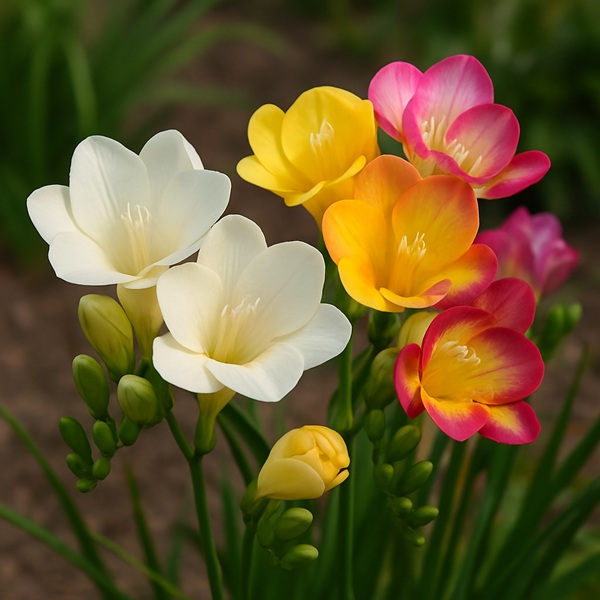
Freesia (Freesia) is a refined and delicate plant that has been appearing more and more often in Ukrainian gardens in recent years. Its fragrant, elegant flowers have become a symbol of elegance and romance, while the variety of colors makes it possible to create unique floral compositions. Freesia is native to South Africa, but thanks to breeding and adaptation it grows quite well in Ukraine’s temperate climate with proper care.
Freesia belongs to the iris family and is a bulbous plant 30 to 70 cm tall. Its graceful arching flower stalks carry funnel-shaped flowers in a wide range of shades: white, yellow, orange, red, lilac, and violet. Varieties with a pronounced fragrance are especially valued, as the scent becomes stronger in the evening. Under Ukrainian conditions, freesia usually blooms in summer and autumn, although the timing can be adjusted through early planting.
In Ukraine, freesia is mostly grown as a seasonal crop, since it cannot overwinter in open ground without protection. Still, with proper care, gardeners successfully achieve abundant flowering in flower beds, on balconies, and in container gardens. In addition, freesia is one of the most popular cut flowers: its delicate blooms retain freshness in bouquets for a long time, which makes it especially востребована in floristry.
For successful cultivation, it is important to take its natural characteristics into account: a preference for diffused sunlight, moderate moisture needs, and sensitivity to temperature conditions at different stages of development. The right choice of location, timely planting, and careful care make it possible to obtain not only abundant flowering, but also healthy planting material for the next season.
Planting freesia requires careful preparation, since this plant is rather demanding in terms of soil and microclimate. A proper start ensures active growth and abundant flowering.
Main soil requirements:
Structure. The soil should be light, loose, and well drained. The ideal option is a mixture of garden soil, humus, and sand in equal proportions.
Nutrient content. Freesia needs soil enriched with organic matter. It is recommended to incorporate compost or well-rotted humus (5 kg per 1 m²) into the site 2–3 weeks before planting.
Acidity. The optimal pH is slightly acidic or neutral (6.0–7.0). If the soil is too acidic, it is deacidified with wood ash or lime.
Site preparation:
Dig the soil to a depth of 25–30 cm.
Remove weed roots and large soil clods.
Apply a base dressing of phosphorus-potassium fertilizers to stimulate root development.
Step-by-step planting instructions:
Freesia bulbs are planted in open ground in April–May, once the danger of frost has passed.
Planting depth is 5–7 cm, with 10–15 cm between plants.
The bulbs are set with the pointed end upward, covered with loose soil, and watered carefully.
After shoots appear, the area is mulched to retain moisture and protect against overheating.
Freesia can also be pre-sprouted in containers indoors: 2–3 weeks before planting outdoors, the bulbs are planted in small pots and kept at +15...+18°C. This helps bring the flowering period forward in open ground.
It is important to remember: freesia does not tolerate water stagnation. If overwatering is suspected, additional drainage should be provided or the planting site should be changed.
Freesia requires attentive care, and following all its needs is the key to abundant and prolonged flowering. Despite its delicate appearance, with proper care the plant shows great resilience and endurance.
Watering. Freesia likes regular but moderate watering. It is especially important to maintain moisture during active growth (May–June) and bud formation (July). Watering is done 1–2 times a week, depending on the state of the soil: it should remain slightly moist, but not wet. Water should not be allowed to get on the leaves or flowers.
Feeding. Several feeding stages are carried out during the season:
Two weeks after planting — nitrogen fertilizers to stimulate green mass growth.
During bud formation — phosphorus-potassium fertilizers to strengthen the flower stalks and improve blooming.
In August–September — light feeding to maintain decorative value and prepare the plant for dormancy.
It is best to apply fertilizer in liquid form together with watering so nutrients reach the roots more quickly.
Tying. The thin flower stalks of freesia easily lodge, especially in windy weather, so support is essential. Small stakes or netting are used, and they should be installed before the plants enter active growth.
Additional care measures:
regular loosening of the soil after watering;
hand removal of weeds to avoid damaging the root system;
light shading during the hottest hours to prevent overheating.
With proper care, freesia blooms 10–12 weeks after planting and continues flowering until the onset of cold weather.
Freesia can be propagated effectively in several ways. Under Ukrainian conditions, bulb and bulblet propagation is used most often. The seed method is also possible, but it is more difficult and takes more time.
Propagation by bulbs. After the vegetation period ends, several small daughter bulbs form on the mother bulb. In autumn, after lifting, the bulbs are carefully cleaned of soil, dried, and sorted. For the next season, large, firm bulbs without signs of rot or damage are selected. Bulblets are planted according to the same scheme as adult plants, but flowering begins a year later.
Step-by-step bulblet propagation:
After lifting, carefully separate the bulblets from the mother bulb.
Treat them with a weak fungicide solution to prevent fungal diseases.
Store the bulblets over winter in a dry, cool place at about +15°C.
Plant them in spring in open ground or in a greenhouse.
Seed propagation is used mainly by professionals and breeders. Freesia seeds have a dense coat, so before sowing they are stratified or soaked in warm water for 24 hours. They are sown into a light substrate in March–April, and seedlings appear in 20–30 days. With the seed method, the first flowering occurs in the second or third year.
Propagation by bulblets is the most accessible and reliable method for Ukrainian gardeners. It preserves varietal traits and makes it possible to renew planting material every year.
Like most bulbous crops, freesia may be vulnerable to certain diseases and pests. However, with proper care, most problems can be prevented or minimized.
Common freesia diseases:
Fusarium. A fungal disease that causes bulb rot and plant wilting. The main prevention is disinfecting bulbs before storage and planting, and treating them with fungicides.
Botrytis (gray mold). Appears as a gray coating on leaves and flower stalks, especially under high humidity. Treatment includes removing the affected parts and applying fungicidal products.
Root rot. Occurs because of water stagnation in the soil. Prevention consists of good drainage and a proper watering regime.
Main freesia pests:
Thrips. Tiny insects that suck sap from the plants, causing deformation of leaves and flowers. They are controlled with insecticides such as Confidor and Aktara.
Spider mite. Appears in hot, dry weather. Control involves acaricides and increasing air humidity.
Bulb mites. Damage the bulbs during storage. Prevention requires careful drying and storing the planting material in cool, dry conditions.
Preventive measures:
follow the watering regime and avoid stagnant water;
sanitize soil and gardening tools;
inspect plants regularly and detect disease early;
use only healthy planting material.
With proper agricultural care, freesia rarely suffers from serious diseases, and timely prevention helps keep it healthy and blooming.
Freesia is a versatile plant widely used both in landscape design and in floristry. Its elegant flowers add grace and freshness to any setting.
Ideas for using freesia in the garden:
Flower beds and rabatkas. Freesias are excellent for creating borders along garden paths or for tiered flower beds. Mass plantings of one color or harmonious combinations of several shades look especially effective.
Container growing. Planting freesia in pots and containers makes it possible to decorate balconies, terraces, and courtyards. Container plants are easy to move when the weather turns cold.
Mixed borders. Freesias combine beautifully with perennials and ornamental grasses, adding softness and movement to the compositions.
Freesia as a cut flower:
Freesia is one of the best flowers for bouquet work thanks to its excellent vase life and pleasant fragrance. The flowers are best cut when the first 1–2 buds on the flower stalk have opened. In a vase, they may last 10–14 days, gradually opening the remaining buds.
Care of cut freesias:
change the water daily and refresh the stem ends;
use antiseptic additives in the water;
protect them from direct sun and drafts.
Freesia combines beautifully in bouquets with roses, tulips, irises, and lisianthus, creating distinctive spring and summer arrangements.
Ukrainian gardeners who have mastered freesia cultivation gain not only aesthetic pleasure, but also luxurious flower beds and long-lasting bouquets that decorate the home for many days.